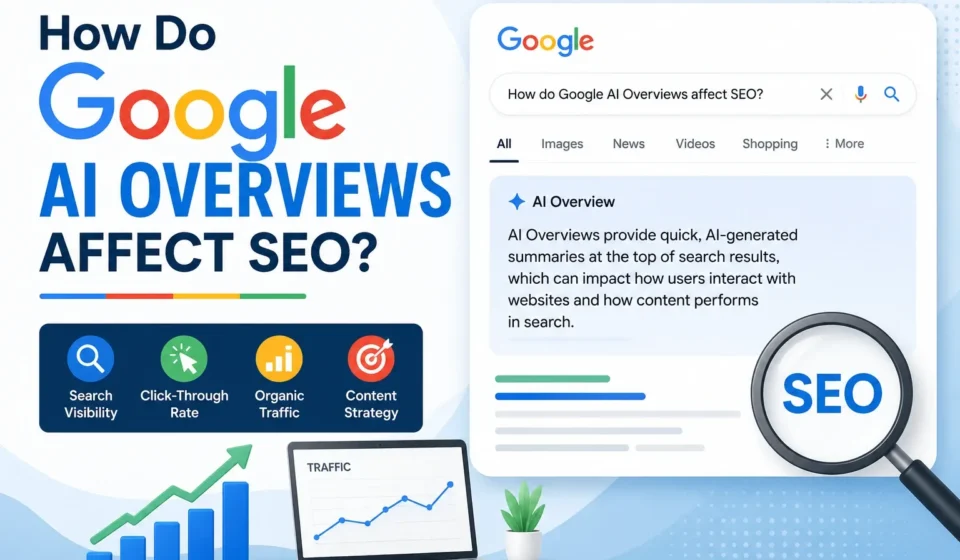

If you’ve published a blog post recently and watched its traffic sit flat despite a decent ranking, you’re not imagining things. Google search results don’t look like they did even two years ago. For a huge share of queries, an AI-written summary now sits above the traditional blue links – answering the question before anyone scrolls down to your page.
This is Google’s AI Overviews feature, and it has become one of the most-discussed shifts in SEO history. In this guide, we’ll break down how do Google AI Overviews affect SEO, why education and EdTech content is being hit particularly hard, and exactly what you can do about it – whether you run a school website, a coaching blog, or a general content site.
What Are Google AI Overviews?
AI Overviews are AI-generated summaries that Google places at the top of search results for certain queries. Instead of asking you to click through five different articles to compare “best AI tools for students” or “IELTS vs TOEFL,” Google’s system reads across many indexed pages and writes a condensed answer directly on the results page, usually with a handful of source links attached.
Google doesn’t show an AI Overview for every search. It tends to appear most often for informational, multi-part questions – the kind where a user is trying to learn or compare something, rather than looking for a specific website, product page, or local business. Simple navigational searches (“Byju’s login”) or transactional searches (“buy NCERT books online”) mostly still show standard results.
Importantly, AI Overviews are not written from nothing. Google’s system pulls from pages that its normal ranking systems already consider relevant and trustworthy for that query. So traditional SEO fundamentals – relevance, quality, authority – still decide which pages get used as source material. AI Overviews build on top of classic SEO; they don’t replace it.
How Do Google AI Overviews Affect SEO in 2026?
1. Fewer clicks, even for top rankings
The most immediate effect is a drop in click-through rate, even for pages ranking in position one. Industry tracking studies through 2025 and into 2026 have repeatedly found that when an AI Overview appears above the results, the top organic listing loses a meaningful share of its clicks – in some studies, close to a third. Ranking #1 no longer guarantees the same traffic it did a few years ago.
This connects to a broader trend called zero-click search – searches where the user gets what they need directly on the results page and never visits a website at all. Multiple analyses have found that well over half of all Google searches now end this way.
2. A new kind of visibility: citations and mentions
It’s not all bad news. AI Overviews create two new ways for your content to be seen, even without a click:
- Citations – a direct, clickable link to your page shown as a source card beneath the AI summary. Some users do click through.
- Mentions – Google’s AI naming your brand, tool, or website inside the answer text itself, with or without a link.
Both build brand recall and signal to users (and to Google) that your site is considered a trustworthy source on the topic – even in cases where the click doesn’t happen.
3. Informational “definition” content is losing the most
Content that simply defines a term or answers a one-line factual question is the easiest for an AI Overview to replace outright. If your article could be summarized in two sentences by any AI model, it’s a prime candidate for zero-click loss. Content that goes deeper – original analysis, real examples, first-hand data, step-by-step application – is far harder for an AI system to fully substitute.
Why This Hits EdTech and Education Content Especially Hard
Education-related searches are exactly the kind of multi-part, informational queries that trigger AI Overviews most often. Think about searches like:
- “which online course is best for a fresher in India”
- “IELTS vs TOEFL which is easier”
- “best AI tools for exam preparation”
These used to be reliable traffic drivers for EdTech blogs, comparison sites, and coaching institutes. Increasingly, Google’s AI system answers them directly – recommending a course or tool, summarizing pricing, and offering an enrollment path, all without a single click to any website.
For a site like ours covering EdTech, AI tools, and exam guidance, this means one thing clearly: generic “top 10” and definition-style listicles are the most exposed content type. The blogs that will keep ranking and driving traffic are the ones built around a genuinely specific angle – a real comparison with numbers, a step-by-step tutorial, a first-hand review of using a tool for a specific exam – not a rehashed list of tools everyone already has.
AI Overviews vs. Featured Snippets vs. Organic Results
It helps to see how these three result types actually differ:
| Result Type | Typical Trigger | Click Behavior |
|---|---|---|
| Organic (blue link) results | Most searches | User must click to get the full answer |
| Featured Snippet | Single clear factual question | Short answer shown, but often still drives clicks for more detail |
| AI Overview | Broad, multi-part informational questions | Full synthesized answer shown; click-through drops sharply |
The takeaway: if your target keyword is the kind of broad question an AI Overview would answer completely, don’t expect it to behave like a snippet opportunity used to. Plan your content – and your success metrics – differently.
How to Adapt: A Practical SEO Strategy for the AI Overviews Era
Build genuine E-E-A-T, not just keyword coverage
Google has been explicit that it wants content showing a creator’s real experience and unique point of view, not just information restated from other sites. For an EdTech or education blog, that means:
- Add a named author with real credentials or relevant background, not a generic “Team” byline
- Include first-hand testing notes when reviewing an AI tool or course (“we tested this with a Class 10 CBSE syllabus and found…”)
- Cite primary sources (official exam boards, Google’s own documentation, published studies) rather than paraphrasing other blogs
- Keep author bios, an About page, and contact details visible and complete – these are basic trust signals both users and Google’s systems check for
Keep technical SEO solid
Before your content can be used in an AI Overview, it has to be crawled, indexed, and understood correctly. That means:
- Fast page load and mobile-friendly design
- Clean URL structure and internal linking
- Structured data (Article, FAQ, HowTo schema) so both Google and AI systems can parse your content’s structure
- No orphaned pages or broken navigation – a technically messy site gets discovered and used less often
Go deeper than a definition
Ask yourself before publishing: could an AI model already write this from memory? If yes, that topic alone won’t hold up well. Instead:
- Turn “what is X” articles into “how we used X for [specific exam/grade/scenario]” articles
- Add real screenshots, real numbers, real comparisons specific to India or your target audience
- Update older posts with 2026 data instead of only publishing new ones
Build real off-page authority
Backlinks and mentions from relevant, reputable sites remain one of the strongest trust signals feeding into both classic rankings and AI Overview source selection. For a new or growing site, prioritize:
- Guest contributions on established education or SEO publications
- Getting listed in relevant directories (education blogs, EdTech tool directories)
- Genuine social proof – real profiles, real engagement, not placeholder links
Track visibility, not just rankings
Clicks and rank position no longer tell the full story. Where possible, monitor:
- Whether your pages appear as citations or brand mentions inside AI Overviews for your target keywords
- Which of your content types get cited most (guides, comparisons, original data) so you can produce more of what works
Understanding GEO and AEO (Without the Buzzword Confusion)
You’ll increasingly see terms like Generative Engine Optimization (GEO) and Answer Engine Optimization (AEO) used alongside AI Overviews. Don’t treat these as brand-new disciplines you need to learn from scratch – they describe the same core SEO principles (clarity, structure, trust, depth) specifically applied to how AI systems read and summarize content. Clear headings, direct answers early in a section, well-organized FAQs, and proper schema markup all help both traditional SEO and AI-answer visibility at the same time.
Your 6-Step Action Plan
- Audit your existing posts – identify which ones are pure “definitions” versus genuinely original guides
- Rewrite or merge thin definition posts into deeper, experience-based content
- Add real author bios and credentials across the site
- Implement FAQ and Article schema on all key posts
- Build a small number of high-quality backlinks rather than many low-quality ones
- Review performance monthly, watching for AI citations alongside normal rankings
Conclusion
Google’s AI Overviews haven’t ended SEO – they’ve raised the bar for what counts as genuinely useful content. For EdTech and education websites especially, the sites that will keep growing traffic in 2026 are the ones that stop competing on generic “top 10 tools” content and start publishing what only they can offer: real testing, real regional context, and a clear point of view. That’s the content Google’s AI has the hardest time replacing – and the content readers actually trust.
As AI-powered search continues to evolve, partnering with an experienced SEO team like Bluelinks SEO Agency can help businesses create authoritative content, improve search visibility, and adapt to the changing landscape of Google AI Overviews.
Frequently Asked Questions
Does ranking #1 on Google still matter if AI Overviews are shown?
Yes, but its value has changed. Top-ranking pages are still the most likely to be used as source material for AI Overviews, even though the click-through rate for that position has dropped.
Should EdTech blogs stop publishing informational content?
No – but be selective. Skip topics an AI model could fully answer from general knowledge, and prioritize content with original data, real testing, or a specific regional/exam angle that generic AI training data won’t cover as well.
Is Generative Engine Optimization (GEO) different from SEO?
Not fundamentally. GEO applies familiar SEO principles – clarity, structure, trust, originality – specifically to how generative AI systems select and summarize content.