
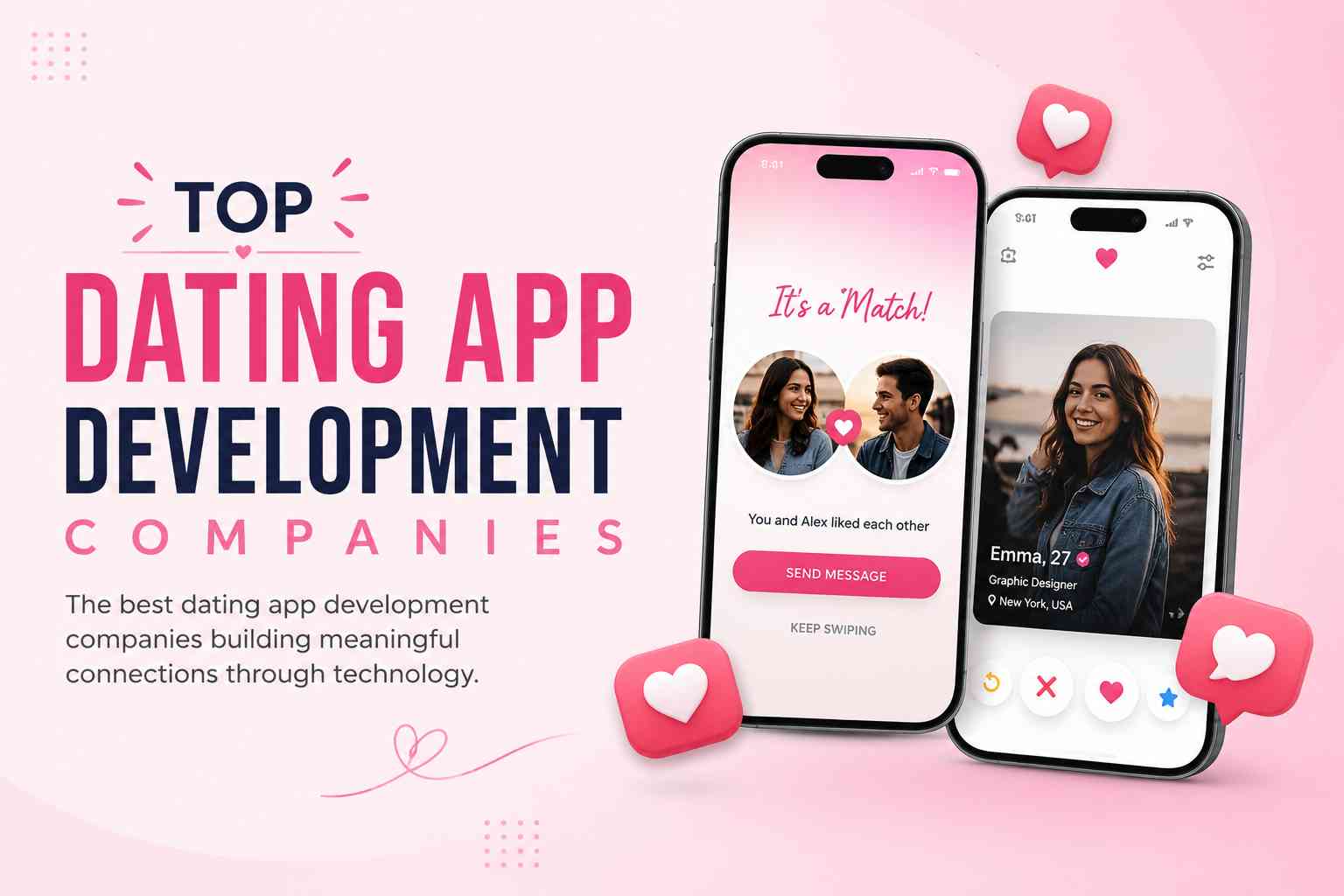

Finding love is big business. The online dating industry crossed $12 billion in global revenue in 2025 and continues growing at 7–8% annually. Mobile applications now account for roughly 87% of all online dating service usage, confirming that mobile dating app development is where the real action is. Whether you’re a startup founder with a niche community concept or an enterprise building the next large-scale matchmaking platform, the demand is real – and the technical bar keeps rising.
The problem is that a search for “dating app developer” returns hundreds of agencies, most of them making identical claims. This guide cuts through that noise. We cross-referenced Clutch, GoodFirms, and G2 reviews, verified company histories, scrutinized actual portfolio work, and examined technology specializations to bring you a list of the top 10 dating app development companies in 2026 – companies genuinely capable of building what the market now demands: AI-powered matching, trust-first safety systems, real-time chat, and monetization that actually converts.
How We Selected These Dating App Development Companies
Before reading a single company profile, you deserve to know how this list was built. Every company was evaluated against the same criteria:
- Third-party verified reviews on Clutch or GoodFirms with a minimum rating of 4.5/5
- Demonstrated dating or social app portfolio – not just general mobile claims
- Core technical capabilities including real-time messaging, AI matchmaking, location services, and in-app payments
- Safety and compliance experience covering GDPR, photo verification, and content moderation
- Post-launch support with clear maintenance, analytics, and iteration commitments
- Years of continuous delivery – longevity signals that a company has survived multiple tech cycles
No company paid to appear on this list. No affiliate relationships exist between EdTech Buzzz and any company listed below.
The Global Dating App Market in 2026: Why the Stakes Are So High
Before choosing a development partner, it helps to understand what you’re building for. Here are the key numbers every founder and product lead should know:
- $3.24 billion in global online dating app revenue projected for 2026 (Statista)
- 380+ million active users on dating platforms worldwide
- 87.3% of all online dating engagement happens on mobile apps
- 58% of platforms have already integrated AI-based compatibility tools (Business Research Insights)
- India’s dating app users reached 75 million in 2025, growing steadily year-over-year
- AI-powered features including matchmaking, fraud detection, and sentiment analysis are now expectations, not differentiators
The market is simultaneously growing in total revenue and shifting structurally. Users are leaving generic swipe apps for niche platforms that match specific communities, values, or interests. That creates a genuine opportunity for new entrants – but it also means the technical and UX standards are higher than ever. A competent dating app developer today needs to build for AI, safety, and retention from day one, not as afterthoughts.
Read Also: Top AI App Development Companies in India
Quick Comparison Table: Top 10 Dating App Development Companies
| # | Company | Headquarters | Founded | Clutch/GF Rating | Best For |
| 1 | Appinventiv | Noida, India | 2014 | 4.8/5 (Clutch) | Enterprise-grade, AI-heavy dating platforms |
| 2 | Hyperlink InfoSystem | Ahmedabad, India | 2011 | 4.8/5 (Clutch) | High-volume MVPs; broad tech stack |
| 3 | MindInventory | Ahmedabad, India | 2011 | 4.6/5 (Clutch) | AI matchmaking + fraud prevention |
| 4 | TechAhead | Noida + LA, US | 2009 | 4.7/5 (Clutch) | Enterprise mobility; US-India dual delivery |
| 5 | RipenApps | Noida, India | 2016 | 4.8/5 (GoodFirms) | Niche & community-focused dating apps |
| 6 | Quytech | Gurugram, India | 2010 | 4.5/5 (Clutch) | AR/VR, AI-driven immersive dating features |
| 7 | Apptunix | Mohali, India | 2013 | 4.9/5 (GoodFirms) | Full-cycle builds; 3,000+ project history |
| 8 | Code Brew Labs | Mohali, India | 2013 | 4.7/5 (Clutch) | Cross-platform, community & niche dating |
| 9 | OpenXcell | Ahmedabad, India | 2009 | 4.7/5 (Clutch) | AI-powered dedicated teams |
| 10 | Space-O Technologies | Ahmedabad, India | 2010 | 4.8/5 (Clutch) | Healthcare, fintech & social MVP development |
Ratings and details reflect publicly available data as of June 2026.
Top 10 Dating App Development Companies in 2026 (In-Depth Profiles)
1. Appinventiv – Best for Enterprise-Grade & AI-Powered Dating Platforms
Founded: 2014 | Headquarters: Noida, India | Team: 1,500+ specialists | Clutch Rating: 4.8/5
Appinventiv is consistently one of the most cited dating app development services providers in independent rankings across Clutch, GoodFirms, and G2. Founded in 2014, the company has delivered over 3,000 digital products, including apps for global enterprise brands like Adidas, IKEA, KFC, Domino’s, and Pizza Hut. In the dating and social app space, they are recognized for full-cycle delivery: from discovery and UX wireframing to AI integration, backend architecture, and post-launch analytics.
What makes them stand out for dating apps:
Appinventiv excels at the parts of mobile dating app development that most agencies underestimate – namely, the AI and backend complexity. Their teams have delivered real-time messaging systems with WebSocket architecture, AI-based compatibility scoring, secure photo verification workflows, and subscription billing systems that can handle concurrent premium users at scale. They also demonstrate genuine GDPR compliance experience, making them a strong choice for founders targeting European markets.
The company holds international offices in the US, UK, UAE, Canada, and Australia, which addresses one of the biggest pain points of offshore development: timezone-friendly communication and regional account management for clients outside India.
Key capabilities:
- AI-powered matchmaking algorithms and user behavior analysis
- Real-time chat with WebSocket, encryption, and media sharing
- Photo verification and identity confirmation systems
- Subscription billing, in-app purchases, and premium feature gating
- Full GDPR and data privacy compliance
Potential limitation: Appinventiv sits in the mid-to-premium pricing range. For a lean MVP validation build, the overhead of their enterprise-style engagement process may feel heavier than required.
2. Hyperlink InfoSystem – Best for High-Volume, Fast-to-Market Dating App Builds
Founded: 2011 | Headquarters: Ahmedabad, India | Apps Delivered: 4,500+ | Clutch Rating: 4.8/5
Hyperlink InfoSystem is one of the best dating app development companies for founders who need broad technology coverage at SMB-friendly pricing. Hyperlink InfoSystem has deployed over 4,500 apps, maintains a Clutch rating of 4.8/5, and covers iOS, Android, cross-platform, blockchain, AR/VR, and AI/ML in-house. Their dating app portfolio is publicly visible, with shipped apps including WhatsDeGo (a social connector app for café meetups), Club Meet, and Cool Charm – demonstrating actual delivery rather than capability claims.
What makes them stand out for dating apps:
Hyperlink’s strength is the breadth of its technology stack combined with competitive pricing. A dating app startup that needs native iOS, native Android, and a cross-platform option evaluated simultaneously – without paying enterprise agency rates for each – is exactly what this company is built to serve. Their teams handle swipe-based discovery mechanics, smart matching, profile moderation workflows, and real-time chat without requiring clients to stitch together multiple specialist vendors.
Key capabilities:
- Cross-platform development with React Native and Flutter
- Location-based matching and geolocation services
- Smart recommendation engines and AI chatbot integration
- Profile moderation, block/report tools, and content filtering
- Affordable pricing structure suited for pre-Series A teams
Best suited for: Startups and small-to-mid businesses that need a single reliable dating app developer capable of handling almost any mobile tech stack requirement without enterprise-level pricing or timeline overhead.
Potential limitation: For design-forward consumer apps competing directly with Tinder or Bumble on UI polish, founders may want to set explicit design quality benchmarks upfront.
3. MindInventory – Best for AI Matchmaking + Fraud Prevention Combination
Founded: 2011 | Headquarters: Ahmedabad, India | Team: 200+ | Clutch Rating: 4.6/5 (47 verified reviews)
MindInventory occupies a specific and valuable niche in the dating app development landscape: the intersection of AI personalization and user safety. Founded in 2011 and now serving clients across 20+ countries with offices in both India and Ohio (US), the company has built a reputation for technically sophisticated matching systems paired with fraud detection and sentiment analysis – a combination that directly addresses the biggest challenges facing dating platforms in 2026.
What makes them stand out for dating apps:
MindInventory offers AI-powered personalized matchmaking that adapts to user behavior, fraud detection and smart verification to filter fake profiles, and sentiment analysis for understanding user communication patterns – making them one of the few mobile dating app development companies that explicitly addresses both the engagement problem and the safety problem in a single integrated system.
Their 4.6/5 Clutch rating built on verified reviews consistently highlights fast delivery cycles, strong backend architecture, and technical communication that doesn’t require clients to translate product requirements into engineering language. Their agile process supports rapid prototyping, which is critical for startups that need to validate core loop retention before committing to a full-scale build.
Key capabilities:
- AI-driven compatibility scoring with behavioral adaptation
- Fraud detection and fake profile filtering using ML models
- Sentiment analysis for conversation quality monitoring
- Clean UI/UX with fast onboarding flows
- Cross-device performance across iOS, Android, and web
Potential limitation: Their team size is smaller than Appinventiv or Hyperlink, so very large, parallel-workstream projects may benefit from a larger-capacity vendor.
4. TechAhead – Best for Enterprise Clients Needing US-India Dual Delivery
Founded: 2009 | Headquarters: Noida, India + Los Angeles, USA | Apps Delivered: 2,000+ | Clutch Rating: 4.7/5
TechAhead brings something that most India-based dating app development companies cannot: a genuine dual-presence model with a US-facing team for account management and an India delivery team for engineering – without the significant price premium that typically comes with Western-headquartered agencies. Founded in 2009 with completed projects across 18 countries, TechAhead has a demonstrable history across entertainment, education, healthcare, and social app verticals.
What makes them stand out for dating apps:
TechAhead’s Clutch reviews specifically and repeatedly praise communication quality and project management discipline – the two areas where offshore development most commonly fails. For US and European clients building dating apps, this matters enormously. A dating platform has continuous post-launch demands: OS updates, app store compliance changes, A/B testing, moderation adjustments, and retention feature iterations. A vendor that communicates clearly and predictably is worth a premium over a slightly cheaper vendor that goes quiet between milestones.
Their technical strength in dating apps covers video modules, personalized recommendation systems, analytics pipelines, and geolocation services – all areas where real-time performance is non-negotiable.
Key capabilities:
- US-based account management with India-based engineering delivery
- Video call integration and WebRTC infrastructure
- Geolocation, proximity matching, and location-based discovery
- Analytics and A/B testing integration
- Long-term maintenance and performance optimization contracts
Best suited for: US and European enterprise founders or product teams who want the cost advantage of a dating app developer in India without sacrificing timezone overlap, clear communication, or accountability.
Potential limitation: Not the most budget-friendly option compared to smaller India-only agencies, but significantly more affordable than US-headquartered agencies with equivalent experience.
5. RipenApps – Best for Niche and Community-Focused Dating Platforms
Founded: 2016 | Headquarters: Noida, India | Apps Delivered: 700+ | GoodFirms Rating: 4.8/5
RipenApps has emerged as one of the strongest options for founders building custom dating app development products aimed at specific communities, demographics, or relationship models rather than competing head-on with Tinder for the mainstream market. This is exactly the right strategy for 2026, where market data consistently shows that niche platforms – serving LGBTQ+ communities, specific age groups, religious communities, professional networks, or hobby-based matching – are outperforming broad-market alternatives in retention and subscription conversion.
What makes them stand out for dating apps:
RipenApps follows a step-by-step, design-engineering-unified delivery model where designers and developers collaborate from the earliest stage rather than handing off wireframes and hoping the translation holds. This reduces the most common source of dating app quality failures: the gap between what the UI promises and what the engineering actually delivers. Their portfolio spans both mainstream dating apps and niche community platforms, with verifiable case studies available on request.
RipenApps delivers intelligent dating applications with advanced matching algorithms, security protocols, and real-time messaging, ensuring users stay connected and safe, with scalable mobile builds reflecting tomorrow’s user expectations.
Key capabilities:
- Niche matchmaking algorithm design for specific communities
- Real-time chat with multimedia sharing and read receipts
- Secure data handling, encryption, and privacy controls
- Location-based suggestions with customizable interaction flows
- Scalable cross-device experiences across iOS and Android
Best suited for: Founders with a clearly defined niche audience concept who need a dating app development services partner that can translate community-specific requirements into a differentiated product – not a Tinder clone with a new color scheme.
Potential limitation: Newer than some competitors on this list (founded 2016), but has built a strong review base that compensates for a shorter operating history.
6. Quytech – Best for AR/VR-Enabled and Immersive Dating Experiences
Founded: 2010 | Headquarters: Gurugram, India | Clutch Rating: 4.5/5
Quytech occupies the most technically forward-looking position on this list. While most dating app developers are still catching up on AI matchmaking, Quytech is already building the next layer: augmented reality experiences, virtual dating environments, and immersive social interaction features that align with where the market is heading as the lines between physical and digital social life continue to blur.
For founders with a long-term product vision that includes virtual date spaces, AR-based icebreakers, or immersive community events – rather than just a swipe-and-match loop – Quytech has the technology infrastructure to build it without requiring a complete architectural rebuild in 18 months.
What makes them stand out for dating apps:
Quytech focuses on apps that are secure, engaging, and easy to scale, with expertise in AI-powered and AR-driven features that boost user engagement, a strong focus on data privacy, fraud detection, and encrypted chat systems, and experience in delivering social networking and dating platforms across industries.
Their ability to combine AR/VR feature development with core dating app infrastructure (matching, chat, payments, moderation) within a single development team is a meaningful advantage – most companies that can build AR can’t also build a production-grade dating backend, and vice versa.
Key capabilities:
- Augmented reality features and virtual date environments
- AI-powered personalized matchmaking with behavioral adaptation
- Real-time messaging, encrypted communication
- In-app payment systems and premium subscription mechanics
- Data privacy and GDPR-compliant architecture
Best suited for: Founders building experience-first dating platforms – particularly those targeting tech-forward, experience-driven audiences or positioning their app around video-first or virtual interaction rather than profile-based swiping.
Potential limitation: AR/VR features add significant development complexity and cost. If your core product is a straightforward matching app, Quytech’s specialization may be over-engineered for your current scope.
7. Apptunix – Best for Full-Cycle Builds with a Deep Verified Project History
Founded: 2013 | Headquarters: Mohali, Punjab, India | Projects Delivered: 3,000+ | GoodFirms Rating: 4.9/5
Apptunix employs more than 250 people across three offices and has built a consistently strong reputation on both Clutch and GoodFirms – appearing in the top tier of both platforms independently, which is a harder signal to manufacture than a single-platform rating. With over 3,000 projects delivered across 50+ countries and 11 years of continuous operation, Apptunix has one of the most verifiable track records of any dating app development company in India.
What makes them stand out for dating apps:
Apptunix offers what many founders actually need but rarely ask for upfront: a true end-to-end partner that handles discovery, design, development, QA, launch, and ongoing iteration rather than handing off a codebase and disappearing. Their dating app development services explicitly cover several of the features that most agencies treat as optional add-ons: niche community platforms, AI-powered compatibility tools, and moderation workflows that actually function at scale.
Their agile delivery model includes dedicated project managers, regular milestone reviews, and documented QA protocols – the process foundations that separate a professional development partner from a code shop.
Key capabilities:
- AI-powered compatibility and recommendation features
- Niche community platform development (interest-based, identity-based)
- Complete moderation workflow design and implementation
- In-app purchase systems, subscription tiers, and monetization strategy
- Cross-platform delivery (iOS, Android, web) with unified codebase options
Best suited for: Founders who want a single, accountable mobile dating app development partner for the complete product lifecycle, including post-launch analytics and iteration, rather than a vendor for a single development phase.
Potential limitation: The breadth of their service portfolio means you should confirm upfront which specific team members will own your project rather than relying on generic company capability claims.
8. Code Brew Labs – Best for Cross-Platform Builds and Community Dating Models
Founded: 2013 | Headquarters: Mohali, India | Clutch Rating: 4.7/5
Code Brew Labs has built genuine expertise in two areas that matter most for 2026 dating app strategy: cross-platform engineering (using Flutter and React Native to reduce development cost by 20–35% compared to native builds) and niche community model development. Their portfolio includes Digyoo – a purpose-built dating platform connecting singles at social events – demonstrating they understand that the best dating apps in the current market serve specific contexts and communities rather than competing for generic swiping volume.
What makes them stand out for dating apps:
Code Brew Labs understand what most development companies miss: building a general Tinder alternative in 2026 is a commercially questionable decision. Their dating app development process starts with audience definition and competitive positioning before a line of code is written – a sign of product maturity that reduces expensive pivots later. Their cross-platform approach also delivers a meaningful cost advantage for early-stage founders who need to validate both iOS and Android audiences simultaneously.
Key capabilities:
- Flutter and React Native cross-platform development
- Community and event-based dating models
- Scalable backend architecture for growing user bases
- Real-time chat, video call integration, and push notification systems
- Flexible monetization including subscription tiers, boosts, and premium features
Best suited for: Early-stage founders and startups building niche or community-specific custom dating app development products on a controlled budget who need simultaneous iOS and Android presence without native development costs.
Potential limitation: Their primary focus is cross-platform; if you’ve made a deliberate decision to build native-only for either iOS or Android, there are stronger native specialists on this list.
9. OpenXcell – Best for AI-First Dating Platforms with Dedicated Team Models
Founded: 2009 | Headquarters: Ahmedabad, India | Clutch Rating: 4.7/5
OpenXcell has made a deliberate strategic shift from general mobile development toward AI-native engineering – a bet that positions them unusually well for the 2026 dating app market, where AI-powered matching is now an expectation, with 58% of dating platforms having integrated algorithm-based compatibility tools. Their dedicated developer engagement model lets clients embed OpenXcell engineers directly into their product team – building institutional knowledge of the codebase rather than the high-handoff overhead of a traditional project-based agency.
What makes them stand out for dating apps:
OpenXcell’s AI specialization means their developers are building matching logic, recommendation systems, and fraud detection as first-class engineering concerns – not retrofitting ML features into apps that weren’t designed for them. For founders whose competitive differentiation depends on the quality of matches their algorithm produces, this architectural intentionality matters enormously at scale.
Their dedicated team model also reduces one of the biggest risks in dating app development: knowledge loss when a project-based team rotates off your product after launch. A dedicated team that has lived inside the codebase continues to own it through the iteration cycles that determine whether a dating app retains users or bleeds them.
Key capabilities:
- AI/ML-first development with model integration from architecture stage
- Dedicated team engagement model for ongoing product ownership
- Real-time chat, media sharing, and live video features
- Scalable cloud infrastructure with performance monitoring
- App Store Optimization (ASO) support for post-launch visibility
Best suited for: Founders building an AI-differentiating dating product who want a consistent team that owns the AI layer throughout the product lifecycle rather than a handoff to a maintenance vendor.
Potential limitation: The dedicated team model requires a longer engagement commitment; it’s less suitable for one-time MVP builds where the client doesn’t plan to continue with the same vendor.
10. Space-O Technologies – Best for Healthcare, Social, and Mission-Driven App Founders
Founded: 2010 | Headquarters: Ahmedabad, India | Apps Delivered: 4,400+ | Clutch Rating: 4.8/5
Space-O Technologies rounds out this list with a credentialed history of building social and community apps that solve real human problems – not just entertainment products. Founded in 2010 with a belief that great software should not be a privilege of funded enterprises alone, Space-O has built 4,400+ apps and helped three companies achieve unicorn status, including contributing engineering work to Glovo.
Their relevance for dating app development comes partly from their EdTech and social sector experience. Founders building dating platforms that serve specific populations – people with disabilities, medical conditions, age-specific communities, professional groups – will find Space-O’s experience building apps for sensitive user populations more transferable than agencies with only mainstream social app experience.
What makes them stand out for dating apps:
Space-O has delivered apps across healthcare, fintech, EdTech, and on-demand verticals – all sectors that share the same core challenges as dating apps: sensitive user data, high-stakes trust dynamics, complex matching or recommendation logic, and monetization that must not feel predatory. Their ISO certification and 1,200+ client history across 15 years provide the institutional process maturity that reduces risk on complex or regulated builds.
Key capabilities:
- Custom social matching logic for specific user populations
- Sensitive data handling with ISO-certified security processes
- Cross-platform development (Flutter, React Native) and native builds
- AI/ML integration for personalization and behavioral matching
- Long-term maintenance with clear SLA commitments
Best suited for: Mission-driven founders building dating or social connection apps for specific populations – older adults, people with disabilities, professional communities, religious groups – where the development partner’s experience with sensitive UX and data handling matters as much as their mobile engineering credentials.
Potential limitation: Space-O’s primary portfolio is healthcare and enterprise SaaS rather than consumer dating apps specifically; dating-niche founders should review their social portfolio directly before engaging.
More info:
Must-Have Features for a Dating App in 2026
Choosing a dating app development company is only useful if you know what you need them to build. Here is the feature set that competitive dating platforms require in 2026 – organized by functional category.
Trust and Safety Features (Non-Negotiable)
Safety is no longer a differentiator in dating apps – it is table stakes. Profile verification has moved from nice-to-have to competitive advantage: Bumble’s AI-driven “Deception Detector” automatically scans photos, and verified profiles receive 56% more matches. Hinge has announced plans to require verification for all profiles by end of 2026.
Every custom dating app development project in 2026 should include photo verification (real-time selfie matching against profile photos), AI-driven content moderation, block and report tools with human moderation escalation, and community standards enforcement. Platforms that cannot demonstrate effective fraud prevention risk losing users to verified alternatives as trust becomes the primary competitive axis.
AI-Powered Matching and Discovery
A machine learning matching system in 2026 considers explicit preferences (age, distance, interests), implicit signals (who you message first, conversation length, reply rate), and collaborative filtering (users similar to you matched with whom). This is meaningfully different from rule-based filtering – it’s a system that learns and improves with usage, which is the actual competitive moat for post-launch retention.
Ask any dating app developer you evaluate to explain how their matching logic is built. A system that only filters by declared preferences is not AI matching – it’s a search query with a swipe interface.
Messaging and Engagement Infrastructure
Real-time chat is the core product mechanic of any dating app. This means WebSocket or equivalent real-time messaging infrastructure, not polling-based chat. The stack should also support media sharing, voice messages, read receipts (optional per your product model), and smart conversation prompts that reduce the blank-page problem for new matches.
Monetization Architecture (Built In, Not Bolted On)
Subscription tiers, premium profile boosts, super likes, advanced filters, and in-app purchases are all proven dating app revenue mechanisms. The most expensive version of any dating app development project is one where monetization is added after the app is built. Subscription billing, paywall gating, and A/B testing of premium feature placements should be in the architecture from the start.
Analytics and Retention Tooling
Activation rate, Day-7 retention, messaging conversion, and subscription upgrade rate are the metrics that tell you whether your app is working. A development partner that cannot help you instrument these metrics or integrate an analytics platform during the build phase will cost you months of guessing after launch.
Learn more: Top Best Sniffies Alternatives For 2026
Dating App Development Cost in 2026: Honest Pricing Guide
Dating app development costs in 2026 range from $30,000–$80,000 for a basic swipe-and-match MVP with profiles, swipe, basic matching, and messaging; $80,000–$200,000 for a full-featured app with AI matching, video chat, safety verification, and premium subscriptions; and $200,000–$600,000 or more for complex platforms rivalling Hinge or Bumble with advanced AI compatibility scoring and trust systems.
Here’s how those numbers break down in practice:
| Build Type | Cost (USD) | Cost (INR) | Timeline |
| Basic MVP (swipe, match, chat, profiles) | $30,000 – $80,000 | ₹25 lakh – ₹65 lakh | 8–14 weeks |
| Full-featured app (AI matching, video, subscriptions, safety) | $80,000 – $200,000 | ₹65 lakh – ₹1.6 crore | 14–24 weeks |
| Enterprise / complex platform (Hinge/Bumble-scale architecture) | $200,000 – $600,000+ | ₹1.6 crore – ₹5 crore+ | 24–40+ weeks |
Why Indian dating app development companies offer better value:
US agencies quote $50,000–$300,000 for the same apps because their developers charge $100–$250 per hour instead of $25–$60. An Indian dating app development company delivers equivalent engineering at Indian rates – typically $25–$60 per hour – without the quality trade-off that the price gap might suggest. The companies on this list maintain Western-standard development practices (agile sprints, code reviews, automated testing, documented QA) while charging Indian-market rates.
What makes costs escalate most often:
The biggest budget surprises in dating app development are not the features founders expect – they are the safety infrastructure, the identity verification system, the AI matching that performs well at scale, and the subscription billing that survives chargebacks and cancellation flows without leaking revenue. Budget for these from the start or budget double to rebuild them after launch.
Cross-platform development with Flutter or React Native saves 20–35% versus building native iOS and Android apps separately – a significant saving for early-stage founders who need to validate both platforms simultaneously.
How to Choose the Right Dating App Developer: A Practical Checklist
Use these questions with every dating app development company on your shortlist before signing a contract.
On portfolio and dating experience: Ask to see two or three dating or social apps they have shipped that are currently live in app stores. Generic “we can build dating apps” positioning without shipped examples is a red flag. Ask specifically what matching logic they implemented and how they handled the cold-start problem (no matches when user numbers are low).
On AI and matching architecture: Ask how they build matching systems – specifically whether they use rule-based filtering, collaborative filtering, or behavioral ML. Ask how the system improves over time with user data. A vendor that cannot clearly answer this question cannot build a competitive matching algorithm.
On safety and moderation: Ask how photo verification works in the apps they’ve built. Ask what their content moderation workflow looks like – specifically how automated flagging escalates to human review. Trust and safety is a significant ongoing operational cost; understand what the vendor will build versus what you’ll need to staff yourself.
On post-launch support: Confirm what is included after launch and for how long. Ask what the maintenance and iteration engagement looks like after the first version ships. Dating apps require continuous OS updates, app store compliance changes, and retention feature iteration. A vendor that treats launch as the end of the engagement is the wrong partner for a live product.
On IP and contracts: Verify the contract includes explicit IP assignment (source code ownership transfers to you), a signed NDA, milestone-based payment terms rather than large upfront sums, and a minimum post-launch maintenance commitment.
Dating App Trends That Will Shape Development in 2026 and Beyond
Understanding where the market is heading will help you brief a development partner more effectively and build a product with a longer useful lifespan.
AI goes from backend to frontend. Matching algorithms moving out of black boxes and becoming transparent user-facing features – “Here’s why we think you’d match” – is an emerging design pattern that improves trust and retention simultaneously.
Verification becomes competitive advantage. Platforms that can demonstrate biometric verification and AI-powered fake profile detection are winning users from unverified competitors. Building this in at launch rather than retrofitting it later is significantly less expensive.
Video-first replaces photo-first. Short video profiles, live video icebreakers, and asynchronous video messages are replacing static photo galleries as the primary discovery mechanism on leading platforms. Builders need to plan for WebRTC infrastructure and AI video moderation from the start.
Niche beats mass-market. The market is fragmenting. Apps serving specific communities – professional networks, age-specific groups, interest-based matching, values-aligned platforms – consistently outperform generic competitors on retention and subscription conversion. The right dating app development company will help you define your audience before writing architecture requirements.
Safety regulation is coming. UK’s Online Safety Act and equivalent EU frameworks are moving data privacy and moderation requirements from optional to legally mandated. Building for compliance from day one is now a business necessity, not just a best practice.
Conclusion
The dating app market in 2026 is not saturated – it is fragmenting into a landscape where niche platforms, AI-first matching, and trust-first user experiences consistently outperform generic swipe apps competing for the same mass audience. That fragmentation creates real opportunity for founders who build something specific, safe, and technically sound.
Choosing the right dating app development company determines whether your platform can deliver on that opportunity. Appinventiv leads for enterprise-scale AI-heavy builds. Hyperlink InfoSystem suits high-volume MVPs with broad tech stack needs. MindInventory is the strongest option for AI matching paired with fraud prevention. TechAhead solves the US-India communication challenge for Western-facing enterprise clients. RipenApps, Code Brew Labs, and Quytech serve niche, community, and immersive-experience-first builds respectively. Apptunix and OpenXcell offer full-cycle and AI-first team models. Space-O Technologies rounds out the list for mission-driven founders serving specific populations.
The single most valuable next step is to shortlist two or three companies from this list that match your audience, budget, and technical complexity – then request a paid discovery sprint (4–6 weeks, $5,000–$15,000) from each. A discovery sprint produces wireframes, a technical architecture document, and a realistic project plan. Companies that deliver a strong discovery output almost always deliver a strong final product. Companies that resist a paid discovery phase are worth approaching with caution.
Your app doesn’t need to be the next Tinder. It needs to serve your specific audience better than anything else available – and it needs a development partner who understands the difference.
Frequently Asked Questions About Dating App Development
How much does it cost to build a dating app in 2026?
A basic MVP with core features – profiles, swipe, match, and chat – typically costs $30,000 to $80,000 with an Indian dating app development company. A full-featured app with AI matching, video calls, safety verification, and subscription billing runs $80,000 to $200,000. Complex enterprise-scale platforms can exceed $600,000. The biggest budget surprises come from safety infrastructure, identity verification, and scalable AI matching, not core UI features.
How long does dating app development take?
A basic MVP takes 8–14 weeks. A full-featured app with AI, video, and subscription systems takes 14–24 weeks. Enterprise-scale platforms take 24 weeks or longer. Timeline depends heavily on feature scope, number of platforms (iOS, Android, web), and whether the engagement model is fixed-price project or a dedicated team.
What is the difference between a dating app developer and a dating app development company?
A dating app developer usually refers to a freelance individual engineer who can build code but typically cannot handle UX design, QA, project management, and post-launch support independently. A dating app development company provides a complete team – designer, developers, QA, and project manager – with business accountability, clear IP assignment, and the capacity to maintain the app through its full lifecycle.
How does AI improve a dating app?
AI improves dating apps across three areas. First, matching quality: behavioral ML systems learn from who users actually engage with rather than just who they say they want, producing better-quality matches over time. Second, fraud detection: machine learning identifies fake profiles and suspicious behavior patterns faster and more accurately than manual review. Third, conversation support: AI-generated icebreakers and conversation prompts reduce the “blank page” problem that causes new matches to go cold.
What features are non-negotiable in a dating app in 2026?
Profile verification (photo or ID-based), real-time chat with encryption, AI-powered matching, block and report tools with moderation workflow, subscription monetization with A/B testing capability, and analytics instrumentation. Safety features in particular have moved from optional to legally expected in many markets, and from optional to competitively necessary everywhere else.
Should I build a native app or a cross-platform app?
Cross-platform development (Flutter or React Native) reduces cost by 20–35% compared to building separate native apps for iOS and Android. For early-stage validation with limited budget, cross-platform is almost always the right decision. For apps where native performance is a core user experience differentiator – particularly those with heavy AR/VR or video features – native may be worth the additional investment.
How do I evaluate a dating app development company’s portfolio?
Ask for two or three dating or social apps that are currently live in app stores. Download and use them. Look specifically at onboarding smoothness, matching speed, chat reliability, and how the app handles edge cases like no matches available. Check reviews in the app stores – they are unfiltered feedback on real production quality. A company that cannot show you shipped, working apps in the dating category is not a dating app development specialist regardless of what their website claims.
Is data privacy important in dating app development?
Extremely. Dating apps collect deeply sensitive personal data – relationship status, sexual orientation, location, private photos, and conversation content. GDPR in Europe, CCPA in California, and India’s DPDP Act all impose specific obligations on how this data is collected, stored, and processed. A credible dating app development services provider will address compliance as a technical requirement from the architecture phase, not as an afterthought.


Comments are closed.

[…] lists of the “best dating app development companies” are either self-promotional content written by the agencies themselves, or thin aggregator […]