














































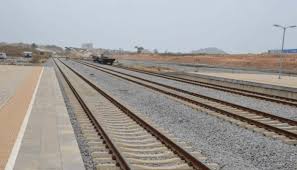

The Federal Government has officially confirmed that the ambitious Kano-Jigawa-Katsina-Maradi Railway Project is now 60 percent complete and remains firmly on track for full delivery by December 2027. The announcement was made following a high-level site inspection by the Presidential Media Team in Jigawa State, led by the Special Adviser to the President on Media and Public Communication, Sunday Dare.
Project at a glance
| Parameter | Details |
|---|---|
| Project Name | Kaduna–Kano–Jigawa–Katsina–Maradi Railway |
| Total Length | Approximately 284 km (Kano to Maradi) |
| Completion Status | 60% across both corridors |
| Expected Delivery | December 2027 |
| Key Corridor | Kano–Dutse stretch (intensified construction) |
| Major Works | Bridge construction, track laying, earthworks |
| Funding Scheme | President Bola Tinubu’s Renewed Hope Infrastructure Funding |
| Contractor | Mota-Engil (Portuguese firm) |
| Total Project Cost | Approximately $1.96 billion |
| Major Financiers | Nigerian Government, AfDB, China Exim Bank, IFC |
Source: Various FG announcements (May 2026) and project records
Search Query: “Kano Maradi railway project completion date 2027”
Construction intensifies across key corridors
Engr. Ali Bukar, the Federal Ministry of Transportation’s Resident Engineer overseeing Section Two of the project, disclosed during the inspection that construction activities along the Kano to Dutse stretch have intensified significantly. Major work is currently focused on bridge construction across key waterways and challenging terrains.
“Foundation works, including piling and substructure development for several bridges, have reached advanced stages, while superstructure installations are ongoing in multiple locations,” Bukar stated. He further confirmed that significant milestones have been achieved along the 104-kilometre Kano–Jigawa section, as well as the branch line linking Kano to Dutse, with track laying, earthworks and structural components already in place.
Indeed, about 68% of the 203km Kaduna–Kano line has been completed, while approximately 63% of the 296km Kano–Maradi section is done according to Engr. Abdullahi Adamu Yakubu, the project’s Desk Officer at the Ministry of Transport.
Search Query: “Kano Maradi rail project progress 2026”
Why this railway matters: strategic and economic significance
The project is not merely a transportation link; it is a strategic regional connector designed to boost trade, enhance food security and position Kano as the undisputed economic hub of Northern Nigeria. Here is why it matters:
Boosting regional trade and export: The rail line is a vital artery for regional integration and economic development. Once operational, it will provide a faster, safer and more efficient mode of transporting goods and passengers across West Africa. It connects Kano, Jigawa and Katsina states to Maradi in Niger Republic — one of the largest commercial towns in Niger — thereby opening up new regional markets and strengthening cross-border commerce.
Enhancing food security: NRC Managing Director Kayode Opeifa has explained that the rail link is key to ensuring Nigeria’s food security. “Mobility is at the centre of food security, and that’s what the Kano–Maradi rail line … will represent,” he noted. Cereal and livestock production for Nigeria and West Africa is tied to Maradi, making the railway crucial for the food supply chain.
Relieving road networks and reducing costs: The railway will take heavy freight loads off the roads, extending the lifespan of existing highways while reducing transportation costs for goods moving between northern Nigeria and the coast. “It can lift freight, and at least it will increase the lifespan of the roads,” Yakubu added.
Connecting to dry ports and multimodal logistics: The Kano station will connect directly to the Dala Dry Inland Port, meaning imported goods cleared in Lagos can be transported directly by rail and customs-cleared at Dala, eliminating costly truck bottlenecks.
Job creation and economic corridors: The project is designed not just as a transport route but as an “economic corridor” that will connect markets, farming clusters and businesses while creating thousands of jobs during and after construction.
Search Query: “Economic benefits of Kano Maradi railway”
Fully funded under Renewed Hope Infrastructure Scheme
According to Engr. Bukar, the project is being fully funded under President Bola Tinubu’s Renewed Hope Infrastructure funding scheme. The Federal Government has ensured timely release of funds, which has been vital in fast-tracking critical infrastructure.
The total project cost is approximately 1.96billion∗∗,withmajorfinanciersincludingtheNigerianGovernment,theAfricanDevelopmentBank(AfDB),theChinaEximBank,andtheInternationalFinanceCorporation(IFC).Notably,Nigeriasecureda∗∗1.96billion∗∗,withmajorfinanciersincludingtheNigerianGovernment,theAfricanDevelopmentBank(AfDB),theChinaEximBank,andtheInternationalFinanceCorporation(IFC).Notably,Nigeriasecureda∗∗350 million loan from the AfDB specifically to advance the Kano–Maradi rail project.
This reflects the government’s deliberate policy of sustaining inherited projects while initiating new ones to ensure balanced national development.
Timeline overview (updated)
| Milestone | Target Date |
|---|---|
| Project approved | September 2020 |
| Contract awarded to Mota-Engil | January 2021 |
| Construction commenced | 2022–2023 |
| 60% completion milestone achieved | May 2026 |
| Kano–Maradi line fully operational | December 2027 |
Search Query: “Kano Maradi railway timeline 2020 to 2027”
Complementary infrastructure projects
Beyond the railway itself, the government is also delivering complementary infrastructure to maximize impact:
- Tal-Udu interchange flyover bridge in Gwale Local Government Area of Kano State
- Concrete waterline from Kapin Chiri Dam in Garko for irrigation farming in Kano South Senatorial District
- Bola Ahmed Tinubu Skills Acquisition Centre in Dutse, Jigawa State
- New tractors procured by the Jigawa State Government for agricultural purposes
Additionally, President Tinubu has awarded contracts for rehabilitation of several key roads in the region, including the Martabar Kankara–Dutsinma–Katsina road and the Zaria–Hunkuyi–Dabai road, to complement the railway.
The new 1,000-passenger capacity Kano station will be an international hub linking the state to Niger Republic, further cementing Kano’s position as the biggest commercial centre in northern Nigeria.
Search Query: “Tinubu Kano Maradi rail infrastructure projects”
Conclusion
The Kano–Katsina–Maradi railway project is no longer a distant promise or a political talking point — it is now a tangible reality taking shape across the northwest Nigerian landscape. With 60% of the work already completed and the December 2027 completion target firmly in sight, the Federal Government is delivering on its Renewed Hope Agenda.
For businesses, investors and residents across the region, this project represents a transformative game-changer — one that promises to unlock economic prosperity, enhance food security and redefine cross-border trade in West Africa.
Search Query: “Kano Maradi rail project updates 2026 Nigerian government”
This article is based on official statements from the Federal Government of Nigeria, the Federal Ministry of Transportation, and the Nigerian Railway Corporation (NRC) as of May 2026.
Frequently Asked Questions
Q: When will the Kano-Katsina-Maradi railway be completed?
A: The Federal Government has confirmed that the project is 60% complete and will be delivered by December 2027 as announced in May 2026.
Q: What is the total length of the Kano-Maradi railway?
A: The railway line runs approximately 284 kilometres from Kano (Nigeria) through Jigawa and Katsina states to Maradi in Niger Republic.
Q: Who is financing the Kano-Maradi rail project?
A: The major financiers include the Nigerian Government, the African Development Bank (AfDB), the China Exim Bank, and the International Finance Corporation (IFC).
Q: How will the railway benefit northern Nigeria’s economy?
A: The railway will open new trade routes, ease movement of goods, support food security, create jobs, reduce road damage, and position Kano as the region’s leading commercial hub.
Q: Will the railway connect to other major cities beyond Kano?
A: Yes. The line will integrate with the Lagos–Ibadan–Kaduna rail corridor, effectively linking Lagos to Maradi via a standard gauge network.