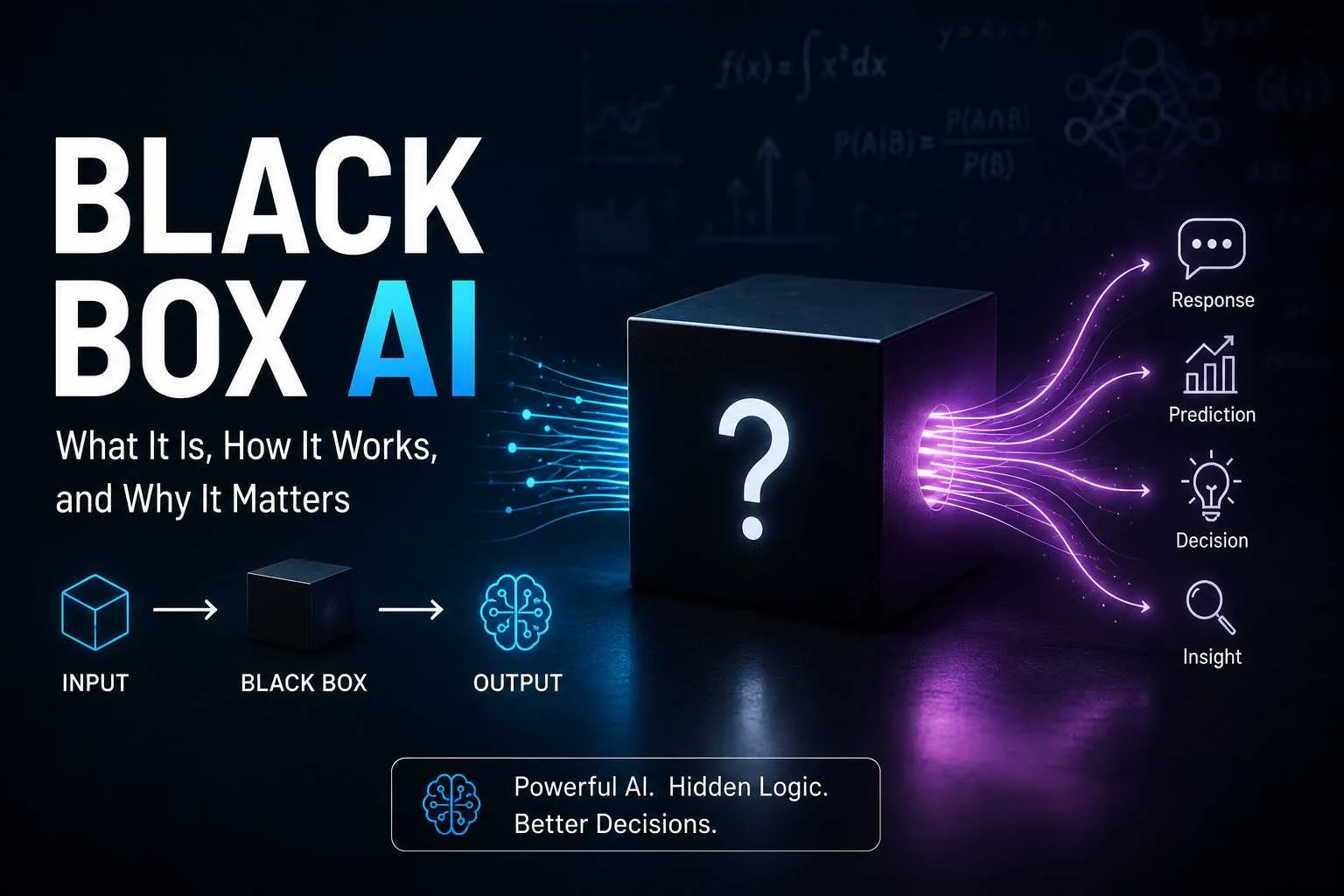

Imagine dropping your homework into a machine that returns a perfect answer – but you have absolutely no idea what happened inside it. That is the simplest way to describe black box AI: a system where you can see what goes in and what comes out, but the process in between is completely hidden, even from the engineers who built it.
From CBSE classrooms to billion-dollar banks, black box AI is reshaping how decisions are made. Understanding it isn’t optional anymore – it’s a core skill. guide breaks down what black box AI is, how it works, what students in Class 10 and Class 12 need to know for their exams, and how the tool Blackbox.ai is being used by students worldwide to study smarter.
What Is Black Box AI?
Black box AI is an artificial intelligence system in which the internal decision-making process is hidden, opaque, or too complex for a human to interpret directly. Users feed data in (input) and receive a result (output), but the logic, calculations, and patterns applied in between are invisible.
Think of it like a magic vending machine: you press a button (input), a snack comes out (output), but you have no idea what’s happening behind the panel. The AI equivalent of that hidden panel is layers upon layers of complex mathematical computations inside a neural network – and that is exactly what makes modern AI a black box.
Key Definition (exam-ready): Black box AI is an AI model whose internal reasoning is not visible or interpretable to its users, even though its inputs and outputs can be observed.
Also read: Gemini vs ChatGPT
How Does Black Box AI Work?
Most black box AI systems are powered by deep learning, a type of machine learning that uses multilayered neural networks. Here is what happens step by step:
- Input Layer: Raw data enters the model – text, images, numbers, or audio.
- Hidden Layers: The data passes through dozens, hundreds, or even thousands of processing layers. Each layer transforms the data in complex mathematical ways that are not easy to interpret.
- Output Layer: A result is produced – a classification, a prediction, a recommendation, or generated content.
The “hidden layers” are literally where the mystery lives. Even the developers of models like ChatGPT or Google Gemini cannot fully explain what happens at each node inside those layers. This is why AI black box behaviour is one of the most actively studied problems in modern computer science.
Why Is Black Box AI So Common?
Two main reasons explain why so much modern AI is a black box:
1. Intellectual Property Protection Some companies deliberately keep their AI’s source code and decision logic secret to prevent competitors from copying them. The model’s creators know how it works, but they don’t share it publicly.
2. Complexity Beyond Human Interpretation Advanced models – especially large language models (LLMs) like ChatGPT, Claude, or Gemini – are trained on billions of data points through deep learning. They become so complex that even their own creators cannot fully trace every decision. These are sometimes called “organic black boxes.”
Black Box AI in CBSE Class 10 and Class 12 Curriculum
Black box AI is a topic students in Class 10 and Class 12 are increasingly expected to understand, particularly under the CBSE Artificial Intelligence (Code 417) subject introduced as a skill-based elective.
Class 10 Students
In the CBSE Class 10 AI curriculum, students are introduced to the foundational concepts of machine learning, neural networks, and model evaluation. The idea of black box AI often appears in the context of:
- Understanding why AI models sometimes give wrong outputs
- Learning about bias in AI systems (a key ethical concern)
- Distinguishing between AI transparency and opacity
- Understanding the role of training data in shaping a model’s hidden behaviour
Sample exam question (Class 10): “What is meant by a ‘black box’ in the context of AI? Why is it considered a challenge for users?”
A model answer: A black box AI is a system where the user can observe the input given to the AI and the output it produces, but cannot see or understand the internal decision-making process. It is a challenge because users cannot verify how or why the AI reached a particular conclusion, making it hard to identify bias, errors, or security vulnerabilities.
Class 12 Students
At the Class 12 level, the treatment of AI black box concepts becomes more analytical and applied. Students are expected to understand:
- The difference between black box AI and white box AI (explainable AI)
- Real-world implications of opaque AI in healthcare, finance, and criminal justice
- Techniques used to improve AI interpretability, such as LIME (Local Interpretable Model-Agnostic Explanations)
- The ethical, legal, and social concerns of deploying black box models
Sample exam question (Class 12): “Differentiate between black box AI and white box AI. Give one example of each and explain the ethical concerns associated with black box AI.”
What Is Blackbox.ai – The Student Tool?
There is an important distinction to make here. Alongside the concept of black box AI, many students are now using a popular AI coding and study assistant called Blackbox.ai (blackbox.ai).
Blackbox.ai is a free AI-powered platform designed for developers and students. It helps users with:
- Writing, debugging, and explaining code in real-time
- Answering technical questions with context-aware responses
- Generating code snippets from natural language descriptions
- Analysing programming question papers and suggesting what topics to revise
Students frequently use Blackbox.ai for exam paper preparation, particularly those preparing for computer science and AI-related subjects. Many use features like “ask Blackbox AI anything” to get instant answers to programming problems or concept questions.
Note: The tool Blackbox.ai is separate from the concept of black box AI. Ironically, Blackbox.ai is an AI assistant – which itself uses deep learning models that could technically be described as black boxes internally!
Is Blackbox AI Better Than ChatGPT for Students?
For coding-specific questions and exam prep, many students find Blackbox.ai more targeted than ChatGPT because it is specifically optimised for technical and programming content. However, ChatGPT, Claude, and Gemini offer broader reasoning and writing support. For CBSE AI subject preparation, using multiple tools in combination yields the best results.
Read Also: Discover AI Tools
Black Box AI vs. White Box AI: Key Differences
| Feature | Black Box AI | White Box AI (Explainable AI) |
|---|---|---|
| Transparency | Low – internal logic is hidden | High – decision process is visible |
| Performance | Generally higher | Slightly lower on complex tasks |
| Trust | Harder to validate | Easier to audit and trust |
| Examples | ChatGPT, deep neural networks, recommendation engines | Decision trees, linear regression models |
| Regulatory compliance | Difficult to prove | Easier to demonstrate |
White box AI – also called explainable AI (XAI) or glass box AI – is the approach researchers are pushing toward. The goal is to build AI systems that are both powerful and interpretable, so that humans can understand, audit, and correct them when needed.
More Info: How to Use AI Tools for Study
The Black Box Problem: Real-World Risks
The black box nature of modern AI is not just an academic concern – it creates genuine real-world problems:
1. Bias Without Accountability
If a hiring algorithm trained on biased historical data rejects qualified candidates because of their gender, nationality, or postcode, users cannot easily identify why – because the reasoning is hidden. A 2018 example from Amazon showed exactly this: an internal AI recruiting tool was quietly penalising resumes that included the word “women’s.”
2. Medical Misdiagnosis
AI models trained to detect diseases from X-rays or scans have been found to “learn” irrelevant visual cues – such as annotations doctors left on images – rather than the actual disease markers. Because the model is a black box, this error was only discovered by chance.
3. Criminal Justice Opacity
Several jurisdictions use AI tools to assess a defendant’s likelihood of reoffending. These tools are often black boxes – neither defendants nor their lawyers can fully examine the factors used in the assessment, raising serious questions about fairness and legal rights.
4. Security Vulnerabilities
Because the inner workings of a black box model are invisible, hidden vulnerabilities can be exploited through prompt injection or data poisoning – attacks that alter model behaviour without users realising it.
Solutions: Making AI Less of a Black Box
Researchers and regulators around the world are working on several approaches:
- Explainable AI (XAI): Techniques like LIME and SHAP (SHapley Additive exPlanations) analyse a model’s inputs and outputs to estimate which factors most influenced a decision.
- Open-Source Models: Publishing a model’s architecture and weights adds a layer of transparency, even if the deep learning itself remains complex.
- AI Governance Frameworks: The EU AI Act (2024) now requires high-risk AI systems to provide explainability to affected individuals, pushing companies to move away from pure black box approaches.
- Hybrid Systems: Combining opaque deep learning models with transparent, rule-based systems (like radar in self-driving cars) can add interpretability at critical decision points.
More info: Top Great Online Tools
Final Thoughts
Black box AI sits at the centre of one of the most important debates in technology today: how do we build AI systems that are powerful and trustworthy? Whether you are a CBSE student preparing for your Class 10 or Class 12 AI exam, a developer using Blackbox.ai to sharpen your coding skills, or a professional working with AI tools in your organisation, understanding what happens inside the black box – and why it matters when you can’t see it – is essential.
The goal isn’t to fear black box AI. It’s to use it wisely, question it critically, and work towards a future where AI systems are both remarkably capable and genuinely transparent.
Learn more: Best Online Tools
FAQs on Black Box AI
Q1. What is black box AI in simple terms? Black box AI is any AI system where you can see what data you put in and what result comes out, but you cannot see or understand the steps the AI took to reach that result. The decision-making process is hidden.
Q2. What is black box AI in Class 10? In CBSE Class 10 AI, black box AI refers to the concept of AI systems that produce outputs from inputs without revealing their internal logic. Students are expected to understand why this creates challenges around trust, bias, and accountability.
Q3. What is black box AI in Class 12? For Class 12, students go deeper – exploring the ethical implications, differences from explainable AI, real-world case studies, and techniques like LIME that help interpret black box model behaviour.
Q4. What is Blackbox.ai? Blackbox.ai is an AI-powered coding assistant and student tool available at blackbox.ai. It helps with coding questions, debugging, exam preparation, and lets users “ask Blackbox AI anything” related to programming and technology subjects.
Q5. Can you use Blackbox.ai for exam paper preparation? Yes. Many students use Blackbox.ai to analyse previous exam papers, identify frequently asked topics, generate practice questions, and get explanations for complex AI and computer science concepts.
Q6. Is black box AI dangerous? Not inherently – but its lack of transparency introduces real risks including undetected bias, security vulnerabilities, and accountability gaps, especially when applied to high-stakes decisions in healthcare, finance, or law.
Q7. What is the difference between black box AI and white box AI? Black box AI hides its internal decision-making process; white box AI (or explainable AI) makes its reasoning visible and auditable. White box models trade some performance for transparency.
Q8. Can black box AI ever become fully explainable? Researchers are making progress, but fully explaining models with billions of parameters remains an open challenge. Techniques like LIME, SHAP, and mechanistic interpretability research (such as Anthropic’s work on Claude’s neural activations) are steadily closing the gap.