
How to Improve Your Brand’s Visibility in AI Search: What 89,000 LinkedIn Citations Reveal

Introduction
The landscape of digital discovery is undergoing a fundamental transformation. While traditional search engines have long served as the primary gateway connecting audiences with brands and information, a new layer of intelligence is reshaping how people find answers, explore products, and make decisions. AI-powered search systems-including ChatGPT Search, Google AI Mode, and Perplexity-are increasingly positioned as first-touchpoint resources, delivering comprehensive answers directly within conversation interfaces rather than directing users toward collections of blue hyperlinks.
For businesses, this shift presents both a challenge and an opportunity. The challenge lies in understanding how these systems select, evaluate, and cite sources when generating their responses. The opportunity emerges for brands that recognize AI search visibility as a distinct discipline requiring specialized content strategies.
Recent research from Semrush provides compelling insights into how AI search engines actually interact with professional content networks. In a comprehensive study examining over 325,000 unique search queries across three major AI search platforms, researchers identified nearly 89,000 distinct LinkedIn URLs that appeared in AI-generated responses. The findings reveal patterns, preferences, and content characteristics that forward-thinking brands can leverage to strengthen their position within this emerging visibility landscape.
This article explores the Semrush study’s key discoveries, translates their implications into actionable strategies, and presents a comprehensive framework for building AI search visibility through LinkedIn-while acknowledging that citation in AI responses, like all visibility strategies, cannot be guaranteed and depends on numerous factors beyond any single optimization technique.
What Is AI Search Visibility?
Before exploring the study’s findings, it’s essential to understand what we mean by “AI search visibility” and how it differs from traditional search engine optimization.
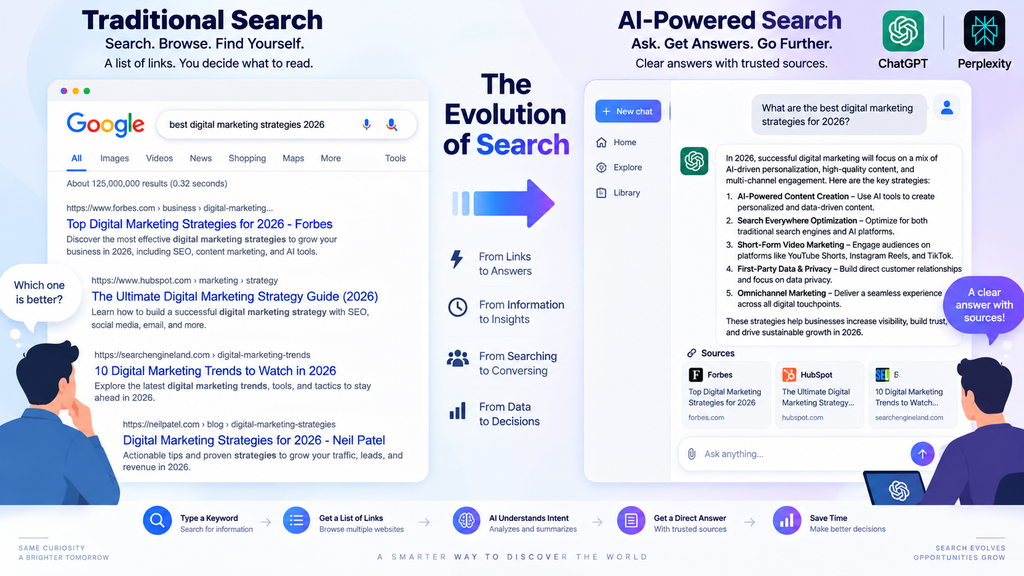
Traditional search visibility refers to where your website or content appears in search engine results pages (SERPs). A higher ranking typically means more clicks, more traffic, and more opportunities for conversion. The system is relatively transparent-webmasters can track rankings, analyze competitor positions, and implement technical or content-based improvements.
AI search visibility operates on different principles. When users pose questions to systems like ChatGPT Search, Perplexity, or Google AI Mode, these platforms generate responses by synthesizing information from multiple sources they have indexed and learned from during training. Instead of presenting a list of links, the AI produces a direct answer-and may cite sources to support or reference its response.
Consider this practical distinction:
Traditional Search Scenario: A marketing director asks Google “best project management tools for remote teams.” They receive a SERP featuring articles, comparison pages, and product listings. The goal for brands is ranking on page one.
AI Search Scenario: The same professional asks ChatGPT Search the same question. They receive a curated response summarizing key considerations, featuring attributes of suitable tools, and potentially citing specific articles, expert posts, or company pages as sources. The goal for brands shifts from ranking highly to being included in-and accurately represented within-the AI’s synthesized answer.
This distinction matters enormously for brand strategy. In traditional search, visibility focuses on driving clicks to owned properties. In AI search, visibility encompasses both citation as a source and accurate representation within synthesized responses. Being mentioned matters. Being understood matters equally.
What Did the Semrush Study Analyze?
The Semrush LinkedIn AI visibility study represents one of the most comprehensive examinations of how AI search platforms interact with professional content. The research methodology combined broad data collection with nuanced analysis of content characteristics, author signals, and engagement patterns.
Scope of the Analysis
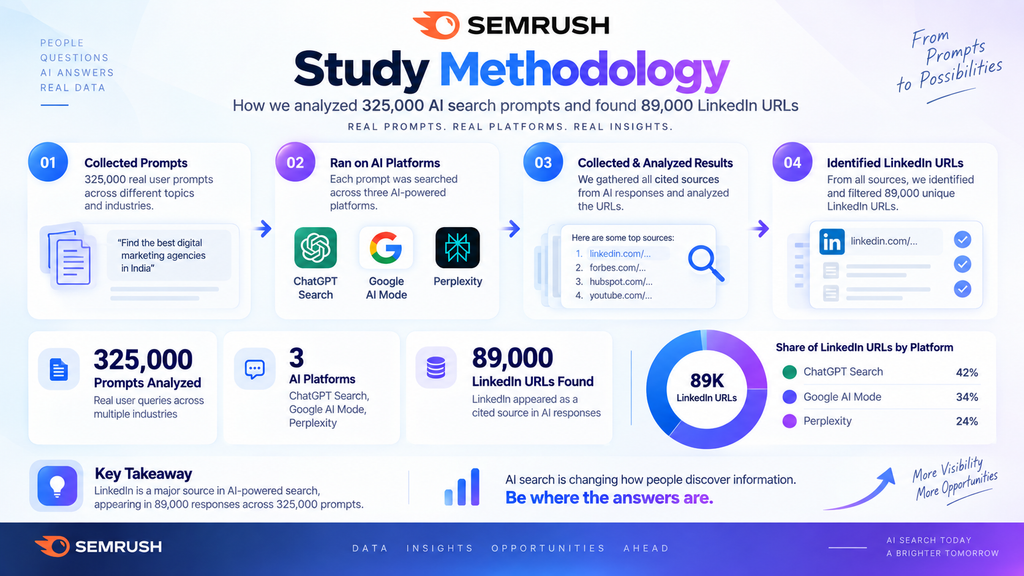
Researchers examined more than 325,000 unique prompts across three major AI search platforms:
- ChatGPT Search (OpenAI’s conversational search interface)
- Google AI Mode (Google’s AI-powered search enhancement)
- Perplexity (an AI-native search platform)
From this dataset, the team identified approximately 89,000 unique LinkedIn URLs that appeared in AI-generated responses. This large sample enabled statistically meaningful conclusions about patterns in content selection, author characteristics, and content formatting preferences.
What the Study Measured
The research evaluated multiple dimensions of LinkedIn content and its relationship to AI citation:
- Content Type Analysis – Examining whether AI systems preferentially cited articles, feed posts, Company Pages, or individual profiles
- Author Signals – Investigating characteristics of frequently-cited content creators, including posting frequency, follower counts, and profile completeness
- Engagement Metrics – Analyzing the relationship between reactions, comments, and shares and citation frequency
- Content Signals – Evaluating word count, semantic characteristics, formatting choices, and topic categories
- Semantic Similarity – Measuring how closely AI-generated responses matched the meaning of cited LinkedIn content
The study’s findings provide an evidence-based foundation for developing LinkedIn strategies oriented toward AI search visibility-though it’s important to recognize that citation patterns observed in this dataset represent correlations and associations rather than guaranteed causal relationships.
For the complete methodology and findings, refer to Semrush’s LinkedIn AI visibility study.
Key Statistics From the 89,000 LinkedIn Citation Study
The following table summarizes the most significant findings from Semrush’s research, along with their practical implications for brand strategy.
| Metric | Finding | What It Means for Brands |
| Platform Citation Ranking | LinkedIn ranked #2 in citations across the dataset | LinkedIn is a major source for AI-generated answers, particularly for professional, B2B, and educational topics |
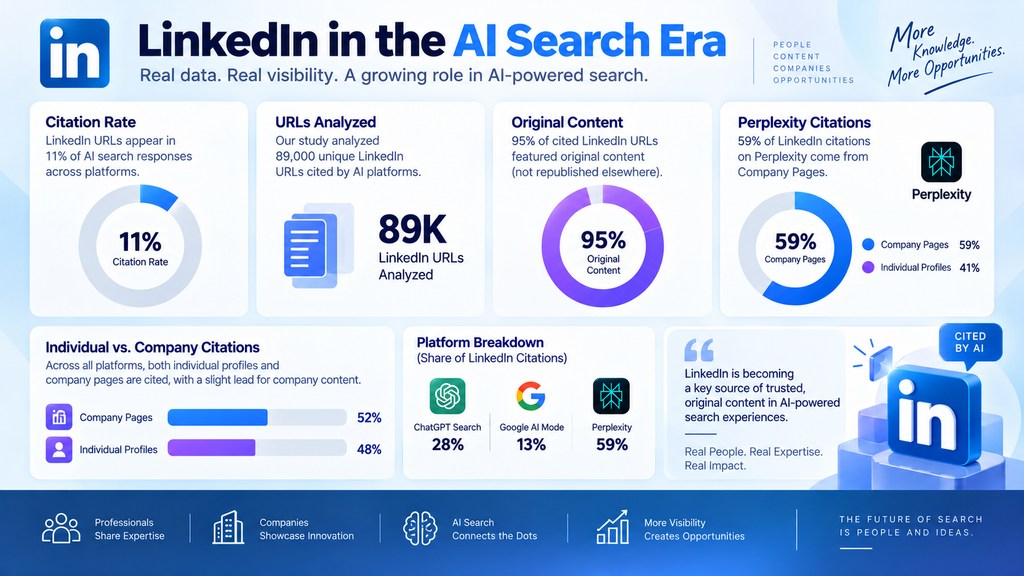
| Average Citation Rate | Appeared in approximately 11% of AI responses across platforms | LinkedIn content has meaningful but not dominant visibility-opportunity exists to increase representation |
| Content Type: Articles | Articles of 500–2,000 words showed significant citation patterns | Mid-length, substantive articles perform well for AI source selection |
| Content Type: Feed Posts | Posts of 50–299 words represented the largest share of cited posts | Concise, focused posts can achieve visibility alongside longer-form content |
| Original vs. Reshared | Approximately 95% of cited posts were original content | AI systems strongly prefer first-hand content over reshared material |
| Company Page Citations | Accounted for 59% of LinkedIn citations on Perplexity | Platform preferences vary-some AI systems favor institutional sources |
| Individual Creator Citations | Accounted for 59% of citations on both ChatGPT Search and Google AI Mode | Personal expertise and thought leadership may be preferred by certain platforms |
| Posting Frequency | Approximately 75% of cited post authors were frequent posters (5+ posts in 4 weeks) | Consistent publishing activity correlates with citation frequency |
| Follower Count | Nearly half of cited post authors had more than 2,000 followers | Audience size provides some advantage but isn’t the determining factor |
| Engagement Levels | Median cited posts had approximately 15–25 reactions and ≤1 comment | High engagement is not required for AI visibility-useful content can achieve citation with modest engagement |
| Semantic Similarity | LinkedIn content achieved semantic similarity scores of approximately 0.57–0.60 | AI systems can extract and represent meaning from LinkedIn content, not just verbatim text |
All statistics attributed to Semrush’s 2026 LinkedIn AI visibility analysis.
Also Read: Black Box AI: What It Is, How It Works & Benefits
Why LinkedIn Matters for AI Search Visibility
The study’s finding that LinkedIn ranked second among citation sources across the analyzed dataset underscores the platform’s growing importance in AI-driven discovery. Understanding why LinkedIn content resonates with AI search systems helps brands prioritize their efforts effectively.
Professional Authority and Expertise
AI search platforms aim to provide accurate, helpful responses to user queries. LinkedIn’s ecosystem inherently emphasizes professional expertise, industry knowledge, and first-hand experience. Content creators on LinkedIn typically share insights from their actual professional contexts-product launches, implementation lessons, industry observations, and career guidance. This authentic expertise aligns well with what AI systems seek when synthesizing responses.
Structured Professional Information
LinkedIn provides a structured environment for professional information. Company Pages include standardized fields for products, services, industry classification, and company size. Individual profiles feature structured sections for experience, education, skills, and recommendations. This structured data may help AI systems parse and integrate professional information more effectively.

B2B and Educational Content Strength
The Semrush research found that educational and advice-driven content represented a substantial share of cited LinkedIn content. This aligns with AI search’s preference for informative, explanatory material over purely promotional content. For EdTech companies, B2B service providers, technology companies, and professional consultants, this represents a natural alignment between their content strengths and AI visibility opportunities.
Platform Trust Signals
LinkedIn operates within Microsoft’s ecosystem and maintains professional identity verification through employment and educational affiliations. AI search systems may incorporate platform-level trust signals into their source selection criteria. Content appearing on LinkedIn benefits from this institutional context.
Practical Applications Across Industries
Consider how these dynamics play out across different business contexts:
- SaaS Companies benefit from sharing implementation experiences, product use cases, and technical insights-all of which align with AI citation patterns for educational content.
- Digital Marketing Agencies can establish visibility through original research, strategy frameworks, and campaign analysis published on LinkedIn.
- EdTech Organizations align naturally with the study’s finding that educational content performs well, positioning platform content as AI-ready when it addresses learning objectives, technology implementation, or educational methodology.
- Technology Companies can leverage LinkedIn for technical depth that AI systems value when generating responses about enterprise solutions, software comparisons, or implementation considerations.
- Consultants and Subject Matter Experts can build thought leadership that translates to AI citation through first-hand experience sharing, framework development, and industry perspective.
AI Doesn’t Just Cite LinkedIn – It Can Echo the Meaning
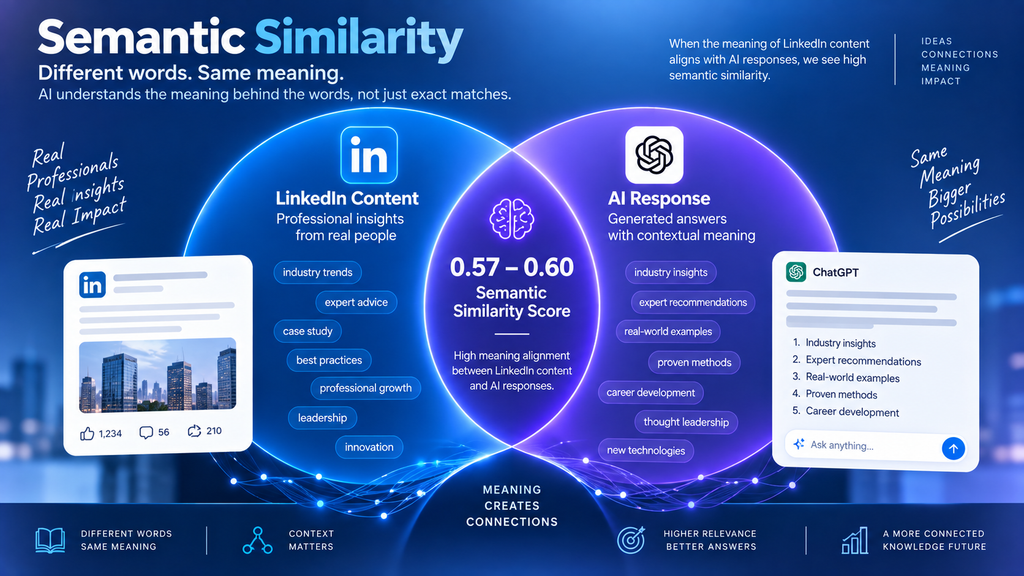
One of the study’s more nuanced findings relates to semantic similarity. LinkedIn content in the dataset achieved semantic similarity scores of approximately 0.57–0.60 with AI-generated responses that cited it. Understanding this metric is crucial for brands developing content strategy.
What Semantic Similarity Means
Semantic similarity measures how closely the meaning of one text matches another, rather than measuring exact word overlap. A score of 0.57–0.60 indicates moderate-to-strong semantic alignment-meaning the AI system could extract and incorporate the core concepts from the LinkedIn content into its response without necessarily reproducing exact phrasing.
This finding carries important implications for content strategy:
Clarity of Core Messages Matters
If your LinkedIn content discusses “improving customer onboarding retention through personalized email sequences,” but buries this insight in lengthy tangents, AI systems may struggle to accurately extract and represent your key point. Clearly stating your core insight early and reinforcing it throughout your content increases the likelihood that AI systems will represent your perspective accurately.
Consistent Terminology Helps
Using consistent terminology for key concepts helps AI systems build accurate mental models of your content. If you sometimes call a process “lead nurturing” and other times “customer engagement” without distinguishing between them, you create ambiguity that AI systems must navigate.
Definitions Clarify Intent
Explicitly defining important terms, frameworks, or concepts provides AI systems with precise building blocks for incorporating your content into synthesized responses. Rather than assuming shared understanding, treat your content as educating both human readers and AI systems.
What This Doesn’t Mean
It’s crucial to avoid overinterpreting semantic similarity findings. A moderate similarity score does not mean:
- AI systems will reproduce your exact wording
- Your content will be accurately represented in every relevant query
- Semantic similarity is a ranking factor you can directly optimize
- Citation is guaranteed based on any semantic score
Rather, semantic similarity represents an observed characteristic of how AI systems process and incorporate content into their responses. Brands should focus on clear, consistent communication rather than attempting to manipulate semantic metrics.
What Type of LinkedIn Content Gets Cited by AI?
The Semrush analysis revealed clear patterns in the types of LinkedIn content that appeared in AI-generated responses. While correlation doesn’t guarantee citation, understanding these patterns helps brands allocate content development resources strategically.
Educational Content
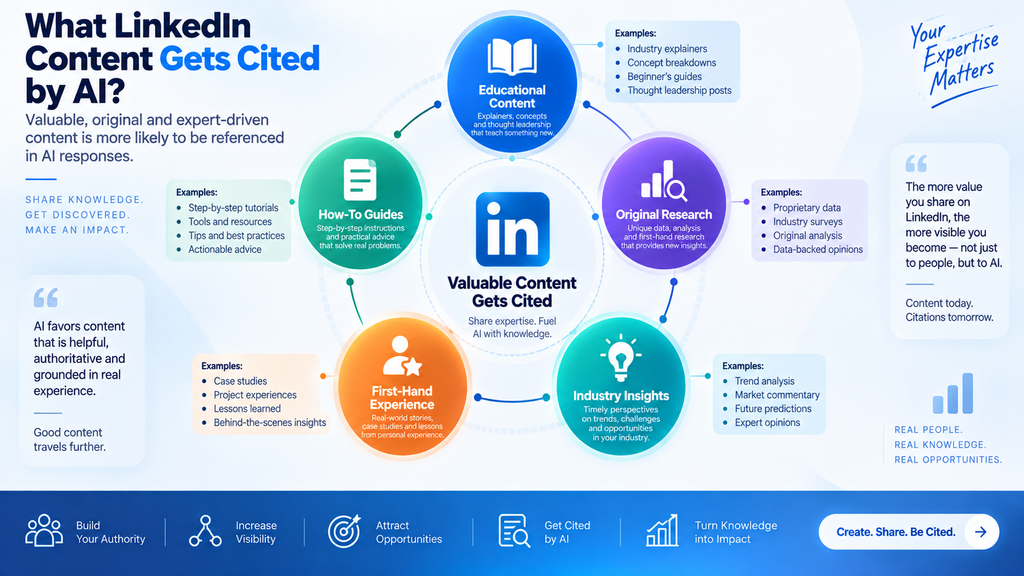
Educational content-material that teaches concepts, explains processes, or builds understanding-represented a significant portion of cited LinkedIn content. This aligns with AI search systems’ fundamental purpose: answering questions and providing useful information. Content that directly addresses “how” and “why” questions positions itself for potential inclusion in AI responses.
Practical How-To Content
Step-by-step guides, implementation tutorials, and practical frameworks appeared frequently among cited content. When users ask about processes, tools, or methodologies, AI systems may draw on LinkedIn posts that break down complex topics into actionable steps.
Original Research
Sharing proprietary data, survey results, or original analysis provides high-value content that AI systems may reference when responding to queries related to industry trends, benchmarks, or statistics. Original research establishes topical authority and provides unique information that human readers and AI systems cannot find elsewhere.
First-Hand Experience
Content grounded in direct professional experience-lessons from implementations, insights from client work, observations from industry involvement-offers authenticity that AI systems may value. First-hand experience provides context and nuance that distinguishes original observations from general knowledge.
Industry Insights and Perspective
Analysis of industry trends, commentary on news events, and professional perspective on market developments represent another content category with citation potential. When AI systems generate responses about industry dynamics, they may incorporate expert perspectives from LinkedIn.
Detailed Explanations
Thorough explanations of complex topics, tools, or concepts showed citation frequency in the study. Rather than oversimplifying, providing comprehensive coverage of nuanced subjects may increase relevance for AI systems addressing sophisticated queries.
Data-Driven Content
Content incorporating statistics, research findings, or quantitative analysis may appeal to AI systems seeking authoritative sources for factual claims. As with original research, data-driven content provides verifiable information that supports AI-generated responses.
LinkedIn Articles vs LinkedIn Posts for AI Visibility
The study analyzed both LinkedIn’s long-form article feature and its shorter feed post format, revealing distinct patterns in how each content type performed for AI citation.
Comparative Analysis
| Feature | LinkedIn Article | LinkedIn Feed Post |
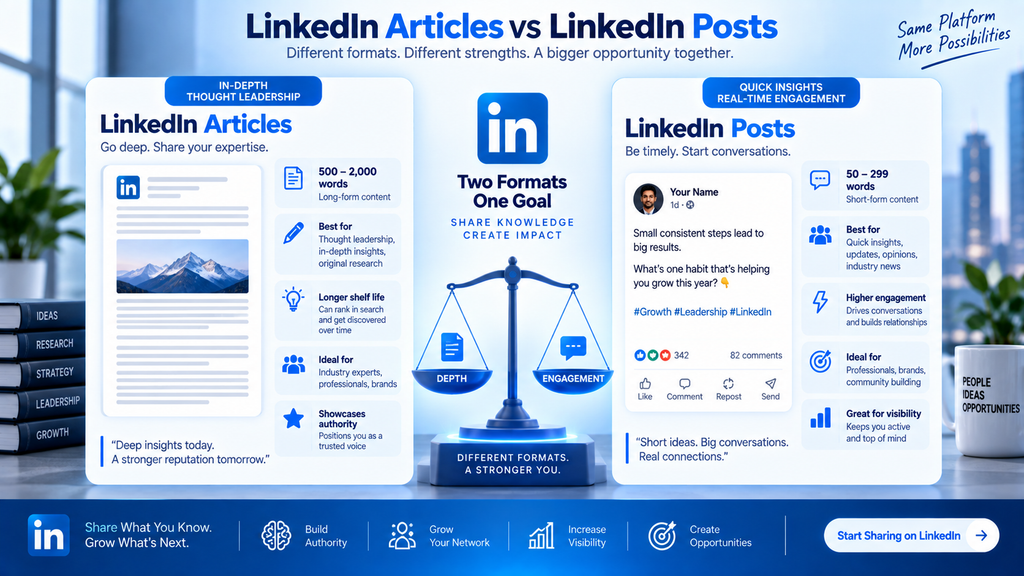
| Typical Length | 500–2,000 words (cited range) | 50–299 words (cited range) |
| Depth of Coverage | Comprehensive, multi-section | Focused, single-point |
| Topic Treatment | Thorough exploration of single topics | Concise treatment of specific insights |
| Use Cases | Frameworks, methodologies, research, guides | Quick tips, opinions, observations, announcements |
| Citation Potential | Higher for complex, educational queries | Strong for concise, actionable insights |
| Ideal Purpose | Establishing authority on comprehensive topics | Demonstrating ongoing expertise and engagement |
Strategic Implications
The study’s findings suggest that both formats have legitimate roles in an AI visibility strategy. Articles suit topics requiring comprehensive treatment-industry analyses, methodological frameworks, educational series. Feed posts suit timely observations, quick insights, and ongoing engagement that demonstrates consistent expertise.
Rather than choosing one format exclusively, consider:
- Using articles for cornerstone content that establishes comprehensive expertise
- Using feed posts for ongoing thought leadership and audience engagement
- Repurposing article insights into feed post formats to maximize distribution
- Developing article series that build topical authority over time
Original Content Matters More Than Resharing
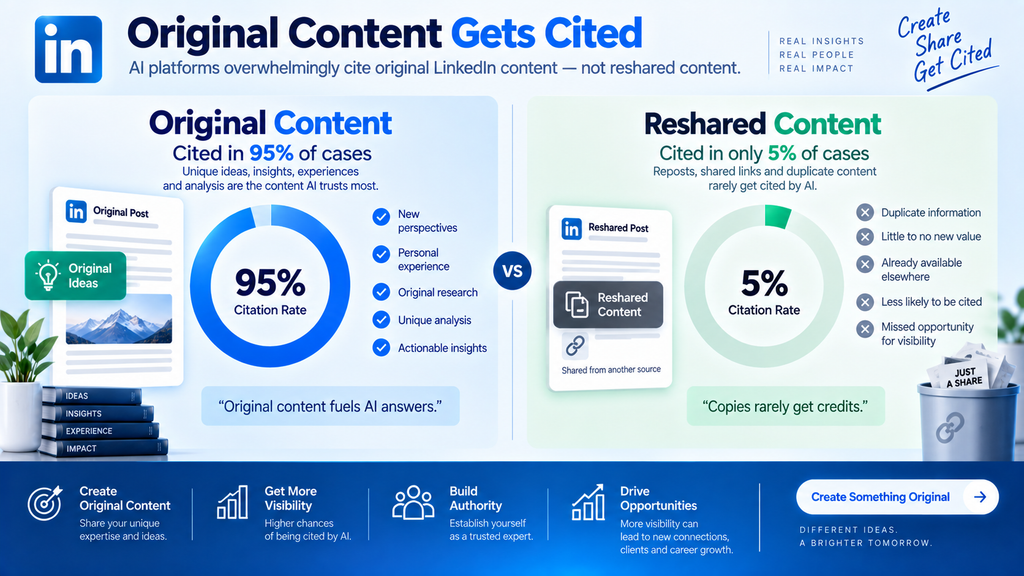
The study found that approximately 95% of cited LinkedIn posts were original content, with reshares accounting for only about 5% of citations. This finding carries clear strategic implications.
Why Original Content Dominates
AI search systems aim to provide unique value to users. Reshared content, by definition, does not add new information to the ecosystem-it merely amplifies existing content. AI systems have direct access to original sources and may prefer citing primary sources rather than intermediaries.
Additionally, original content typically includes the creator’s perspective, analysis, or experience-the unique value that distinguishes one person’s insights from another’s. This first-hand interpretation provides material for AI systems to synthesize and reference.
Practical Recommendations for Original Content Creation
Building an original content strategy requires consistent effort and a clear differentiation approach:
Share Personal Experience
Rather than simply reporting industry news, add your personal perspective on what the news means for your industry, your clients, or your professional domain. “Here’s what Apple’s announcement means for EdTech product development” provides more citation-worthy content than a simple news reshare.
Develop Proprietary Insights
Conduct original analysis, synthesize lessons from your professional experience, or develop frameworks based on your unique methodology. These original contributions provide content that doesn’t exist elsewhere-making it inherently more valuable for AI systems seeking authoritative sources.
Explain Lessons Learned
Sharing what you’ve learned from successes and failures provides authentic, first-hand content. These lessons carry weight that generic advice cannot match.
Create Original Data
If you have access to relevant data-customer surveys, industry benchmarks, internal metrics-sharing this original research provides unique value that AI systems may reference when responding to related queries.
Use Unique Examples
Illustrating concepts with examples from your specific experience adds originality that distinguishes your content from generic treatments of similar topics.
Avoid Reposting Without Adding Value
If you do share others’ content, add substantial original commentary that elevates the reshare beyond mere duplication. A brief “interesting article” with no added perspective provides minimal value.
Company Page vs Personal LinkedIn Profile: Which Should Brands Focus On?
The study revealed an interesting platform-specific pattern in how AI systems cite different LinkedIn entity types:
- On Perplexity: Company Pages accounted for 59% of LinkedIn citations
- On ChatGPT Search: Individual members accounted for 59% of citations
- On Google AI Mode: Individual members accounted for 59% of citations
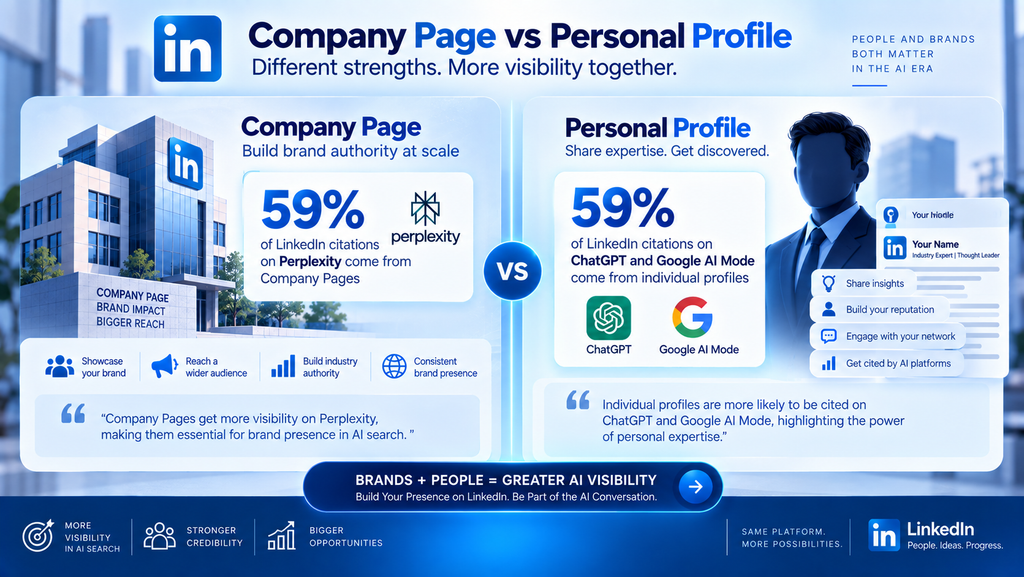
This variation suggests that different AI search platforms may have distinct preferences for institutional versus personal sources. Rather than choosing one approach exclusively, strategic brands should develop presence across both dimensions.
Leveraging Company Pages Effectively
Company Pages provide:
- Brand Information: Official descriptions, mission statements, and positioning
- Product and Service Details: Features, use cases, and specifications
- Company Research: Founding story, team information, company news
- Industry Classification: Sector, size, and specialty indicators
- Official Announcements: Product launches, partnership news, company milestones
For queries where institutional information matters-questions about specific companies, product comparisons, or organizational details-Company Pages may serve as preferred sources.
Leveraging Individual Profiles Effectively
Individual profiles, particularly those of founders, executives, and subject matter experts, provide:
- Thought Leadership: Expert perspectives on industry topics
- First-Hand Experience: Lessons from direct professional involvement
- Expertise Demonstration: Skills, certifications, and career trajectory
- Industry Perspective: Commentary on trends, news, and developments
- Practical Advice: How-to guidance grounded in real experience
For queries seeking expert insight, practical guidance, or professional perspective, individual profiles may be preferred sources.
Strategic Recommendation: Develop Both
Rather than choosing between Company Pages and individual profiles, successful AI visibility strategies typically include:
- Optimized Company Pages that accurately represent the brand, products, and services
- Executive and Founder Profiles that establish personal thought leadership
- Employee Advocacy Programs that amplify expertise across multiple voices
- Coordinated Positioning that ensures consistent messaging across all LinkedIn presences
This multi-channel approach addresses the varying preferences different AI systems may have for institutional versus personal sources.
Does Follower Count Determine AI Visibility?
The study found that nearly half of cited LinkedIn post authors had more than 2,000 followers. This finding might suggest that audience size drives AI visibility-but the picture is more nuanced.
What the Data Actually Shows
While a significant portion of cited creators had 2,000+ followers, this doesn’t mean follower count is a determining factor. Several observations complicate any simple interpretation:
Small Audiences Can Achieve Visibility
The study focused specifically on cited content. This means the analysis examined characteristics of content that was cited-not characteristics of all content that achieved high engagement. Content from creators with smaller followings may achieve citation when it provides highly relevant, accurate, or useful information for specific queries.
Follower Count Provides Amplification, Not Authority
Followers increase the reach of content, potentially exposing it to more contexts where AI systems might reference it. However, reach doesn’t directly translate to authority or relevance. A post reaching 10,000 people with generic content may receive less AI consideration than a post reaching 500 people with highly specific, expert-level insight.
The Metric That Matters: Content Relevance
For AI citation purposes, content relevance-how well a piece addresses the types of queries AI systems receive-likely matters more than follower count. Highly specialized expertise shared with a smaller audience may be exactly what AI systems need for certain queries.
Strategic Implications
Rather than obsessing over follower counts, focus on:
- Building topical authority within your specific domain
- Developing original expertise that distinguishes your perspective
- Creating content relevant to the types of questions your audience and industry ask
- Publishing consistently to build a body of work that demonstrates expertise
Follower growth often follows from producing consistently valuable content-the same content that AI systems may find worth citing.
Why Consistent LinkedIn Publishing Matters
The study found that approximately three-quarters of cited post authors were frequent posters, defined as publishing more than 5 posts during the previous four weeks. This finding supports the value of consistent publishing activity.
Why Frequency Correlates with Citation
Several factors may explain why frequent publishers appear more frequently among cited creators:
Volume Increases Probability
More published content increases the statistical probability that some content will align with queries AI systems address. A creator publishing 20 posts per month has more “opportunities” for AI systems to reference their content than a creator publishing once monthly.
Consistency Signals Commitment
Regular publishing demonstrates ongoing engagement with a topic area. AI systems evaluating source credibility may consider consistent contribution patterns as indicators of genuine expertise.
Breadth of Coverage
Frequent publishers can cover more topics, answer more questions, and address diverse queries. This breadth increases the likelihood that at least some content will match relevant AI search queries.
A Recommended Publishing Framework
Based on the study’s findings and general content strategy principles, consider establishing a sustainable publishing rhythm. The following framework represents a recommended approach-not a direct Semrush recommendation-designed for brands seeking to build consistent presence:
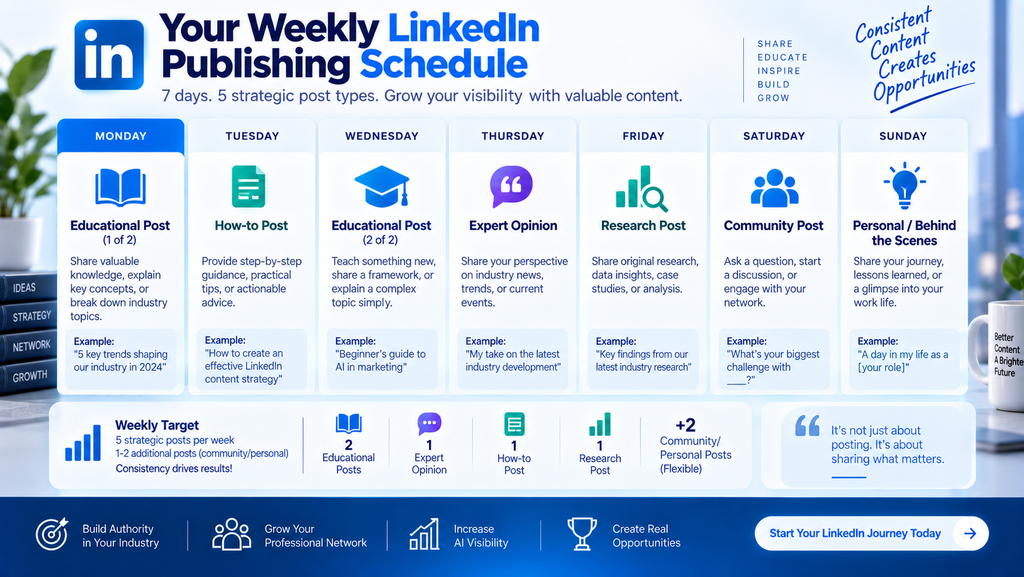
Weekly Content Mix:
- 2 Educational Posts: Content that teaches concepts, explains processes, or builds understanding
- 1 Expert Opinion Post: Perspective on industry news, trends, or developments
- 1 Practical How-To Post: Step-by-step guidance, tips, or implementation advice
- 1 Research or Data Post: Original analysis, survey results, or data-driven insights
This mix balances educational value, thought leadership, and practical utility while maintaining sustainable output levels.
Remember: Consistency matters more than volume. A sustainable pace you can maintain indefinitely will build a larger body of work over time than unsustainable bursts of activity followed by extended gaps.
Engagement Matters – But Going Viral Isn’t the Whole Strategy
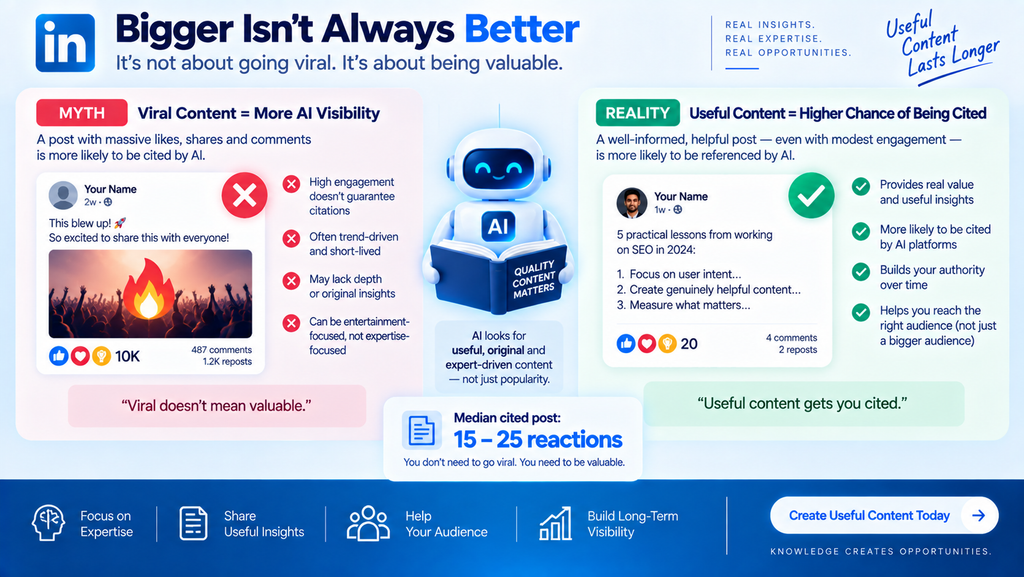
The study found that the median cited LinkedIn post had approximately 15–25 reactions and no more than one comment. This finding challenges assumptions that viral or highly-engaged content necessarily dominates AI citation.
Interpreting Engagement Data
High engagement signals content resonates with human audiences, but engagement and AI citation operate through different mechanisms:
Human Engagement vs. AI Source Selection
Human engagement reflects how content performs with LinkedIn’s feed algorithm and human readers. AI source selection reflects how content addresses specific queries and provides useful information. These are related but distinct considerations.
Relevance Trumps Virality
A post about nuanced enterprise software implementation might receive 30 reactions from a highly relevant audience while a generic motivational quote receives 500 reactions from a broader audience. For AI systems addressing specific technical queries, the 30-reaction post may be far more valuable.
Engagement Quality Over Quantity
A small number of highly relevant engagements-thoughtful comments, meaningful shares within your professional community-may indicate content that AI systems would find worth citing, even if total engagement numbers appear modest.
Strategic Implications
Rather than pursuing viral content as an AI visibility strategy:
- Prioritize useful content that genuinely helps your audience
- Address specific questions that professionals in your domain actually ask
- Provide accurate, detailed information that serves as a reliable source
- Accept that modest engagement doesn’t indicate your content lacks value for AI systems
The goal is producing content AI systems find worth citing-not producing content that performs well in LinkedIn’s engagement metrics.
How to Create LinkedIn Content That AI Search Can Understand
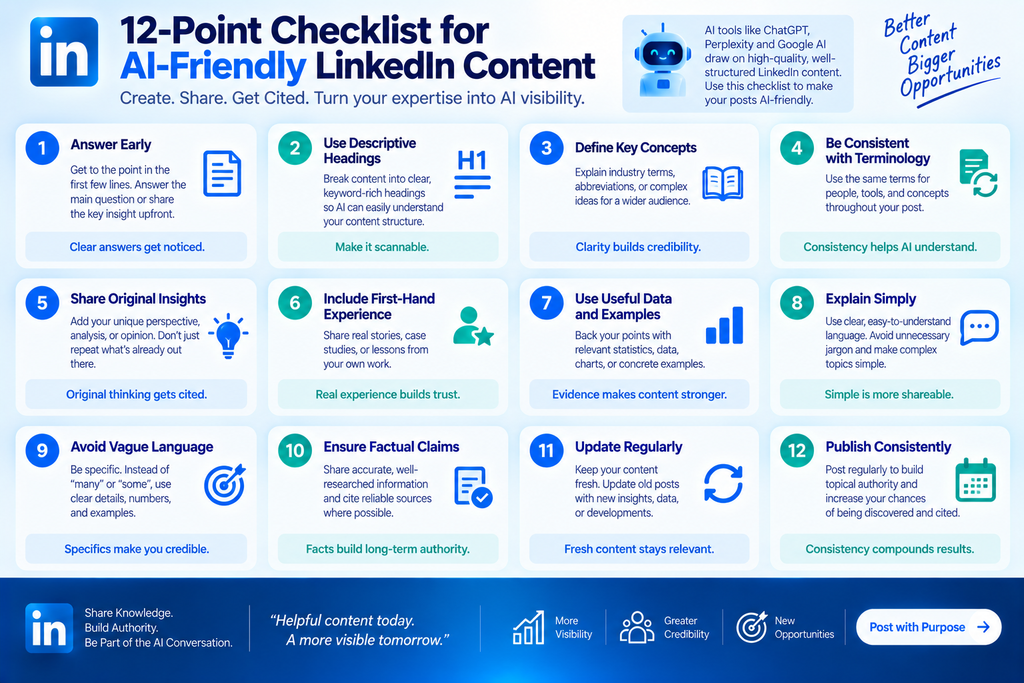
Based on the study’s findings and general content best practices, the following checklist helps create LinkedIn content with better alignment to AI search citation patterns:
Content Structure Checklist
- Answer the core question early – State your main insight, recommendation, or finding within the first few sentences rather than building toward it gradually.
- Use descriptive headings – Clear section headers help AI systems parse content structure and locate relevant information.
- Define important concepts – Don’t assume shared understanding. Explicitly define key terms, frameworks, and methodologies.
- Use consistent terminology – Maintain consistent language for key concepts throughout your content rather than switching between synonyms.
- Provide original insights – Share your unique perspective, analysis, or experience rather than rehashing commonly known information.
- Add first-hand experience – Ground your content in direct professional experience rather than theoretical abstractions.
- Include useful data – Incorporate relevant statistics, benchmarks, or research findings that support your points.
- Explain complex concepts simply – Break down sophisticated ideas into understandable components without sacrificing accuracy.
- Avoid vague marketing language – Replace generic claims (“world-class solution,” “unparalleled expertise”) with specific, verifiable statements.
- Keep company and product claims factual – Ensure factual accuracy in all claims. AI systems may check claims against multiple sources.
- Update outdated information – Regularly review and refresh content as information evolves. AI systems may prefer current sources.
- Publish consistently – Maintain regular publishing activity to build a body of work demonstrating ongoing expertise.
How to Optimize Your LinkedIn Profile for AI Visibility
Both Company Pages and individual profiles contribute to AI visibility. Optimization strategies should address both dimensions.
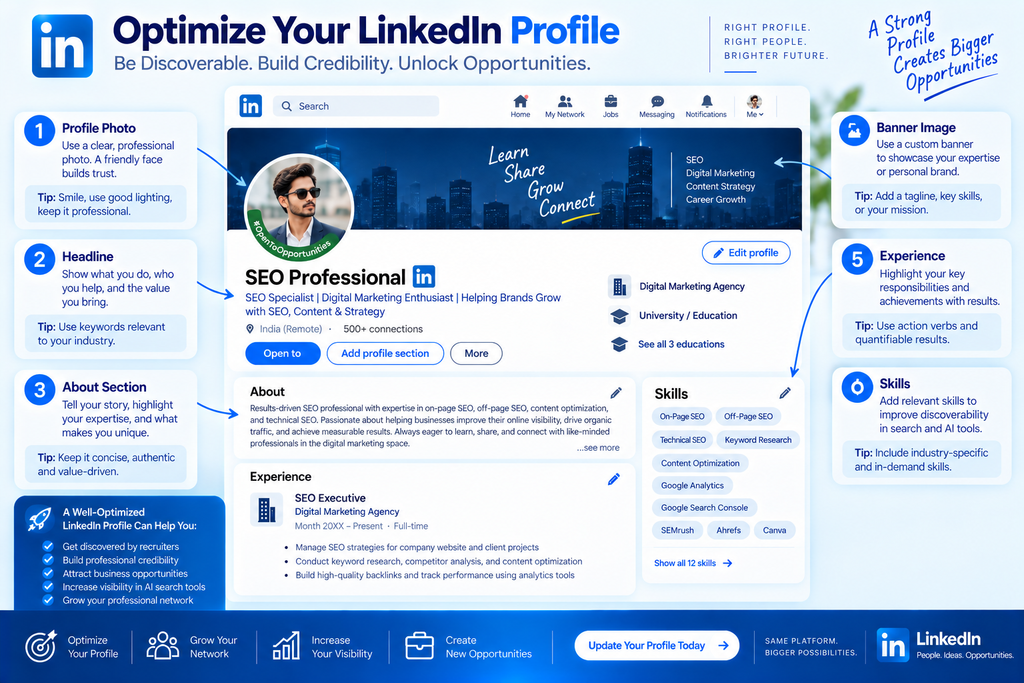
Individual Profile Optimization
Clear, Descriptive Headline
Your LinkedIn headline appears prominently and may influence how AI systems identify and reference your expertise. Instead of job titles alone, consider incorporating your specialty:
Instead of: Marketing Manager
Consider: Marketing Manager | B2B SaaS Content Strategy & SEO
Comprehensive About Section
Your About section should clearly articulate:
- Your professional focus and expertise areas
- Types of challenges you solve
- Your professional philosophy or approach
- Key achievements or specializations
- Topics you frequently address
Relevant Experience Sections
Ensure your experience section includes roles, responsibilities, and achievements that demonstrate your expertise domains. Use industry-specific terminology that aligns with queries your professional community asks.
Skills and Endorsements
Include skills relevant to your expertise areas. Skills help AI systems understand your professional domains and may influence how your content is associated with relevant queries.
Creator Mode Activity
If using LinkedIn Creator mode, ensure your content consistently addresses your chosen topic areas. This helps establish topical focus that AI systems may recognize.
Active Publishing
Regularly publish both feed posts and articles that demonstrate ongoing engagement with your expertise domains.
Company Page Optimization
Complete All Sections
Ensure your Company Page includes comprehensive information across all available sections-about us, products, services, industry, size, and specialties.
Use Industry Terminology
Incorporate relevant industry terminology in your Company Description and other sections. This helps AI systems associate your company with relevant query topics.
Maintain Current Information
Regularly update your Company Page as your offerings, leadership, or positioning evolve. Outdated information may confuse AI systems.
Publish Regular Updates
Use your Company Page for announcements, company news, and organizational content. This provides institutional context that may support AI citation.
How Companies Can Build an AI Visibility Strategy Using LinkedIn
Translating research findings into action requires a structured approach. The following 30-day strategy provides a starting framework for building LinkedIn presence oriented toward AI search visibility.
Week 1: Research and Positioning
Day 1–2: Audit Current Presence
Evaluate your existing LinkedIn Company Page and key individual profiles against the optimization checklist. Identify gaps in completeness, terminology, and positioning.
Day 3–4: Competitive Analysis
Identify LinkedIn profiles of competitors, industry leaders, and companies with strong AI visibility. Analyze their content themes, publishing frequency, and engagement patterns.
Day 5–7: Positioning Development
Define your core topic areas, key messages, and differentiation. Ensure consistent positioning across Company Page and individual profiles.
Week 2: Educational Content Development
Day 8–9: Content Strategy Development
Identify 8–10 educational topics aligned with your expertise and audience needs. These should address questions your professional community actually asks.
Day 10–12: Article Development
Create 2–3 long-form LinkedIn articles (500–1,500 words) addressing core educational topics. Focus on comprehensive coverage and original insights.
Day 13–14: Post Development
Create 4–5 feed posts (50–300 words) that distill article insights into concise, shareable formats.
Week 3: Thought Leadership and Original Research
Day 15–17: Original Content Creation
Develop at least one piece of original research, analysis, or data-driven content based on your professional experience or proprietary information.
Day 18–19: Expert Perspective Posts
Create 2–3 posts offering your perspective on industry news, trends, or developments. Focus on adding unique analysis rather than simple commentary.
Day 20–21: Personal Experience Content
Develop 1–2 posts sharing lessons learned, implementation experiences, or professional observations grounded in your first-hand experience.
Week 4: Repurposing and Analysis
Day 22–23: Content Repurposing
Adapt high-performing or high-potential content into additional formats-expand articles into series, distill articles into posts, convert posts into articles.
Day 24–26: Performance Review
Assess content performance across dimensions:
- Engagement metrics (reactions, comments, shares)
- Audience feedback and questions
- Follower growth patterns
- Content topics generating most interest
Day 27–30: Strategy Refinement
Based on Week 4 analysis, refine your content strategy:
- Identify highest-performing content types
- Adjust topic mix based on audience interest
- Plan content calendar for the following month
- Continue optimizing profiles based on learnings
Ongoing Considerations
This 30-day framework provides an initial structure, but sustainable AI visibility requires ongoing commitment. Key ongoing activities include:
- Maintaining consistent publishing frequency
- Continuing to develop original insights and research
- Regularly updating profiles and company information
- Monitoring content performance and iterating
- Engaging with comments and building community
LinkedIn + Website SEO + Digital PR: A Combined AI Visibility Strategy
While LinkedIn content showed strong citation patterns in the Semrush study, strategic brands recognize that AI search visibility requires a multi-channel approach. No single platform or content type dominates AI citations across all queries and contexts.
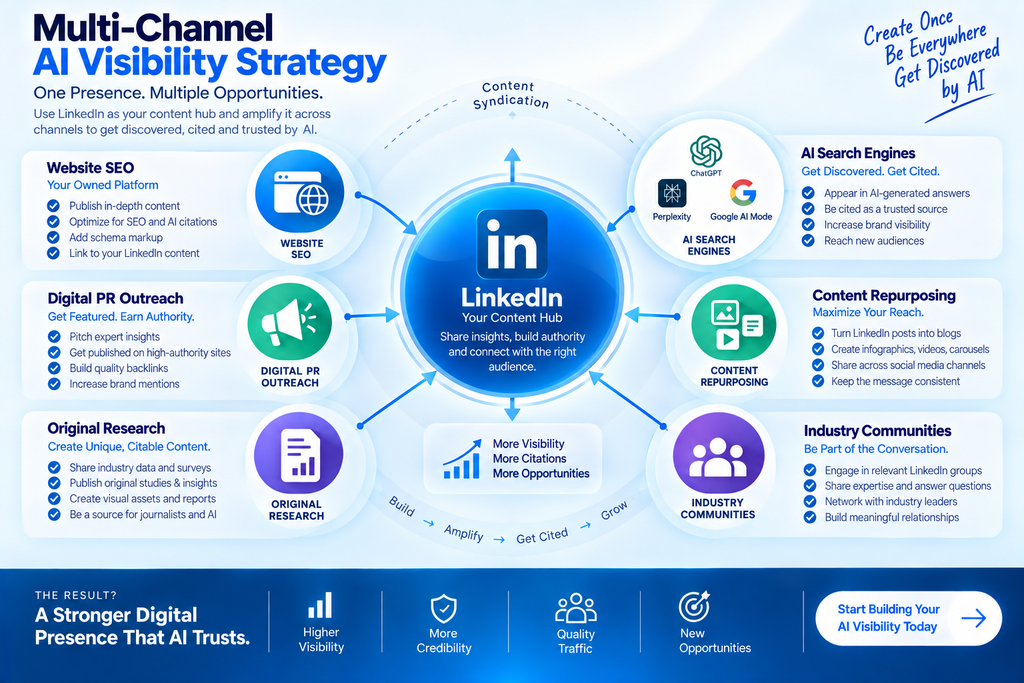
Building a Unified Visibility Ecosystem
A comprehensive AI visibility strategy integrates LinkedIn with complementary channels that reinforce and amplify your brand’s presence.
LinkedIn as a Content Distribution Hub
LinkedIn’s professional focus and strong citation rates make it valuable for thought leadership and expertise content. Use LinkedIn to distribute educational material, industry perspectives, and original insights.
Website Content as a Foundation
Your website provides comprehensive, controlled content that can address topics in greater depth than LinkedIn posts typically allow. Website content also provides a home base for information that LinkedIn alone cannot adequately cover.
How they work together:
- LinkedIn posts reference and link to comprehensive website resources
- Website content incorporates insights from LinkedIn thought leadership
- Both channels establish topical authority through consistent themes
Digital PR for Authority Building
Earned media coverage, guest contributions to industry publications, and participation in expert roundups build authority signals that may influence how AI systems evaluate your expertise.
How it works:
- Media mentions and citations create additional authoritative references
- Expert commentary in third-party publications demonstrates expertise
- Consistent coverage across multiple outlets builds authority perception
Original Research for Differentiation
Original research-surveys, studies, data analysis-provides unique content that AI systems may specifically reference when responding to queries about industry trends, benchmarks, or statistics.
How it works:
- Publish research findings on your website
- Share key insights via LinkedIn with links to full reports
- Pursue digital PR coverage of research findings
- Research becomes a resource AI systems reference for related queries
Author Profiles and Expert Positioning
Consistent expert positioning across LinkedIn, your website, guest contributions, and media appearances helps AI systems associate specific individuals with particular expertise domains.
How it works:
- LinkedIn profiles emphasize expertise areas
- Website author pages establish author credentials
- Guest contributions and media appearances build external authority
- Consistent terminology and focus across all touchpoints builds clear expertise associations
Creating Consistent Brand Footprints
AI systems develop understanding of entities-companies, products, individuals, and concepts-by synthesizing information across multiple sources. Inconsistencies in how your brand is described across different platforms may confuse these systems.
Ensure consistency in:
- Company descriptions and positioning
- Product and service terminology
- Founder and executive bios
- Key statistics and claims
- Industry classifications and focus areas
The goal is creating a clear, consistent entity footprint that AI systems can reliably reference when generating responses about your brand.
How to Create Content for AI Citations Without Writing for AI
A critical distinction separates effective AI visibility strategy from ineffective AI-focused writing. The goal is creating genuinely useful content that happens to align with AI citation patterns-not creating content specifically optimized for AI systems.
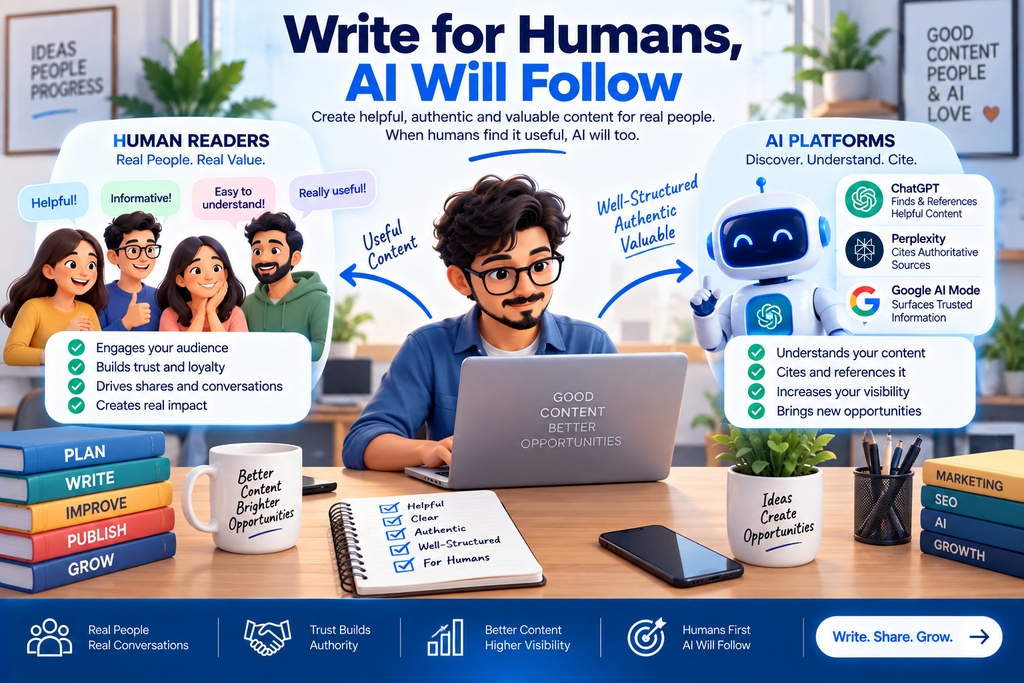
Principles for Human-First Content Creation
Write for Your Audience First
Your primary audience remains human readers-potential clients, industry peers, professional contacts. Content that genuinely helps humans will be more valuable than content engineered for AI systems.
Answer Real Questions
Base your content on questions your audience actually asks-not imagined queries designed to attract AI attention. Real questions reflect genuine information needs that AI systems also aim to address.
Provide Evidence for Claims
Support your assertions with data, citations, examples, or logical reasoning. Well-supported content establishes credibility with both human readers and AI systems evaluating source reliability.
Use Original Expertise
Your unique perspective, experience, and insights provide value that generic content cannot match. Share what you actually know and have actually done rather than producing rehashed conventional wisdom.
Avoid Keyword Stuffing
Incorporate relevant terminology naturally rather than forcing keywords into content. Content that reads naturally serves human readers better and avoids patterns that may signal low-quality optimization attempts.
Build Topical Authority
Consistently publishing quality content within specific domains builds recognized expertise over time. This authority benefits both human readers seeking expert guidance and AI systems seeking authoritative sources.
Common Mistakes That Can Reduce Your AI Visibility
Understanding what reduces AI visibility helps you avoid pitfalls that might undermine your efforts.
Content Quality Mistakes
Only Promotional Content
Content focused exclusively on product features, service offerings, or company news provides limited value for AI systems seeking to answer informational queries. Balance promotional content with educational, helpful material.
Copying Other Creators
Resharing others’ content without original insight provides minimal unique value. AI systems may prefer original sources over secondary reshares.
Excessive Reposting
Even when resharing relevant content, doing so without adding your perspective reduces the originality that drives citation.
Positioning Mistakes
Vague Positioning
Generic descriptions that could apply to many competitors fail to establish clear differentiation or expertise focus.
Inconsistent Terminology
Using different terms for the same concepts across different posts or platforms creates confusion for AI systems parsing your content.
Inconsistent Publishing
Extended gaps in publishing activity may signal reduced engagement or outdated expertise to AI systems evaluating source credibility.
Authority Mistakes
No Original Expertise
Publishing content that merely summarizes widely-known information without adding original insight fails to establish the expertise that drives citation.
Unsupported Claims
Making claims without evidence or citations reduces content credibility and may cause AI systems to prefer better-supported sources.
Fake Statistics
Fabricating data or misrepresenting sources destroys credibility and may result in AI systems disregarding your content entirely.
Presence Mistakes
Ignoring Company Page
A neglected Company Page misses opportunities for institutional visibility, particularly on platforms like Perplexity that favor company sources.
Ignoring Employee Thought Leadership
Focusing only on Company Page while neglecting employee profiles misses the personal expertise visibility available on platforms like ChatGPT Search and Google AI Mode.
Publishing Without Clear Audience
Content without a defined audience often lacks the focus and specificity that makes it valuable for addressing particular queries.
AI Search Visibility Checklist
Use this checklist to evaluate and track your AI visibility strategy:
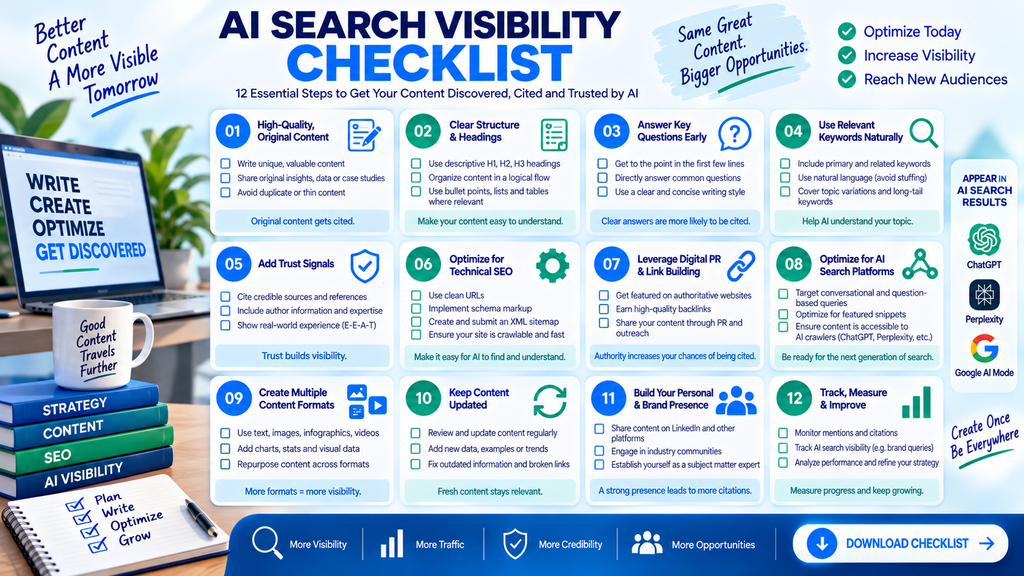
Profile Optimization
- Clear, descriptive LinkedIn headline with expertise focus
- Comprehensive About section articulating expertise areas
- Complete experience section with industry terminology
- Relevant skills listed and endorsed
- Active publishing schedule maintained
- LinkedIn Company Page fully completed
- Consistent terminology across all profiles
- Current information maintained
Content Development
- Original insights prioritized over resharing
- Educational content addresses real audience questions
- First-hand experience incorporated into posts
- Original research or data-driven content created
- Articles of 500–2,000 words developed for key topics
- Concise posts of 50–300 words support main content
- Industry perspectives and commentary provided
- Practical how-to content shared
Strategic Elements
- Consistent publishing schedule maintained (5+ posts monthly)
- Content topics aligned with audience needs
- Clear positioning established across all content
- Links to website resources included where relevant
- Factual accuracy verified across all claims
- Complex topics explained clearly
- Content updated as information evolves
Multi-Channel Integration
- Website content supports LinkedIn themes
- LinkedIn content references website resources
- Digital PR activities building external authority
- Consistent brand information across all channels
- Original research distributed across multiple formats
- Expert positioning consistent across platforms
Conclusion
The transformation of search toward AI-generated answers represents a fundamental shift in how brands achieve digital visibility. The Semrush study’s analysis of 89,000 LinkedIn citations provides valuable insights into how these emerging systems actually interact with professional content-offering evidence-based guidance for brands seeking to establish presence within this evolving landscape.
Several core findings emerge from the research. LinkedIn demonstrates significant citation potential, ranking second among sources in the analyzed dataset and appearing in approximately 11% of AI responses. Original, educational content-particularly material grounded in first-hand expertise-shows stronger citation patterns than reshared content or purely promotional material. Both institutional presence through Company Pages and personal thought leadership through individual profiles contribute to visibility, with different AI platforms showing varying preferences for each.
For EdTech brands specifically, these findings align naturally with content strengths. Educational content, technical expertise, implementation insights, and industry perspective represent areas where EdTech organizations can establish authoritative presence that AI systems may find worth citing. The combination of LinkedIn presence with supporting website content and digital PR activities creates a robust visibility ecosystem that positions brands favorably within AI-generated responses.
Yet maintaining perspective matters. The study reveals patterns and correlations-not guarantees. Citation in AI responses depends on numerous factors, including query specificity, content relevance, competitive landscape, and platform-specific selection criteria that remain imperfectly understood. No optimization technique can promise AI citation, and brands should approach AI visibility as one component of comprehensive digital strategy rather than a singular objective.
The practical path forward involves creating genuinely valuable content that serves real professional needs, establishing clear expertise positioning through consistent publishing, developing presence across both institutional and personal profiles, and maintaining accurate, current information across all digital touchpoints. These fundamentals serve both human audiences and AI systems-making them sound strategy regardless of how AI search evolves.
As AI search continues developing, brands that build authentic expertise, maintain consistent presence, and focus on genuine value creation will position themselves advantageously for whatever visibility landscape emerges next.
Read Also: ChatGPT Resume: How to Use ChatGPT to Write a Resume (2026 Guide)
Frequently Asked Questions
What is AI search visibility?
AI search visibility refers to how frequently and accurately your brand, content, or expertise appears within AI-generated responses from systems like ChatGPT Search, Google AI Mode, and Perplexity. Unlike traditional search rankings measured by position in results, AI visibility encompasses both citation as a source and accurate representation within synthesized answers.
Why does LinkedIn matter for AI search?
According to Semrush’s analysis, LinkedIn ranked second among citation sources across the 89,000 LinkedIn URLs examined. The platform’s emphasis on professional expertise, educational content, and first-hand experience aligns with what AI search systems seek when generating responses. For B2B brands and professional service providers, LinkedIn represents a particularly important visibility channel.
Does ChatGPT cite LinkedIn posts?
Yes. The Semrush study found that LinkedIn posts appeared in AI-generated responses across all platforms examined, including ChatGPT Search. Individual creators accounted for 59% of LinkedIn citations on ChatGPT Search specifically, suggesting personal thought leadership content performs particularly well on this platform.
How can a company get cited by AI search engines?
While no strategy guarantees AI citation, the Semrush research suggests several correlating factors: publishing original, educational content; maintaining consistent publishing activity; developing clear expertise positioning; ensuring content accuracy; and building both Company Page and individual profile presence. Focus on creating genuinely useful content that addresses real professional questions.
Does follower count affect AI visibility?
The study found nearly half of cited post authors had 2,000+ followers, but follower count isn’t the sole determining factor. Content relevance, expertise clarity, and originality likely matter more than audience size. Small-audience creators with highly specialized expertise may achieve citation for specific queries where their content is particularly relevant.
Are LinkedIn articles better than LinkedIn posts?
Both formats show citation patterns in the study. Articles of 500–2,000 words and feed posts of 50–299 words both appeared frequently among cited content. Use articles for comprehensive treatment of complex topics; use posts for ongoing thought leadership, timely observations, and concise insights. A combined approach leveraging both formats provides optimal coverage.
How often should businesses post on LinkedIn?
The study found approximately three-quarters of cited post authors were frequent posters (5+ posts in four weeks). This suggests regular publishing activity correlates with citation frequency. A sustainable publishing rhythm-prioritizing consistency over volume-builds the ongoing presence that may support AI visibility over time.
Should companies focus on their Company Page or employee profiles?
Both matter, but for different purposes and potentially different platforms. The study found Company Pages accounted for 59% of LinkedIn citations on Perplexity, while individual profiles accounted for 59% of citations on ChatGPT Search and Google AI Mode. Strategic brands develop both institutional presence (Company Page) and personal thought leadership (employee profiles).
Does original content improve AI visibility?
The study found approximately 95% of cited posts were original content, while reshares represented only about 5% of citations. This strong correlation suggests original content-including personal insights, first-hand experience, and proprietary research-may be preferred by AI systems over reshared material.
How is AI visibility different from traditional SEO?
Traditional SEO focuses on ranking position in search engine results pages, with success measured by clicks and traffic from organic listings. AI visibility focuses on being cited as a source within AI-generated responses, with success measured by presence and accuracy within synthesized answers. Traditional SEO drives traffic to owned properties; AI visibility influences how AI systems represent your brand within conversational interfaces.