
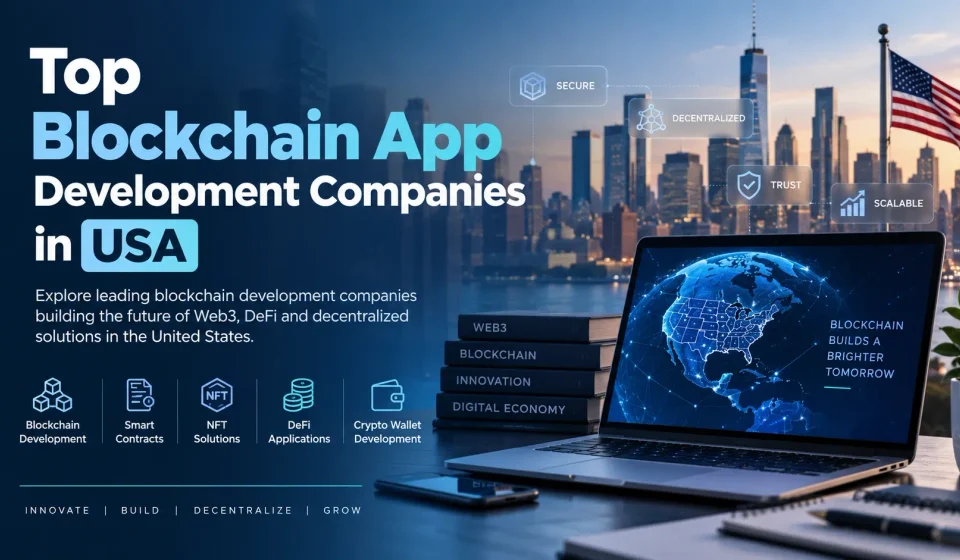

Blockchain app development is the process of designing, building, and deploying software that runs on a decentralized, distributed ledger rather than a single centralized server. Instead of one company controlling a database, a blockchain application records data across a network of computers, making it transparent, tamper-resistant, and verifiable by anyone with access to the ledger.
Businesses are investing in blockchain applications because the technology solves problems that traditional software struggles with: proving ownership without a middleman, settling payments across borders in minutes instead of days, tracking goods through a supply chain with an unchangeable audit trail, and giving users direct control over their digital identity and assets. Banks, healthcare providers, logistics companies, and retailers are all experimenting with blockchain to cut costs, reduce fraud, and build trust with customers and partners.
At the center of most blockchain applications are a few core building blocks. Smart contracts are self-executing pieces of code that automatically enforce the terms of an agreement once conditions are met, removing the need for a third party to arbitrate. Web3 refers to the broader shift toward decentralized, user-owned internet applications built on blockchain rails. DeFi (decentralized finance) uses these same rails to recreate lending, trading, and payments without a bank in the middle. Tokenization converts real-world or digital assets into blockchain-based tokens that can be issued, transferred, and traded. And wallets and decentralized applications (dApps) are the interfaces everyday users rely on to interact with all of this technology.
Because blockchain development touches cryptography, distributed systems, security auditing, and regulatory compliance all at once, the margin for error is high. A single flaw in a smart contract can be exploited permanently, since blockchain transactions generally cannot be reversed. This is why selecting an experienced blockchain app development company — one with a demonstrated track record in smart contract security, Web3 architecture, and enterprise-grade delivery — matters as much as the idea itself. This guide looks at how the U.S. blockchain market is growing and profiles ten notable blockchain app development companies in USA that businesses can consider when evaluating a development partner.
Blockchain Market Statistics and Growth in 2026
According to Fortune Business Insights, the global blockchain technology market was valued at USD 31.18 billion in 2025 and is projected to grow to USD 47.96 billion in 2026, before reaching USD 577.36 billion by 2034 — a compound annual growth rate (CAGR) of 36.50% across the 2026–2034 forecast period.
Fortune Business Insights also reports that North America dominated the blockchain technology market with a 43.80% share in 2025, which translates to a regional market size of approximately USD 13.65 billion that year. Within North America, the U.S. blockchain market specifically is projected to reach approximately USD 14.26 billion in 2026, according to the same source. This regional dominance is one reason so many established and emerging blockchain development services providers are headquartered in the United States.
Market Stats Table
| Metric | Statistics |
|---|---|
| Global Blockchain Market Size (2025) | USD 31.18 Billion |
| Estimated Market Size (2026) | USD 47.96 Billion |
| Projected Market Size (2034) | USD 577.36 Billion |
| CAGR (2026–2034) | 36.50% |
| North America Share (2025) | 43.80% |
| North America Market Size (2025) | Approximately USD 13.65 Billion |
| U.S. Market Projection (2026) | Approximately USD 14.26 Billion |
For additional context, Grand View Research also publishes independent sizing and forecasts for the blockchain technology market. Because different research firms use different market definitions, segmentation, and forecasting methodologies, their published figures are not directly comparable to Fortune Business Insights’ numbers, and readers should treat each estimate as coming from its own methodology rather than as interchangeable data points.
Top Blockchain App Development Companies in USA
The blockchain app development companies in USA below are presented as notable options for startups, enterprises, and product teams to research further – not as a definitive or scored ranking. Details are drawn from each company’s public information and official website wherever possible. If you’re comparing regional options as well, our guide to the top mobile app development companies in Dubai follows a similar side-by-side approach.
| Company | Location | Core Services | Specialization | Best For |
|---|---|---|---|---|
| ConsenSys | Fort Worth, TX | Ethereum software, MetaMask, Infura, Web3 infrastructure | Ethereum ecosystem & Web3 tooling | Enterprises and developers building on Ethereum |
| IBM Blockchain | Armonk, NY | Enterprise blockchain networks on Hyperledger Fabric | Permissioned enterprise blockchain | Large enterprises needing regulated, permissioned networks |
| LeewayHertz | San Francisco, CA | Blockchain consulting, smart contracts, dApp development | Multi-chain enterprise & startup solutions | Startups and enterprises needing custom dApps |
| PixelPlex | New York, NY | Blockchain consulting, tokenization, NFT & DeFi development | Fintech and enterprise blockchain platforms | Fintech, retail, and healthcare blockchain projects |
| ScienceSoft | McKinney, TX | Blockchain consulting, architecture design, PoC/MVP delivery | Regulated-industry blockchain outsourcing | Complex enterprise blockchain initiatives |
| Cubix | West Palm Beach, FL | Enterprise blockchain, dApps, smart contracts, tokenization | Enterprise blockchain & protocol development | Enterprises needing full-cycle blockchain builds |
| Codezeros | Montgomery, AL | Blockchain consulting, smart contracts, tokenomics, DLT | Blockchain consulting for multiple industries | Startups needing whitepaper-to-launch guidance |
| SpaceDev | Miami, FL | Smart contracts, DeFi protocols, crypto trading platforms | Web3 product engineering | Fintech and gaming Web3 products |
| Boosty Labs | New York, NY | Blockchain, fintech, and cloud engineering | Digital asset infrastructure & Web3 protocols | Crypto-native companies needing engineering teams |
| Pharos Production | Las Vegas, NV | Blockchain, DeFi, KYC systems, fintech platforms | Blockchain and high-load fintech systems | Startups needing end-to-end product builds |
1. ConsenSys
Overview: ConsenSys is one of the most established names in the Ethereum ecosystem, founded in 2014 by Ethereum co-founder Joseph Lubin.
Location: Fort Worth, Texas, United States.
Services: Ethereum-based software development, Web3 developer tooling, enterprise blockchain solutions, and smart contract security auditing through its Diligence practice.
Technologies/Platforms: Ethereum, along with its own products such as MetaMask (a widely used Web3 wallet), Infura (blockchain infrastructure and node access), and the Linea Layer 2 network.
Specialization: Ethereum-centric Web3 infrastructure, wallets, and developer tools.
Industries Served: Financial institutions, government bodies, and technology companies building on Ethereum.
Notable Capabilities: Its MetaMask wallet and Infura infrastructure are foundational pieces of Web3 tooling used broadly across the industry.
Official Website: consensys.io
Summary: For businesses building specifically on Ethereum or needing deep Web3 infrastructure expertise, ConsenSys is one of the most recognized names in the space.
2. IBM Blockchain
Overview: IBM Blockchain is the enterprise blockchain arm of IBM, one of the world’s largest technology companies, built around the open-source Hyperledger Fabric framework.
Location: Armonk, New York, United States (IBM’s global headquarters).
Services: Enterprise blockchain network design, deployment, and management on IBM Cloud, along with blockchain consulting for regulated industries.
Technologies/Platforms: Hyperledger Fabric, a permissioned blockchain framework maintained by the Linux Foundation’s Hyperledger consortium.
Specialization: Permissioned, enterprise-grade blockchain networks designed for regulated environments that require high transaction throughput and strict access control.
Industries Served: Banking and financial services, supply chain and logistics, government, and healthcare.
Notable Capabilities: IBM’s blockchain services are built on decades of enterprise transaction-processing experience and IBM’s broader cloud and security infrastructure.
Official Website: ibm.com
Summary: IBM Blockchain is best suited to large enterprises and institutions that need a permissioned, highly governed blockchain network rather than a public, consumer-facing dApp.
3. LeewayHertz
Overview: LeewayHertz is a technology development company founded in 2007 that has offered blockchain development services alongside its broader software and, more recently, generative AI practice.
Location: San Francisco, California, United States (with additional delivery offices internationally).
Services: Blockchain consulting, smart contract development and auditing, decentralized application (dApp) development, and blockchain platform selection guidance.
Technologies/Platforms: Ethereum, Hyperledger, Corda, and Hedera Hashgraph.
Specialization: Building minimum viable products (MVPs) and migrating existing applications onto distributed ledger technology for both startups and enterprises.
Industries Served: Manufacturing, logistics, travel, consumer electronics, and pharmaceutical supply chain, among others.
Notable Capabilities: Experience spanning multiple blockchain platforms rather than a single-chain focus, which can suit businesses still evaluating which network fits their use case.
Official Website: leewayhertz.com
Summary: LeewayHertz is a fit for organizations that want blockchain consulting plus development under one roof, with flexibility across several underlying platforms.
4. PixelPlex
Overview: PixelPlex is a New York-based technology company, founded in 2007, offering blockchain, Web3, and data-focused software development services.
Location: New York, New York, United States, with additional offices in London, Lisbon, and Dubai.
Services: Blockchain consulting, smart contract development and audits, tokenization, cryptocurrency exchange development, and NFT marketplace development.
Technologies/Platforms: Ethereum, Solana, Polkadot, Cardano, and other smart contract platforms.
Specialization: End-to-end blockchain and Web3 platforms for fintech and enterprise clients, alongside its broader work in AI and big data.
Industries Served: Fintech and banking, retail and e-commerce, supply chain and logistics, and healthcare.
Notable Capabilities: A broad service catalog that spans blockchain consulting, smart contract auditing, and tokenization, useful for clients who want a single partner across the product lifecycle.
Official Website: pixelplex.io
Summary: PixelPlex suits businesses — especially in fintech — looking for a full-service blockchain and Web3 development partner with in-house consulting and audit capabilities.
5. ScienceSoft
Overview: ScienceSoft is a long-standing IT consulting and software engineering company, in business since 1989, offering blockchain development services to enterprises and startups.
Location: McKinney, Texas, United States, with an additional U.S. office in Atlanta, Georgia, and offices across Europe and the Gulf Cooperation Council region.
Services: Blockchain feasibility studies, compliance consulting, blockchain architecture design, proof-of-concept (PoC) and MVP delivery, cross-chain integration, and security testing.
Technologies/Platforms: Ethereum, Hyperledger Fabric, and other enterprise-grade blockchain frameworks.
Specialization: Full outsourcing of complex blockchain development initiatives that require structured project and risk management.
Industries Served: Banking, financial services and insurance (BFSI), healthcare, manufacturing, retail, logistics, and real estate.
Notable Capabilities: Decades of broader IT consulting experience applied specifically to blockchain feasibility and architecture work, which can help de-risk large enterprise initiatives.
Official Website: scnsoft.com
Summary: ScienceSoft is well suited to enterprises that want rigorous project governance and risk management layered onto their blockchain development engagement.
6. Cubix
Overview: Cubix is a software and mobile app development company founded in 2008 that has expanded into enterprise blockchain and decentralized application development.
Location: West Palm Beach, Florida, United States, with additional delivery locations internationally.
Services: Enterprise blockchain development, decentralized application (dApp) development, blockchain protocol development, smart contract development, and asset tokenization.
Technologies/Platforms: Custom consensus algorithms and smart contract platforms tailored to client use cases.
Specialization: Enterprise blockchain products that integrate with existing legacy systems.
Industries Served: A broad mix of enterprise clients across mobile, software, and emerging technology projects.
Notable Capabilities: Full-cycle software development experience — spanning mobile, web, and enterprise software — applied to blockchain-specific builds.
Official Website: cubix.co
Summary: Cubix is a reasonable option for businesses that want a broader full-cycle software development partner that also has dedicated blockchain and dApp capabilities.
7. Codezeros
Overview: Codezeros is a blockchain consulting and development company founded in 2015 that positions itself as focused exclusively on blockchain and emerging technology projects.
Location: Montgomery, Alabama, United States.
Services: Blockchain consulting, smart contract creation, tokenomics design, whitepaper and pitch deck support, and new distributed ledger technology (DLT) solution development.
Technologies/Platforms: Smart contract and DLT platforms suited to early-stage token and blockchain launches.
Specialization: Guiding startups from concept and whitepaper through to a working blockchain solution.
Industries Served: Banking, finance, healthcare, insurance, supply chain, and enterprise identity infrastructure.
Notable Capabilities: A narrower, blockchain-only focus rather than a generalist software development practice, along with early-stage advisory services like tokenomics and pitch deck support.
Official Website: codezeros.com
Summary: Codezeros can be a fit for early-stage founders who need help shaping a token model and go-to-market story alongside the technical build.
8. SpaceDev
Overview: SpaceDev is a blockchain and Web3 development company founded in 2017 that builds products for fintech, gaming, and enterprise clients.
Location: Miami, Florida, United States, with nearshore engineering teams in Latin America.
Services: Smart contract development and audits, DeFi protocol and dApp development, tokenization of real-world assets, crypto trading platform development, and crypto wallet development.
Technologies/Platforms: Solidity and Rust-based smart contract development across multiple chains.
Specialization: Web3 product engineering for fintech and gaming companies operating on U.S. time zones.
Industries Served: Fintech, gaming, and energy-sector clients working with blockchain infrastructure.
Notable Capabilities: A nearshore delivery model designed to keep engineering teams working in overlapping U.S. business hours.
Official Website: spacedev.io
Summary: SpaceDev fits startups and mid-market companies that want Web3 engineering support with close time zone alignment to U.S. teams.
9. Boosty Labs
Overview: Boosty Labs is a blockchain, fintech, and cloud engineering company founded in 2017 that serves clients across the crypto and Web3 space.
Location: New York, New York, United States.
Services: Blockchain development, digital asset infrastructure, AI-powered product development, and payment platform engineering.
Technologies/Platforms: Multi-chain development experience across major Web3 protocols and infrastructure tools.
Specialization: Engineering teams and staff augmentation for blockchain, fintech, and cloud-native products.
Industries Served: Cryptocurrency, blockchain infrastructure, and fintech companies.
Notable Capabilities: A remote-first engineering team model that supports both dedicated project delivery and team augmentation for existing blockchain companies.
Official Website: boostylabs.com
Summary: Boosty Labs suits crypto-native companies that need to extend their own engineering capacity with experienced blockchain developers.
10. Pharos Production
Overview: Pharos Production is a software development company established in 2013 that specializes in blockchain and high-load fintech systems.
Location: Las Vegas, Nevada, United States, with a development hub in Kyiv, Ukraine.
Services: Blockchain development, DeFi solutions, KYC-on-blockchain systems, cryptocurrency wallet development, and high-load fintech platform engineering.
Technologies/Platforms: Solidity-based smart contract development alongside Elixir, Erlang, and Scala for high-load backend systems.
Specialization: Blockchain-based identity (KYC) systems and fintech platforms that need to handle high transaction volume.
Industries Served: Finance, banking, insurance, and fintech startups.
Notable Capabilities: A combined focus on blockchain and high-throughput backend engineering, which suits products that need both decentralized trust and heavy transaction loads.
Official Website: pharosproduction.com
Summary: Pharos Production is worth considering for fintech and DeFi startups that need a partner comfortable with both blockchain and demanding backend performance requirements.
How We Selected These Blockchain Development Companies
This list was compiled using publicly available information rather than a proprietary scoring system. The following factors were considered for each company:
- Blockchain development capabilities: Whether the company offers core blockchain services such as smart contract development, dApp development, or blockchain consulting.
- Technical expertise: Publicly documented experience with recognized blockchain platforms such as Ethereum, Hyperledger, or Solana.
- Portfolio and publicly documented work: Evidence of blockchain projects described on the company’s own website or in independent industry coverage.
- Smart contract capabilities: Whether smart contract development and/or auditing is part of the company’s offering.
- Web3 expertise: Experience with decentralized applications, wallets, and Web3 infrastructure.
- Enterprise blockchain experience: For companies serving larger organizations, evidence of permissioned or enterprise-grade blockchain work.
- Industry coverage: The range of sectors (fintech, healthcare, supply chain, and so on) a company has publicly served.
- Geographic presence: Confirmed U.S. headquarters or a significant U.S. office presence.
- Publicly available company information: Availability of verifiable details on the company’s official website or established business directories.
This is an informational list of notable blockchain application development companies to consider, not an objectively verified or scored ranking. Businesses should conduct their own due diligence — including direct conversations, reference checks, and a review of recent project work — before selecting a partner.
Popular Blockchain Platforms for App Development
Choosing the right underlying blockchain platform is one of the most consequential decisions in any blockchain app project, since it shapes cost, speed, security assumptions, and the pool of available developers.
- Ethereum is the most established smart contract platform and has the largest developer ecosystem, tooling library, and DeFi/NFT infrastructure. It is a common choice for projects that prioritize security, decentralization, and compatibility with existing Web3 tools, though transaction costs can be higher than on newer chains.
- Polygon is a Layer 2 scaling network built to work alongside Ethereum, offering lower fees and faster transactions while remaining compatible with Ethereum’s tooling. It’s often chosen by teams that want Ethereum-level security assumptions with more affordable transaction costs.
- Solana is a high-throughput blockchain designed for very fast, low-cost transactions, making it popular for consumer-facing applications, gaming, and high-frequency trading platforms.
- BNB Chain is a smart contract platform associated with the Binance ecosystem, commonly used for DeFi applications and token launches that want lower fees than Ethereum mainnet.
- Avalanche uses a distinct consensus mechanism to offer fast finality and the ability to launch custom, application-specific blockchains (subnets), which appeals to enterprises and projects with specialized throughput needs.
- Hyperledger (particularly Hyperledger Fabric) is a permissioned blockchain framework used primarily in enterprise settings — supply chain, banking, healthcare — where participants are known and access needs to be tightly controlled, unlike the public, permissionless nature of Ethereum or Solana.
Some of the companies profiled above have publicly documented expertise with specific platforms: for example, ConsenSys is closely tied to the Ethereum ecosystem, and IBM Blockchain’s enterprise offering is built on Hyperledger Fabric. For other platform-company pairings, it is worth confirming current expertise directly with the vendor, since blockchain platform specializations can shift over time.
Blockchain Development Services
Companies offering blockchain development services typically provide some combination of the following:
- Custom blockchain development: Building a blockchain network or protocol tailored to a specific business use case, rather than using an off-the-shelf chain.
- dApp development: Building decentralized applications that interact with smart contracts on a public or permissioned blockchain.
- Smart contract development: Writing, testing, and deploying the self-executing code that governs on-chain agreements.
- Crypto wallet development: Building software or hardware wallets that let users store, send, and receive digital assets.
- NFT marketplace development: Building platforms where users can mint, buy, and sell non-fungible tokens.
- DeFi application development: Building decentralized lending, trading, staking, or yield-generating platforms.
- Token development: Creating fungible tokens (such as ERC-20 tokens) for a specific project or ecosystem.
- Tokenization solutions: Representing real-world assets — real estate, securities, commodities — as blockchain-based tokens.
- Enterprise blockchain solutions: Building permissioned networks for supply chain tracking, identity verification, or interbank settlement.
- Blockchain consulting: Advising on feasibility, platform selection, regulatory considerations, and architecture before development begins.
- Blockchain integration: Connecting a blockchain solution with existing enterprise systems such as ERP, CRM, or payment infrastructure.
- Blockchain security and auditing: Reviewing smart contracts and blockchain architecture for vulnerabilities before and after launch.
- Web3 development: Building the broader decentralized web experience, including wallet connections, decentralized identity, and on-chain data access.
How Much Does Blockchain App Development Cost in the USA?
Blockchain app development costs vary widely, and there is no single fixed price that applies across projects. Several factors influence the final cost:
- Application complexity: A simple token or basic dApp costs far less to build than a full DeFi protocol or multi-chain enterprise platform.
- Blockchain network: Developing on a public chain like Ethereum, a Layer 2 like Polygon, or a permissioned framework like Hyperledger Fabric each carries different development and infrastructure costs.
- Smart contract complexity: More intricate contract logic requires more development time and more extensive testing and auditing.
- Wallet integration: Supporting multiple wallet providers and chains adds development and QA overhead.
- UI/UX: Custom, polished interfaces for end users take longer to design and build than a minimal functional front end.
- Backend infrastructure: Off-chain servers, databases, and APIs that support the on-chain components add to overall cost.
- APIs: Integrating third-party data feeds, price oracles, or payment processors increases scope.
- Security audits: Independent smart contract audits are a recommended (and often expected) cost given the irreversible nature of blockchain transactions.
- Third-party integrations: Connecting to exchanges, custodians, or compliance providers adds engineering time.
- Testing: Blockchain applications typically require more extensive testing than conventional software, including testnet deployments before mainnet launch.
- Maintenance: Ongoing monitoring, upgrades, and support after launch are a recurring cost, not a one-time expense.
Because published hourly rates and project minimums vary by vendor and change over time, prospective buyers should request a scoped estimate directly from any blockchain development company they are evaluating rather than relying on generic industry averages. Development cost isn’t limited to the build itself, either — once your blockchain app is ready to ship, budget for launch expenses too; our breakdown of how much it costs to publish an app on the Play Store and App Store covers those fees separately.
How to Choose the Right Blockchain App Development Company
- Technical expertise: Confirm the team has hands-on experience with the specific blockchain platform your project needs.
- Portfolio: Review publicly documented case studies or projects, and ask for references where possible.
- Blockchain platform expertise: Make sure the company’s platform experience (Ethereum, Solana, Hyperledger, and so on) matches your project’s requirements.
- Security practices: Ask how the company approaches smart contract auditing and vulnerability testing.
- Smart contract expertise: Confirm direct experience writing and deploying smart contracts in the language your target chain uses (such as Solidity or Rust).
- Scalability: Discuss how the proposed architecture will handle growth in users or transaction volume.
- Development methodology: Understand whether the company uses agile sprints, fixed-scope delivery, or another approach, and whether that fits your timeline.
- Communication: Evaluate responsiveness and clarity during the sales and scoping process, since this often reflects how the engagement will run.
- Pricing transparency: Look for a clear, itemized estimate rather than a vague lump-sum quote.
- Post-launch support: Ask what happens after launch — bug fixes, monitoring, and upgrade paths should be defined up front.
- Maintenance: Clarify ongoing maintenance costs and response times before signing a contract.
Benefits of Hiring a Blockchain Development Company in the USA
- Access to specialized developers: Blockchain engineering — particularly smart contract development — requires skills that are still relatively scarce compared to general software development.
- Enterprise development capabilities: Established firms often bring project management and compliance experience suited to regulated industries.
- Blockchain security expertise: Dedicated blockchain teams are more likely to have experience identifying the specific vulnerability patterns common to smart contracts.
- Web3 expertise: Companies focused on blockchain typically stay current with fast-moving Web3 tooling, wallets, and standards.
- Advanced infrastructure: Many blockchain development companies maintain relationships with cloud providers, node infrastructure services, and auditing firms.
- Business communication: Working with a U.S.-based company can simplify time zone alignment, contracting, and regulatory conversations for U.S. businesses.
- Long-term technical support: An established company is more likely to be available for ongoing maintenance and upgrades years after initial launch.
Conclusion
The blockchain market opportunity in the United States is substantial: according to Fortune Business Insights, the U.S. blockchain market is projected to reach approximately USD 14.26 billion in 2026, within a global blockchain technology market expected to grow at a 36.50% CAGR through 2034. That growth is being driven by real business needs — faster settlement, tamper-resistant record-keeping, and new models for ownership through tokenization, DeFi, and Web3 applications.
Choosing among the many blockchain app development companies in USA is not a one-size-fits-all decision. The right blockchain development company for a fintech startup building a DeFi protocol on Solana looks very different from the right partner for an enterprise building a permissioned supply chain network on Hyperledger Fabric. Businesses evaluating a partner should compare companies against their own project requirements, technical needs, budget, timeline, and industry — using the criteria and company profiles in this guide as a starting point for further due diligence, direct conversations, and reference checks before making a final decision.
Frequently Asked Questions
1. What is a blockchain app development company?
A blockchain app development company is a technology firm that designs, builds, and often maintains applications running on blockchain technology — including smart contracts, decentralized applications (dApps), crypto wallets, and enterprise blockchain networks.
2. How much does blockchain app development cost in the USA?
Costs vary significantly based on application complexity, the blockchain network used, smart contract complexity, and factors like security audits and third-party integrations. There is no single fixed price, so it’s best to request a scoped estimate from a development partner based on your specific requirements.
3. How long does it take to develop a blockchain application?
Timelines depend heavily on project scope — a simple token or MVP dApp can take a matter of weeks, while a full enterprise blockchain platform or complex DeFi protocol can take several months or longer, particularly once security auditing and testing are factored in.
4. Which blockchain is best for app development?
There is no single “best” blockchain — the right choice depends on the use case. Ethereum offers the largest ecosystem and strong security assumptions, Solana and Polygon offer faster and cheaper transactions, Avalanche supports custom application-specific chains, and Hyperledger Fabric is designed for permissioned enterprise use cases.
5. What services do blockchain development companies provide?
Common services include blockchain consulting, custom blockchain development, smart contract development and auditing, dApp development, crypto wallet development, NFT marketplace development, DeFi application development, tokenization, and enterprise blockchain integration.
6. How do I choose a blockchain development company?
Evaluate technical expertise on your target platform, review the company’s portfolio and security practices, confirm their development methodology and communication style, and clarify pricing and post-launch support before signing an agreement.
7. Is blockchain app development suitable for startups?
Yes. Many blockchain development companies work with early-stage startups on MVPs, proof-of-concept builds, and token launches, though startups should scope projects carefully given the cost considerations around smart contract auditing and security.