

Introduction
Learning English grammar becomes much easier when you practice with real exercises instead of just reading rules. Among all the grammar topics, the simple past tense is one of the most frequently tested – in school exams, competitive exams like SAT, and English proficiency tests like IELTS and TOEFL.
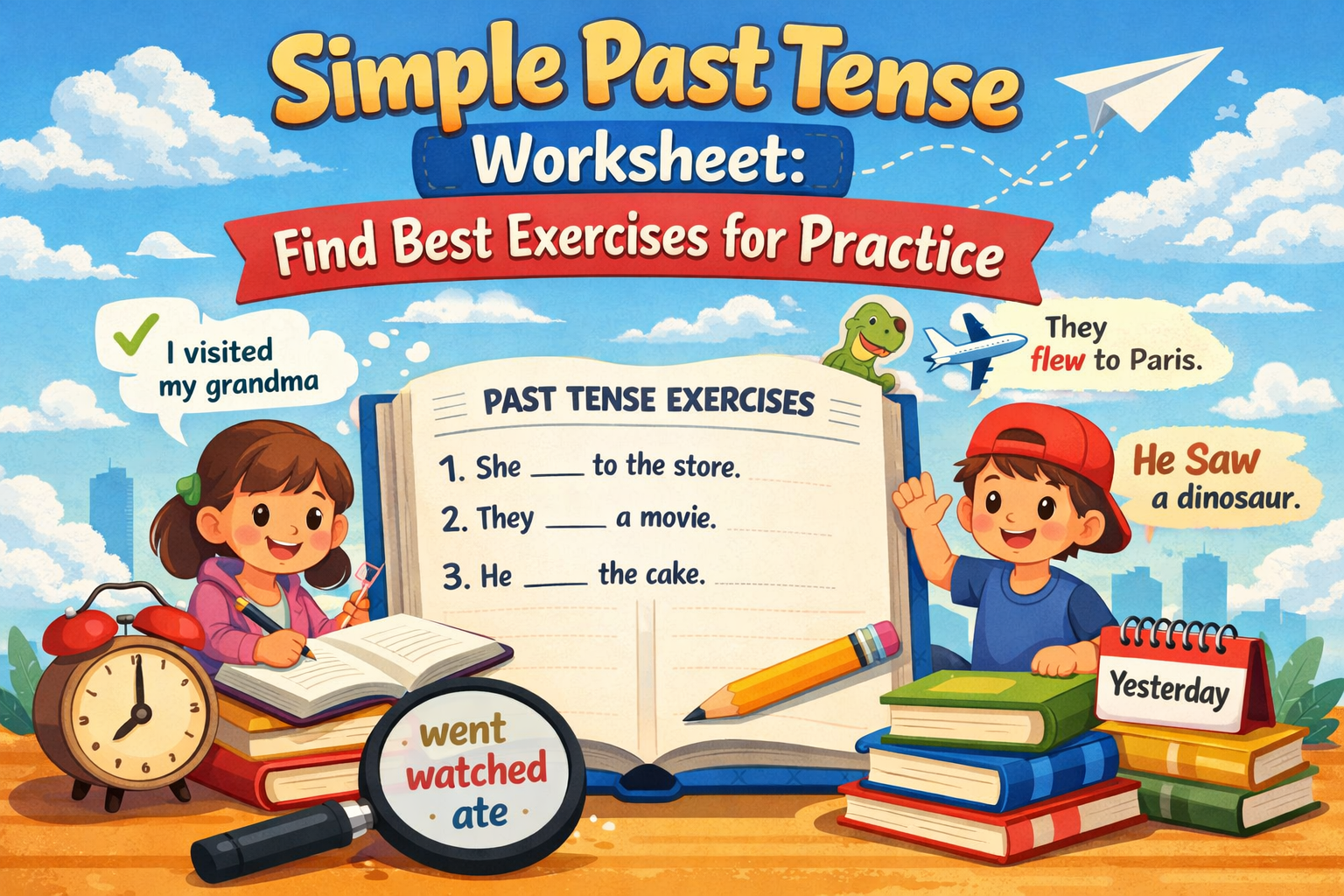
A simple past tense worksheet helps you build accuracy through hands-on practice: fill in the blanks, spot-the-mistake exercises, sentence transformation, and multiple-choice questions. Whether you’re a school student, a beginner learner, or someone preparing for an English proficiency exam, this worksheet-style guide is designed to take you from “I know the rule” to “I can use it correctly every time.”
In this fully updated 2026 guide, you’ll find the complete structure of the simple past tense, a list of common irregular verbs, 50+ practice questions across five exercise types (all with answers), common mistakes learners make, and an FAQ section answering the most-searched questions on this topic.
What Is a Simple Past Tense?
The simple past tense is used to talk about completed actions or events that happened at a specific, definite time in the past. According to Cambridge Dictionary’s English Grammar Today, the simple past is formed by adding -ed to regular verbs, while irregular verbs change form entirely.
Examples:
- I visited my grandparents last week.
- She finished her homework yesterday.
- They watched a movie last night.
- We travelled to Jaipur in December.
Since these actions are already completed – not ongoing and not connected to the present – we use the simple past tense rather than the present perfect or past continuous.
Structure of Simple Past Tense
1. Positive (Affirmative) Sentences
Structure: Subject + Verb (past form)
- I played football.
- She cooked dinner.
- He passed the exam.
Regular verbs add -ed (play → played, cook → cooked). Irregular verbs change completely (go → went, eat → ate).
2. Negative Sentences
Structure: Subject + did not / didn’t + base verb
- I did not go to school.
- He didn’t complete the task.
- They didn’t win the match.
Note: once you use “did,” the main verb always returns to its base form – this is one of the most common mistakes learners make (e.g., “He didn’t went” is incorrect).
3. Interrogative (Question) Sentences
Structure: Did + Subject + base verb?
- Did you finish your work?
- Did she call you?
- Did they arrive on time?
4. Interrogative-Negative Sentences
Structure: Did + Subject + not + base verb?
- Did you not receive my message?
- Didn’t she attend the meeting?
For a deeper breakdown of tense structures beyond simple past, see the British Council’s grammar reference on the past simple.
Regular vs. Irregular Verbs
Regular verbs follow the predictable “add -ed” pattern: walk → walked, play → played, watch → watched.
Irregular verbs don’t follow a fixed rule and must be memorized individually. Here are 20 of the most commonly used ones:
| Base Form | Past Form | Base Form | Past Form |
| go | went | eat | ate |
| write | wrote | buy | bought |
| see | saw | come | came |
| take | took | give | gave |
| make | made | know | knew |
| break | broke | drive | drove |
| sing | sang | teach | taught |
| catch | caught | draw | drew |
| grow | grew | freeze | froze |
| lose | lost | blow | blew |
Tip: Irregular verbs make up a small but high-frequency group in English. Learning just the top 50 will cover most everyday conversation and writing.
Why Use Worksheets for Practice?
A simple past tense worksheet is important because it helps you:
- Improve grammar accuracy through repetition
- Understand irregular verb forms that can’t be guessed from rules
- Practice constructing negative and question sentences correctly
- Avoid common mistakes made in speaking and writing
- Prepare for school exams and English proficiency tests
If you’re preparing for an international English exam alongside grammar practice, check out our guide on IELTS coaching in Jaipur for structured, expert-led preparation.
Practice Exercises (50+ Questions with Answers)
Exercise 1: Fill in the Blanks
Fill in the blanks with the correct simple past form of the verb in brackets:
- I ______ (go) to the market yesterday.
- She ______ (write) a letter.
- They ______ (eat) lunch together.
- He ______ (buy) a new phone.
- We ______ (watch) a movie last night.
- The wind ______ (blow) strongly all night.
- I ______ (break) my favourite mug.
- She ______ (grow) flowers in her garden.
- We ______ (catch) the early morning bus.
- He ______ (teach) us a new game.
Answers:
- went 2. wrote 3. ate 4. bought 5. watched 6. blew 7. broke 8. grew 9. caught 10. taught
Exercise 2: Correct the Sentences
Find and correct the grammatical mistake in each sentence:
- He go to school yesterday.
- She don’t liked the movie.
- We was happy.
- They did went to the park.
- I am saw him yesterday.
- He comed to the party.
- They has went to the store.
- Did she spoke to him?
- They was eatting dinner.
- She do not took the train.
Answers:
- He went to school yesterday.
- She didn’t like the movie.
- We were happy.
- They went to the park.
- I saw him yesterday.
- He came to the party.
- They went to the store.
- Did she speak to him?
- They were eating dinner.
- She did not take the train.
Exercise 3: Sentence Transformation
Convert these sentences into the simple past tense:
- I play cricket.
- She is happy.
- They go to school.
- He eats an apple.
- We visit our friends.
- They are watching a movie.
- She does not understand the rule.
- He is painting a picture.
- I am learning Spanish.
- We are going to the library.
Answers:
- I played cricket.
- She was happy.
- They went to school.
- He ate an apple.
- We visited our friends.
- They watched a movie.
- She did not understand the rule.
- He painted a picture.
- I learned Spanish.
- We went to the library.
Exercise 4: Multiple Choice Questions
- Which sentence is in the simple past tense? a) I am running b) I run c) I ran d) I will run
- She ______ a song. a) sing b) sings c) sang d) singing
- They ______ the match. a) win b) wins c) won d) winning
- Did you ______ the message? a) received b) receive c) receiving d) receives
- We ______ the mountain last summer. a) climb b) climbs c) climbed d) climbing
- He ______ not see the accident. a) does b) do c) did d) is
- I ______ the movie yesterday. a) enjoy b) enjoys c) enjoyed d) enjoying
- She ______ the door quietly. a) close b) closes c) closed d) closing
- They ______ a new song together. a) write b) writes c) wrote d) writing
- We ______ the game last week. a) play b) plays c) played d) playing
Answers:
- c) I ran 2. c) sang 3. c) won 4. b) receive 5. c) climbed 6. c) did 7. c) enjoyed 8. c) closed 9. c) wrote 10. c) played
Exercise 5: Sentence Writing Practice
Write your own simple past tense sentences using the prompts below. Try to include at least one irregular verb in each sentence.
- Write about something you did last weekend.
- Describe a place you visited last year.
- Write about a meal you ate recently.
- Describe something you learned in school last month.
- Write about a movie or show you watched recently.
Example answers:
- I visited a zoo last Sunday and saw an elephant.
- She helped her mother cook dinner yesterday.
- We travelled to Jaipur last December and stayed for a week.
Practising sentence writing daily – even just 2–3 sentences – builds fluency far faster than only doing fill-in-the-blank exercises. For more structured writing practice, see our guide on paragraph writing topics in English.
Common Mistakes to Avoid
1. Using present tense instead of past
- Incorrect: I go yesterday.
- Correct: I went yesterday.
2. Using the wrong irregular verb form
- Incorrect: She writed a letter.
- Correct: She wrote a letter.
3. Incorrect use of “did” with a past-form verb
- Incorrect: Did you went?
- Correct: Did you go? (Remember: after “did,” always use the base form, not the past form.)
4. Double-marking the past tense
- Incorrect: He didn’t went to school.
- Correct: He didn’t go to school.
5. Confusing “was/were” with regular past verbs
- Incorrect: We was happy.
- Correct: We were happy.
For a full breakdown of typical errors, the Cambridge Grammar page on past tense errors is a useful reference.
When Do We Use Simple Past Tense?
You should use the simple past tense when:
- Talking about a completed action at a specific time (I called her at 6 PM.)
- Describing past habits (I walked to school every day when I was young.)
- Narrating stories or past events
- Explaining historical facts or completed events
- Asking questions about the past using “did”
It is commonly used with time expressions like: yesterday, last week, last month, last year, in 2020, an hour ago, when I was a child.
Tips to Learn Simple Past Tense Easily
- Learn the top 50 irregular verbs first – they cover most everyday usage
- Practice a little every day using worksheets like this one, instead of cramming once a week
- Read English short stories or news articles and underline every past-tense verb you find
- Write a 3–4 sentence diary entry each night about your day
- Say sentences out loud, not just in writing – this helps with speaking fluency
- Take short quizzes weekly to track improvement
Regular, spaced-out practice – 10 minutes daily – helps you become confident in using the simple past tense correctly, far more effectively than a single long study session.
Conclusion
The simple past tense worksheet above is one of the most effective ways to practice this essential grammar topic. By working through fill-in-the-blanks, correction, transformation, and MCQ exercises, you train your brain to recognize and produce correct past-tense forms automatically – which is the real goal of grammar practice.
Keep revisiting irregular verbs regularly, since they don’t follow predictable rules and need memorization. Combine this worksheet with daily writing practice for the fastest improvement.
Start practicing today and improve your English step by step!
FAQs
1. What is the structure of the simple past tense?
For positive sentences: Subject + Verb (past form). For negative sentences: Subject + did not/didn’t + base form of the verb. For questions: Did + Subject + base form of the verb?
2. How is the simple past tense different from the past continuous?
The simple past describes a completed action (I ate dinner), while the past continuous describes an action that was in progress at a specific time in the past (I was eating dinner when you called).
3. When do we use the simple past tense?
We use it to describe completed actions or events that happened at a specific time in the past, or to talk about past habits and states.
4. What are some common time expressions used with the simple past?
Common time expressions include “yesterday,” “last week,” “a week ago,” “last year,” and “in1990” (or any specific past year).
5. What is the rule for negative sentences in the simple past?
Negative sentences use Subject + did not/didn’t + the base form of the verb (never the past form). For example: “He didn’t go,” not “He didn’t went.”
6. Do irregular verbs follow the same rule as regular verbs in the simple past?
No. Regular verbs add “-ed” (walk → walked), but irregular verbs change form completely and must be memorized individually (go → went, eat → ate, buy → bought).