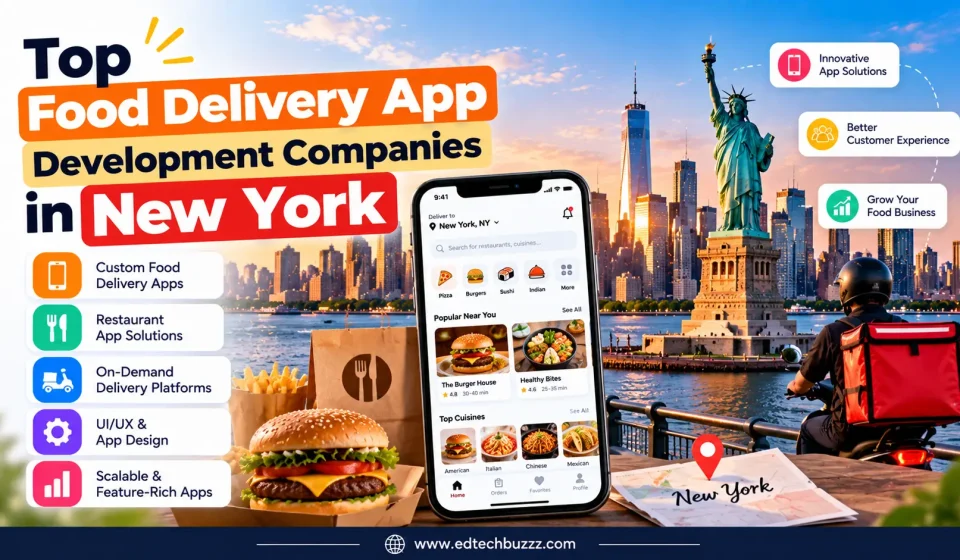

New York isn’t just where a huge share of food delivery happens, DoorDash, Grubhub, Seamless and countless ghost kitchens all compete for the same five-block radius in Manhattan alone, it’s also where a disproportionate number of the companies that build these apps happen to be headquartered. That matters if you’re a restaurant group, a cloud kitchen operator, or a founder building the next hyperlocal delivery startup: working with a developer who’s watched the city’s delivery ecosystem evolve up close tends to produce fewer surprises than briefing a team that’s never dealt with Manhattan’s density, multi-borough logistics, or New York’s specific regulatory environment for gig delivery workers.
This guide profiles ten food delivery app development companies based in New York, each independently researched against official company sources, Clutch reviews and business directories rather than self-published rankings. It’s followed by a complete framework: what food delivery app development actually involves, realistic costs, the difference between custom builds and white-label/clone solutions, essential app features, red flags, and current market stats on the U.S. and New York food delivery industry.
A note on the list order: the ten companies below are presented alphabetically, not ranked by quality. The right fit depends on your budget, timeline and whether you need a fully custom platform or a faster white-label build, which the sections further down are built to help you work out.
What Is Food Delivery App Development?
Food delivery app development is the process of building the software platform that connects customers, restaurants and delivery couriers, typically made up of three or four linked applications: a customer-facing ordering app, a restaurant/merchant dashboard, a courier app for delivery tracking, and an admin panel for the business operator. Unlike a simple mobile app, a food delivery platform needs to handle real-time order status, live GPS tracking, payment processing, dynamic delivery-fee calculation and multi-party notifications simultaneously, all under real-world conditions like a restaurant running out of an item mid-order or a courier’s phone losing signal in a subway tunnel.
Development generally falls into two approaches:
- Custom development – a platform built from scratch around a business’s specific model, branding and features, offering full flexibility but a longer timeline and higher cost
- White-label / clone solutions – pre-built platforms (often modeled on apps like DoorDash or Uber Eats) that are rebranded and configured for a specific business, launching faster and more cheaply but with less customisation
Quick Comparison: Food Delivery App Developers in New York
| Company | Founded | Development Model | Notable Clients/Work | Best For |
|---|---|---|---|---|
| Vention | 2002 | Custom, long-term engagements | Slice (pizza delivery app), Freshly, Bevi | Complex, scalable custom delivery platforms |
| Fueled | 2007 | Custom, design-led | Compass, MGM Resorts, Estee Lauder; Apple App of the Year (Warby Parker) | Brands prioritising premium design and UX |
| Blue Label Labs | 2009 | Custom, full-service | 250+ apps shipped since founding | Startups and enterprises wanting a proven, high-volume studio |
| Dom & Tom | 2009 | Custom, strategy-led | Etsy (ongoing app maintenance), 400+ web projects | Fortune 500 and startups wanting strategy plus execution |
| Utility | 2013 | Custom, mCommerce focus | Food-hospitality and media apps, end-to-end | Businesses wanting mobile commerce expertise specifically |
| Emerline | ~2012 | Custom, time-sensitive launches | 400+ engagements, 95% client satisfaction cited | Time-sensitive delivery app launches |
| Appetizer Mobile | 2009 | Custom | Founded by Forbes 30 Under 30 alum Jordan Edelson | Founder-led, boutique custom builds |
| SFCD (formerly SoftFacade) | ~2007 | Custom digital product | Broadway-based digital product agency | Mid-market businesses wanting a product-design-led partner |
| Monstar Lab Americas (Messapps) | 2001 (as Fuzz Productions) | Custom, full-service | Part of global Monstar Lab network | Businesses wanting global delivery capacity from a NY base |
| Konrad | — | Custom digital product | Toronto HQ with a New York office | Enterprises wanting a cross-border digital innovation partner |
Information reflects what each company publicly states as of this writing. Confirm current portfolio and pricing directly before engaging.
Top 10 Food Delivery App Development Companies in New York
1. Vention
Overview: Founded in 2002 and headquartered at 575 Lexington Avenue in New York City, Vention is one of the longest-established software engineering firms on this list, with more than two decades of custom development experience. Its food-sector client work includes Freshly (a meal delivery service) and, notably, New York-based pizza ordering startup Slice, which worked with Vention to develop its delivery app, alongside IoT company Bevi and wellness platform ClassPass.
Key Services:
- Custom delivery platform development
- Customer, courier and admin applications
- Real-time order and logistics workflows
- Payment system integration
Best Suited For: Delivery businesses needing a complex, highly scalable platform built by an engineering-first team with genuine food-delivery client history.
Website: ventionteams.com
Why Consider This Company:
- Documented work specifically on a New York pizza delivery app (Slice)
- Over two decades of continuous operation
- Broad enterprise client base beyond food, indicating engineering depth
2. Fueled
Overview: Founded in 2007 and based in New York, Fueled is a design-led digital product agency with 51-200 employees, known for award-winning work including Apple’s App of the Year for Warby Parker and a Webby Award for Barneys. Its client roster spans Compass, MGM Resorts, Estee Lauder and The Wall Street Journal, reflecting a design-first approach that treats the ordering experience as core to the product, not an afterthought bolted onto backend logistics.
Key Services:
- Product strategy and UX/UI design
- iOS and Android app development
- Brand and website development
- Engineering for consumer-facing products
Best Suited For: Delivery brands that see design and brand experience as central to competing against established players like DoorDash or Uber Eats.
Website: fueled.com
Why Consider This Company:
- Independently verified major design awards (Apple, Webby)
- A client list including Fortune 500 and venture-backed brands
- Nearly two decades of operation in New York specifically
3. Blue Label Labs
Overview: Founded in 2009 and based in New York City (with a Seattle office), Blue Label Labs is a full-service mobile, tablet, watch, TV, IoT and AR/VR app studio with a roughly 40-person team that has built over 250 apps since launch, one of the more prolific studios of its size in the city. Its process spans strategy, design, development and post-launch growth, giving delivery businesses a single partner across the full product lifecycle.
Key Services:
- Mobile and web app development
- Product strategy and design
- Post-launch growth and digital marketing support
- IoT and connected-device integration
Best Suited For: Startups and enterprises wanting a high-volume, proven studio with verified Clutch project history.
Website: bluelabellabs.com
Why Consider This Company:
- Among the highest total shipped-app counts (250+) of any company on this list
- Post-launch growth support, not just a build-and-walk-away model
- Nearly two decades of continuous New York operation
4. Dom & Tom
Overview: Founded in 2009 by brothers Dominic and Thomas Tancredi and headquartered in New York (with a Brooklyn engineering base), Dom & Tom is a family-owned digital product agency that has launched more than 400 web projects and 120 native mobile applications. Its Brooklyn team maintains both the Etsy marketplace app and its separate seller-management app on an ongoing basis, demonstrating genuine experience with the kind of multi-sided marketplace architecture a food delivery platform also requires.
Key Services:
- Marketplace and multi-sided app architecture
- UX/UI and product design
- Web and mobile development
- Ongoing app maintenance for live marketplace products
Best Suited For: Businesses building a multi-sided platform (customers, restaurants, couriers) who want a team with proven marketplace-maintenance experience.
Website: domandtom.com
Why Consider This Company:
- Documented, ongoing maintenance of a major live marketplace app (Etsy)
- Over 400 shipped web projects, a large verified body of work
- Family-owned structure often means more stable, consistent teams across a project
5. Utility
Overview: Founded in 2013 and headquartered in New York City, Utility is a mobile and digital product agency with a specific focus on mobile commerce (mCommerce), including food, hospitality and media apps delivered end-to-end. Its narrower focus on commerce-driven mobile experiences, rather than general app development, makes it a relevant fit for businesses where conversion and checkout flow are as important as the ordering interface itself.
Key Services:
- mCommerce app design and development
- Food and hospitality app development
- Checkout and payment flow optimisation
- End-to-end product delivery
Best Suited For: Businesses prioritising conversion-optimised mobile commerce experiences specifically within food and hospitality.
Website: utilitynyc.com
Why Consider This Company:
- A specific, stated specialisation in mobile commerce rather than general app development
- Documented food and hospitality sector experience
- End-to-end delivery reduces coordination across multiple vendors
6. Emerline
Overview: Based in New York, Emerline brings more than 14 years in business, over 400 engagements and a cited 95% client satisfaction rate to time-sensitive product launches. It’s positioned specifically for businesses that need an established, repeatable product development process applied to food delivery builds under deadline pressure, such as a restaurant group launching before a specific seasonal or market window.
Key Services:
- Custom food delivery platform development
- Time-sensitive product launches
- Full product development lifecycle management
Best Suited For: Businesses with a firm launch deadline who need a proven, repeatable delivery process rather than a more exploratory build.
Website: emerline.com
Why Consider This Company:
- A large, specific volume of completed engagements (400+)
- A high, specifically cited client satisfaction figure
- Over a decade of established process for time-sensitive builds
7. Appetizer Mobile
Overview: Founded in 2009 by Jordan Edelson, a Forbes 30 Under 30 alumnus, Appetizer Mobile is a Midtown Manhattan-based agency with a founder-led structure uncommon among larger, more corporate studios on this list. Its positioning leans toward direct, hands-on involvement from senior team members across a project rather than handing work off entirely to junior staff after the initial sales process.
Key Services:
- iOS and Android app development
- Custom mobile product design
- Founder-involved project delivery
Best Suited For: Smaller delivery businesses or founders wanting direct, senior-level involvement throughout the build rather than a large account-management layer.
Website: appetizermobile.com
Why Consider This Company:
- Founder recognition (Forbes 30 Under 30) adds a verifiable credibility signal
- Smaller team size can mean closer, more direct client contact
- Over 15 years of continuous Manhattan-based operation
8. SFCD (formerly SoftFacade)
Overview: Operating since around 2007 from a Broadway address in New York, SFCD is a digital product agency that rebranded from its original name, SoftFacade, as its focus matured from technical facade work toward broader digital product design and development. Its longer operating history and product-design lineage make it a relevant option for food delivery businesses that want both a polished consumer interface and solid underlying engineering.
Key Services:
- Digital product design
- Mobile and web app development
- Product strategy
Best Suited For: Mid-market businesses wanting a product-design-led partner with nearly two decades of New York operating history.
Website: sfcd.com
Why Consider This Company:
- Nearly two decades of continuous New York operation
- A product-design-first lineage, rather than engineering-only
- Established Broadway/Manhattan presence
9. Monstar Lab Americas (Messapps)
Overview: Operating from 1460 Broadway in New York, Monstar Lab Americas traces its roots back to 2001 as Fuzz Productions before being absorbed into the global Monstar Lab network, giving its New York team access to a much larger international delivery capacity than a standalone local studio. This combination of deep local roots and global backend resourcing suits delivery businesses planning to expand into multiple markets or countries after an initial New York launch.
Key Services:
- Full-service mobile and web app development
- Multi-market/international app expansion support
- Product strategy and design
Best Suited For: Delivery businesses planning to scale beyond New York into other cities or countries after an initial launch.
Website: monstar-lab.com/americas
Why Consider This Company:
- Deep local New York roots dating back over two decades
- Access to a larger global delivery network through Monstar Lab
- A natural fit for businesses with multi-market ambitions
10. Konrad
Overview: Konrad is a digital product and innovation firm headquartered in Toronto, with a dedicated New York office alongside Vancouver and London, giving it genuine cross-border delivery capacity for businesses operating or expanding across the US-Canada corridor. Its positioning as a broader digital innovation firm, rather than a food-delivery-only shop, suits businesses wanting a partner that can also handle adjacent systems like loyalty programs or enterprise integrations alongside the core delivery app.
Key Services:
- Digital product strategy and innovation
- Mobile app development
- Enterprise systems integration
Best Suited For: Delivery businesses operating across both the U.S. and Canada, or wanting a broader digital innovation partner beyond the delivery app alone.
Website: konrad.com
Why Consider This Company:
- Genuine cross-border New York and Toronto presence
- Broader digital innovation capability beyond a single app
- Multi-city office network (Toronto, New York, Vancouver, London)
Essential Features of a Food Delivery App
| Feature | What It Does | Why It Matters |
|---|---|---|
| Real-Time Order Tracking | Live GPS tracking of the courier from pickup to delivery | The single most-cited feature driving customer trust and repeat use |
| Multi-Restaurant/Merchant Dashboard | Lets restaurants manage menus, availability and incoming orders | A poor merchant experience leads to order errors and restaurant churn |
| Dynamic Delivery Fee Calculation | Calculates fees based on distance, demand and courier availability | Gets pricing wrong and either loses money or loses customers to competitors |
| In-App Payments | Secure, integrated checkout supporting cards, wallets and split payments | Friction at checkout is one of the biggest causes of cart abandonment |
| Push Notifications | Order confirmation, status updates and promotional alerts | Keeps customers informed without requiring them to check the app manually |
| Courier Route Optimisation | Suggests efficient routes, especially for multi-stop deliveries | Directly affects delivery speed and courier earnings per hour |
| Ratings & Reviews | Customer feedback on restaurants and delivery experience | A key trust signal and a feedback loop for quality control |
| Admin Analytics Dashboard | Business-level reporting on orders, revenue and performance | Essential for operators making data-driven decisions post-launch |
How Much Does a Food Delivery App Cost?
Food delivery app development typically costs between $40,000 and $80,000 for a white-label/clone solution, and $80,000 to $250,000 or more for a fully custom platform, depending on feature scope, number of apps (customer, courier, merchant, admin) and ongoing maintenance needs. These figures are directional estimates drawn from published ranges across the food delivery app development industry, not a quote for any specific project.
Key cost drivers include:
- Number of apps needed: customer-only is cheaper than customer plus courier plus merchant plus admin
- Real-time features: live GPS tracking and real-time order status add genuine engineering complexity
- Payment integrations: supporting multiple payment methods and split payments (customer-to-platform, platform-to-restaurant, platform-to-courier) adds cost
- Custom vs white-label: a clone-based build launches faster and cheaper but limits differentiation from competitors
- Third-party integrations: POS systems, delivery logistics APIs and marketing tools all add integration work
- Ongoing maintenance: a live delivery platform needs continuous updates, bug fixes and scaling support, a recurring cost beyond the initial build
Custom Development vs White-Label Solutions
| Factor | Custom Development | White-Label / Clone Solution |
|---|---|---|
| Timeline | Several months to a year or more | Weeks to a couple of months |
| Cost | Higher, $80K-$250K+ | Lower, typically $40K-$80K |
| Customisation | Full control over features and branding | Limited to the template’s configurable options |
| Differentiation | Can build unique features competitors don’t have | Harder to stand out since the underlying product is shared |
| Best for | Businesses with a specific, differentiated model | Businesses wanting to launch and validate quickly |
How to Choose a Food Delivery App Developer
- Ask for live, working examples – request real apps in production, not just mockups, and test the actual courier and merchant experience, not just the customer side.
- Clarify custom vs white-label upfront – make sure the proposal matches what you actually asked for, white-label quoted as custom is a common bait-and-switch.
- Check real-time infrastructure experience – ask specifically how they handle live GPS tracking and order-status updates at scale.
- Confirm payment and compliance handling – PCI DSS compliance for payment data is non-negotiable.
- Ask about post-launch support – a live delivery platform needs ongoing updates and scaling support, not a one-time handoff.
- Verify independent reviews – prioritise Clutch or G2 reviews over testimonials published only on the company’s own site.
- Understand ownership terms – confirm in writing who owns the code, data and IP, especially critical for white-label builds.
Red Flags to Watch For
- Vague answers about real-time infrastructure – live tracking and order updates are technically demanding; a credible team explains their approach clearly.
- A “custom” quote that’s actually a white-label template – ask directly whether the underlying codebase is shared across multiple clients.
- No mention of payment compliance – a developer unfamiliar with PCI DSS likely hasn’t built a real production payment flow before.
- No post-launch support plan – delivery platforms need continuous maintenance; treat “we’ll figure it out later” as a warning sign.
- Self-published “#1 food delivery app developer” rankings – this space is flooded with content-marketing lists published by the agencies featured; verify against independent platforms like Clutch instead.
- Pricing far below the typical range – often means a lightly modified template sold as a custom build.
U.S. Food Delivery Market: Key Stats for 2026
A look at the scale of the food delivery market helps explain why so many New York companies specifically have built their business around this category:
- DoorDash’s continued dominance: DoorDash remains the largest U.S. food delivery platform by order volume and market share, with Uber Eats and Grubhub rounding out the top three nationally, a competitive landscape that makes differentiated features and strong local execution especially important for new entrants.
- New York as a dense, high-frequency market: New York City’s population density and high restaurant concentration make it one of the most active food delivery markets in the country, which is part of why so many of the developers building these platforms are based here.
- Ghost kitchens and multi-brand operations growing: an increasing share of New York food delivery volume now comes from ghost kitchens and multi-brand virtual restaurant operations, which place particular demands on merchant-dashboard software to manage several brands from one kitchen.
For businesses evaluating a developer, the practical takeaway is that food delivery remains a large but highly competitive category, meaning a well-executed, differentiated app matters more than ever against entrenched national platforms.
Final Thoughts
New York’s density as both a food delivery market and a technology hub means businesses building a delivery app here have genuine access to developers who understand the category’s real-world complexity, multi-borough logistics, high order volumes, and intense competition from established national platforms. Companies like Vention and Dom & Tom bring documented marketplace and delivery-specific experience, design-led studios like Fueled and Utility suit brands competing on experience, and smaller, founder-led shops like Appetizer Mobile offer a more hands-on alternative to larger agencies.
Whichever direction fits, clarify custom versus white-label upfront, confirm real-time infrastructure and payment compliance experience, and verify any company’s claims against independent sources like Clutch rather than self-published rankings. For related reading on technology development in the U.S., see our guides to AI development companies and cloud computing companies in the USA.
Frequently Asked Questions
What are the best food delivery app development companies in New York?
There’s no single “best” company, it depends on your budget, timeline and whether you need custom or white-label development. This guide profiles ten independently researched New York companies, from established engineering firms like Vention to design-led studios like Fueled.
How much does it cost to build a food delivery app?
White-label solutions typically cost $40,000-$80,000, while fully custom platforms range from $80,000 to $250,000 or more, depending on the number of apps needed and feature complexity.
What’s the difference between custom and white-label food delivery apps?
Custom development builds a platform from scratch around specific business needs, offering full flexibility but at higher cost and longer timelines. White-label solutions use a pre-built template that’s rebranded and configured, launching faster and cheaper but with less differentiation.
How long does it take to build a food delivery app?
A white-label build can launch in a few weeks to a couple of months. A fully custom platform with real-time tracking, multiple apps and payment integrations often takes several months to a year.
What apps are needed for a complete food delivery platform?
Most platforms need at minimum a customer-facing ordering app, a restaurant/merchant dashboard, a courier app for delivery tracking, and an admin panel for business operations.
Can a new food delivery app compete with DoorDash or Uber Eats?
Competing directly nationally is extremely difficult given their scale, but focused, differentiated apps (hyperlocal, restaurant-owned, or niche-cuisine platforms) can succeed by targeting specific gaps those larger platforms don’t serve well.
What payment compliance do I need for a food delivery app?
Any app processing card payments needs to handle data in a PCI DSS-compliant way, typically achieved by using a compliant payment processor rather than storing card data directly.
Should I hire a New York-based developer if my restaurant isn’t in New York?
Not necessarily required, but a New York-based team often brings direct experience with the density, logistics complexity and competitive dynamics of a major delivery market, which can translate well to other dense urban markets.
What should I avoid when hiring a food delivery app developer?
Avoid vague answers about real-time infrastructure, a “custom” quote that’s actually a shared white-label template, no post-launch support plan, self-published “#1 ranking” claims, and pricing significantly below the typical range.
Do I need a native app, or is a mobile website enough?
For a food delivery platform specifically, a native app is generally worth the investment given the need for push notifications, GPS tracking and a smooth checkout experience, all of which work better in a native app than a mobile website.