
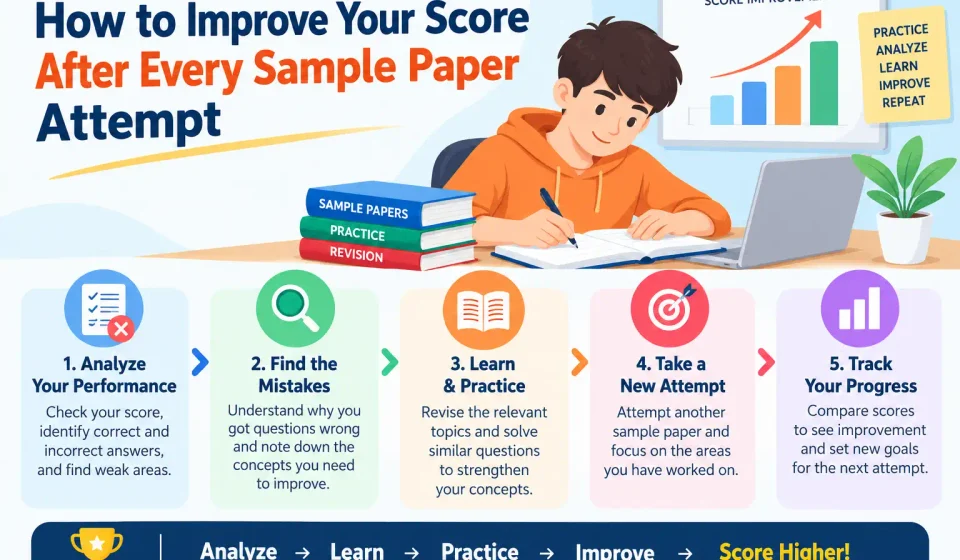

It is a common experience amongst many Class 12 students: several sample papers are solved, but there are very few improvements in the score. The problem here is not the lack of effectiveness in the sample papers themselves but the lack of change that comes with every practice.
However, this improvement can actually come with each test if the right routine is followed. It is a matter of learning science. Below is the detailed plan of the steps to take.
The Case for Score Improvement After Every Test
There is a scientific basis for such a claim. The testing effect is a well-established cognitive principle that asserts that the act of retrieving information during a test makes better memory encoding than the act of re-reading notes. Studies show a correlation between the level of practice on test-style questions and the performance in the coming examinations because each retrieval makes recall of information in future easier.
Therefore, a sample paper does not just serve to test knowledge but serves to reinforce and expand it. Hence, every sample paper is an opportunity for improvement provided that certain things are done.
Consider Every Paper Not Just Practice But Informational Data
This is the main idea that needs to be followed. Reframe every test from being thought of as completed to being thought of as a source of information about the learner’s knowledge and mistakes.
First, complete a full CBSE Class 12 Sample Paper 2026-27 in the real exam conditions. Then consider the results as a diagnostic report where the weak topics, the question types that made you slower and the places where mistakes were made carelessly are identified. Free and up-to-date-pattern sample papers with solutions like on the SelfStudys website facilitate this process by enabling accurate checking of each answer against the marking scheme and understanding what mistakes you made and what marks you missed. Such data gives clear indications for the things that need to be improved before the next test.
Immediate Analysis and Re-solving after Some Time
After every paper do two distinct things at two different times.
- Immediately: analyze your paper when the information is fresh. Understand why you made mistakes and understand the proper way to solve each mistake.
- After two to three days’ delay: re-solve the questions that were solved incorrectly anew without looking at the solutions.
This delay is purposeful rather than careless. Learning studies show that spaced retrieval, the act of revisiting a topic after some time instead of immediately, is more effective in memory encoding. Re-solving a question that was missed by you 48 to 72 hours later serves as a good measure of real learning rather than memorization of the solutions.
Keep an Error Log
This is the only thing that if you do it, you’ll improve. After every assessment, keep an error log where the topics, the question types, and the reasons for making mistakes are written.
Separate your mistakes according to their causes: conceptual mistakes, carelessness, incomplete answers, and timing issues. After several assessments, you’ll see a pattern, for example, repeatedly making mistakes in case-based questions or consistently missing some marks due to being careless in calculations. This gives you a precise list of things to do and not scattered mistakes.
Track Your Progress in a Simple Table
To evaluate your improvement, you need some measure. Track your progress using a simple table with one line for each assessment:
Assessment | Score | Main Error Type | Marks Lost to Carelessness | Fix for Next Time
Keeping such a table after each assessment will serve two purposes: giving you the overview of your progress and forcing you to think about the adjustment before the next assessment. The increasing values in the score line will give you the most clear indication that the current routine works.
Set One Manageable Improvement Goal Per Test
Instead of trying to fix everything at once which is difficult and generally ineffective, set one clear goal for the upcoming test.
Some possible goals include: reduce careless mistakes in physics numericals by fifty percent, ensure full participation in all case-based questions or finish the test with ten minutes to spare. Small goals are achievable and making incremental progress over several assessments helps in moving from 65 score to 75.
Address Conceptual Issues Between Assessments, Not Just Increase Volume
One mistake is to stop working on the gaps and move on to tests. Testing yourself on the weak area without addressing it is not going to improve your knowledge.
Between tests, revise your weak topics using fundamental texts and notes (like NCERT). Your test reveals a gap; your revision closes it; your next test confirms that the gap is closed. This cycle: attempt, analysis, fix, retest is the basis of your improvement.
Test Your Progress Using Previous-Year Question Papers
The sample papers tell you about your progress in the current test pattern; the previous-year papers tell you if your progress is generalizable to the real exams’ difficulty. Once in a while, approximately every two weeks, conduct a CBSE Previous Year Question Papers Class 12 and follow the same test routine. As these are the questions that were previously asked by CBSE, getting better results on them will be the best indicator of your improvement being substantial.
Optimize Digital Practice
Modern preparation includes not just paper practice. Getting a clear picture of how an online mock test assesses you in comparison with the real examination helps you use digital tools wisely and get fast and accurate error analysis. Whether it is practice on paper or using online tools like SelfStudys, the process of improvement remains the same: attempt, analyze, fix and retest.
Conclusion
Improvement with every sample paper does not depend on solving the higher number of papers, but on the quality of the analysis of every paper. The basic principle is supported by the learning science: every attempt, if analyzed properly, improves your knowledge via the testing effect. Consider every paper as data, analyze and re-solve it later, keep the error log, track your progress and address misconceptions between tests.
By keeping consistency with CBSE sample papers and with previous year papers from a reliable website like SelfStudys, you will not just practice but will progressively improve with every paper.