

Ask five software development companies for a quote on the same project and you’ll likely get five numbers that don’t look related to each other, not because anyone’s lying, but because “custom software development” covers everything from a $15,000 internal dashboard to an $800,000 multi-tenant platform, and most quotes don’t explain which variables actually moved the price. Understanding the real cost drivers, not just a single headline number, is what lets you tell a fair quote from an inflated one, or a suspiciously cheap one from a corner-cutting one.
This guide breaks down what custom software development actually costs in the USA in 2026, by project complexity, by region and engagement model, and by the specific cost drivers that separate a $30,000 project from a $300,000 one, based on Clutch’s official 2026 pricing data and a cross-section of current industry sources. It also covers hidden costs, red flags, and how to read a quote properly.
How Much Does Custom Software Development Cost?
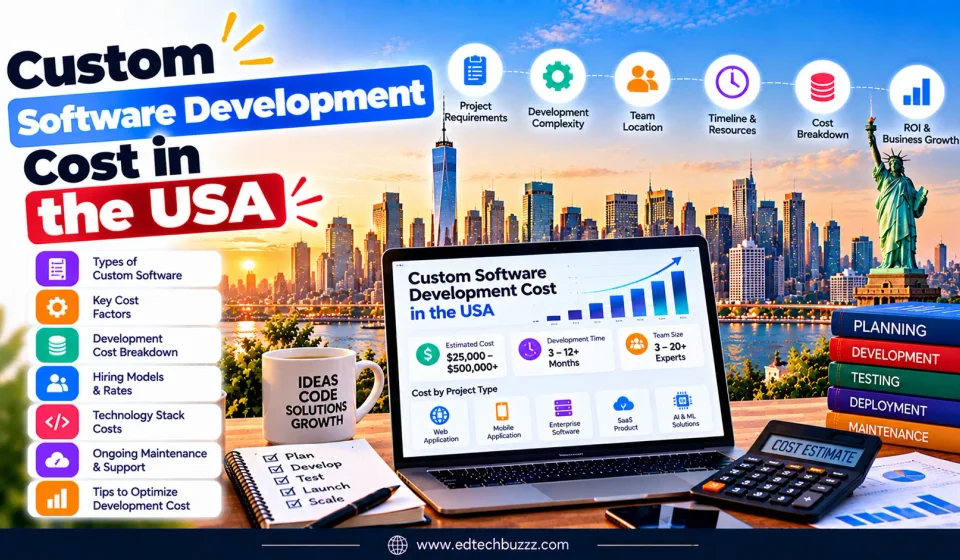
Custom software development in the USA typically costs $25,000 to $75,000 for a simple application, $75,000 to $400,000 for a mid-complexity platform, and $400,000 to $1 million or more for an enterprise-grade system, with Clutch’s official 2026 data putting the average software development project at $132,480 over roughly 13 months.
| Project Tier | Typical Cost | Timeline | Example |
|---|---|---|---|
| Simple tool / MVP | $10,000-$75,000 | 4-10 weeks | Internal dashboard, booking tool, single-feature MVP |
| Mid-complexity application | $75,000-$200,000 | 3-6 months | CRM, customer portal with payments, multi-module platform |
| Complex / scaled system | $200,000-$400,000 | 6-9 months | Multi-tenant SaaS, integration-heavy enterprise tool |
| Enterprise-grade platform | $400,000-$1,000,000+ | 9-18 months | ERP, systems with compliance and scale requirements |
Hourly Rates by Region
Where your development team is based affects cost more than almost any other single factor. According to Clutch’s 2026 pricing data, hourly rates run roughly $25-$49 in India, Ukraine and the Philippines, versus $100-$149 in the US, Canada and Australia, with other industry sources placing senior US rates specifically as high as $150-$275/hour depending on specialisation and location within the country.
| Region | Typical Hourly Rate | Best For |
|---|---|---|
| United States / Canada / Australia | $100-$275/hr | Regulated industries, IP-sensitive projects, close collaboration |
| Western Europe | $90-$180/hr | Strong English, EU data residency requirements |
| Eastern Europe | $40-$95/hr | High technical depth at moderate cost, good timezone overlap for EU/East Coast US |
| India / Southeast Asia | $25-$60/hr | Budget-constrained projects, larger team scale |
A useful way to sanity-check any quote: the unit of software development cost is really a developer-month. At $50-$80/hour, a developer-month of roughly 160 hours costs $8,000-$12,800; at typical US agency rates of $120-$220/hour, the same hours cost two to three times more. Every project price, however it’s presented, is ultimately a multiple of that unit, hourly rate × hours × team size.
Cost by Engagement Model
| Engagement Model | Hourly / Cost Range | Typical Project Range | Best For |
|---|---|---|---|
| Offshore freelancers (Upwork, Fiverr Pro) | $15-$45/hr | $8K-$25K | Small, well-defined scopes with a tight budget |
| Nearshore agencies (Latin America, Eastern Europe) | $40-$90/hr | $25K-$80K | Good timezone overlap at moderate cost |
| Offshore agencies (India, Southeast Asia) | $25-$60/hr | $15K-$60K | Larger team scale on a constrained budget |
| US mid-market agencies | $120-$200/hr | $80K-$250K | Full-scope builds needing US-based accountability |
| US premium agencies/consultancies | $200-$400/hr | $200K-$600K+ | Highly regulated, complex or IP-sensitive projects |
| Full-time in-house hire (US senior engineer) | $80-$130/hr loaded | $140K-$220K/year | Long-term product ownership beyond a single project |
Offshore and nearshore engagements advertise the biggest headline savings, but the true savings after accounting for management overhead, communication friction and rework are typically 25-45% for nearshore and 25-35% for offshore, meaningfully less than the raw hourly rate difference suggests. Budget 30-50% above any initial rate card to account for this, plus an additional 10-20% of total build cost annually for ongoing maintenance after launch.
What Actually Drives Cost Up or Down
- Number of user roles/permission levels: each distinct user type (admin, customer, vendor) typically adds $5,000-$15,000 in scoped work
- Number of major workflows: each significant workflow or feature area commonly adds $8,000-$25,000
- Third-party integrations: payment processors, CRMs, legacy systems each add integration-specific engineering time
- Compliance requirements: HIPAA, PCI DSS, SOC 2 or similar frameworks add both engineering and legal review time (see our healthcare and fintech cost guides for category-specific detail)
- Custom UX/UI design: a fully custom design system costs meaningfully more than adapting an existing component library
- Backend complexity: real-time data sync, AI/ML features or high-availability infrastructure all add engineering depth beyond standard CRUD applications
The cheapest hourly rate rarely produces the cheapest total project, a lower rate multiplied by more hours (due to inexperience, poor communication or rework) can easily exceed a higher rate delivered efficiently.
Hidden Costs Most Budgets Miss
- Post-launch maintenance: budget 10-20% of total build cost annually; bug fixes, security patches and platform updates don’t stop at launch
- Project management overhead: if not already included, PM typically runs $90-$160/hour and adds meaningfully to total project cost
- QA and testing: often underscoped in initial estimates, particularly for projects with many device or browser combinations to support
- Infrastructure/hosting costs: ongoing cloud hosting is separate from development cost and scales with usage
- Rework from scope changes: changes requested mid-project typically cost more than the same feature scoped from the start
How to Read a Software Development Quote
- Ask for a breakdown by phase – discovery, design, development, QA and deployment should each have a line item, not one lump sum.
- Confirm what’s included vs. billed separately – PM, QA, design and post-launch support are sometimes bundled, sometimes not; get this in writing.
- Ask how change requests are priced – understand the process and cost for scope changes before the project starts, not after.
- Clarify fixed-price vs. time-and-materials – fixed price offers budget certainty but less flexibility; time-and-materials offers flexibility but requires more active budget management.
- Compare total cost, not just hourly rate – a lower rate with more estimated hours can exceed a higher rate with a tighter, more experienced estimate.
- Ask about team composition – confirm whether your project is staffed by senior engineers or junior developers billed at a blended rate.
Red Flags to Watch For
- A quote with no phase breakdown – a single lump-sum number with no itemisation makes it impossible to evaluate what you’re actually paying for.
- Pricing dramatically below the regional range – often signals inexperience, undisclosed subcontracting, or scope that will expand once work begins.
- No mention of post-launch maintenance – a vendor that treats launch as the finish line, rather than ongoing product support, leaves you exposed later.
- Vague answers about who owns the code – confirm IP ownership in writing before the project starts, not after a dispute.
- No clear change-request process – without this defined upfront, scope creep becomes a common source of budget overruns and disputes.
Final Thoughts
Custom software development cost comes down to three variables you can actually control: project complexity, team location, and engagement model, and understanding how each moves the price is what separates an informed buyer from someone just comparing headline hourly rates. A $40/hour offshore quote and a $180/hour US agency quote aren’t automatically comparable until you’ve accounted for management overhead, communication friction and the specific deliverables each actually includes.
For category-specific cost breakdowns, see our dedicated guides to AI development, healthcare app development, fintech app development, and hiring mobile app developers in the USA.
Frequently Asked Questions
How much does custom software development cost in the USA?
Custom software development in the USA typically costs $25,000-$75,000 for a simple application, $75,000-$400,000 for a mid-complexity platform, and $400,000-$1,000,000+ for an enterprise system, with Clutch’s 2026 data putting the average project at $132,480.
What is the hourly rate for custom software developers in 2026?
US developer hourly rates generally range from $100-$275/hour depending on seniority and specialisation, compared to $40-$95/hour in Eastern Europe and $25-$60/hour in India and Southeast Asia.
How much does it cost to build custom software for a small business?
A small business application typically costs $25,000-$75,000 for a simple tool and can range up to $150,000-$200,000 for a more feature-complete platform with integrations, depending on scope.
Is offshore development actually cheaper?
Offshore rates are significantly lower on paper, but after accounting for management overhead, communication friction and rework, true savings are typically 25-35% rather than the full rate-card difference. Nearshore development often lands at 25-45% real savings with better timezone overlap.
What’s the difference between fixed-price and time-and-materials pricing?
Fixed-price gives budget certainty but less flexibility for scope changes. Time-and-materials bills actual hours worked, offering more flexibility but requiring more active budget management and trust in the vendor’s estimates.
How long does a custom software project take?
A simple MVP typically takes 4-10 weeks. A mid-complexity application takes 3-6 months. An enterprise-grade platform with compliance and integration requirements often takes 9-18 months.
What should I budget for ongoing maintenance?
Budget roughly 10-20% of the total build cost annually for ongoing maintenance, bug fixes, security patches and platform updates after launch.
Why do quotes for the same project vary so much between vendors?
Quotes vary based on team location, seniority mix, what’s included (QA, PM, design), and how thoroughly the vendor has scoped the actual requirements. A quote with no phase breakdown is harder to evaluate and compare fairly.
What drives software development cost up the most?
Compliance requirements (HIPAA, PCI DSS), the number of distinct user roles, third-party integrations, custom UX/UI design, and complex backend needs like real-time sync or AI features all meaningfully increase cost beyond a basic application.
Should I hire in-house or work with an agency?
In-house hiring suits long-term core product ownership but costs more overall once salary, benefits and recruiting are factored in (often $140K-$220K/year loaded). Agencies suit defined-scope projects with design, QA and PM included, without the overhead of a permanent hire.