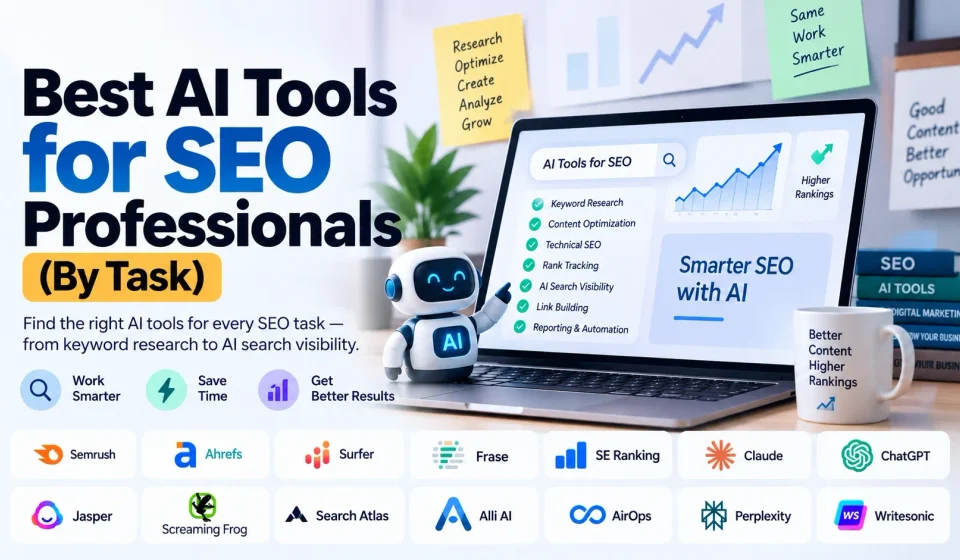

AI SEO tools” stopped being a single category some time ago. In 2026, the label covers everything from a keyword platform that clusters queries with a language model, to a desktop crawler that calls an LLM API to classify pages, to an entirely new class of software that monitors whether ChatGPT or Google’s AI Mode mentions your brand at all.
Those are different problems, solved by different tools, fed by different data. Treating them as one shopping list is how teams end up paying for three overlapping subscriptions while the task they actually needed help with stays unsolved.
This guide is organized the way SEO work is actually organized: by task. For each one, you’ll see what the job involves, what AI genuinely contributes (versus what is just a marketing label), which tools fit, where they fall short, and who should use them. The guiding principle throughout: choose the tool based on the task, the data it relies on, your workflow, and your budget, not simply because it uses AI.
Quick Answer
| SEO Task | Recommended Tool Type | Example Tools |
|---|---|---|
| Keyword research | SEO research platform with AI clustering/intent | Ahrefs, Semrush, SE Ranking, Keyword Insights, LowFruits, AlsoAsked |
| Competitor analysis | Research platform + gap analysis | Ahrefs, Semrush, SE Ranking, Similarweb |
| Content briefs | SERP-analysis brief builder | Frase, Surfer, MarketMuse, Keyword Insights |
| Content creation | General AI assistant + editorial process | ChatGPT, Claude, Gemini, Jasper, KoalaWriter |
| Content optimization | Content scoring / topical coverage | Surfer, Clearscope, Frase, MarketMuse, Semrush content tools |
| Technical SEO | Crawler / audit platform (AI-assisted) | Screaming Frog, Sitebulb, JetOctopus, Semrush Site Audit, Ahrefs Site Audit |
| Internal linking | Link-suggestion tools and crawler data | Link Whisper, InLinks, Yoast Premium, Screaming Frog + embeddings |
| Rank tracking | Rank tracker with SERP-feature + AI-result tracking | SE Ranking, Semrush Position Tracking, Ahrefs Rank Tracker, AccuRanker, Nightwatch |
| AI search / GEO visibility | AI visibility (GEO/AEO) platform | Profound, Peec AI, Otterly.AI, Semrush AI Visibility Toolkit, Ahrefs Brand Radar, SE Visible |
| Link building & digital PR | Backlink database + outreach CRM | Ahrefs, Semrush, BuzzStream, Pitchbox, Respona |
| Reporting | Dashboards + AI summaries | Looker Studio, AgencyAnalytics, native report builders |
| SEO automation / agents | LLM + tool connectors (MCP/API) with human review | Claude/ChatGPT with tool connectors, n8n/Make, vendor agents |
No tool in this table is “#1 overall.” Several are the right answer for one row and the wrong answer for another.
What Are AI SEO Tools?
An AI SEO tool is software that applies machine learning or large language models (LLMs) to at least one step of an SEO workflow: gathering data, interpreting it, generating recommendations, producing content, or executing changes.
That definition is deliberately broad, because the market is. It helps to separate three types:
Traditional SEO software collects and stores data: backlinks, keyword volumes, crawl results, rankings. The value lies in the size and freshness of the dataset. Most of these platforms have existed for a decade or more.
AI-assisted SEO tools are traditional platforms that have added AI layers on top of their existing data. Examples: a keyword tool that groups queries by SERP overlap and labels intent, a crawler that lets you send page content to an LLM for classification, or a rank tracker that writes a plain-English summary of what changed this week. The data is still the core product; AI makes it faster to interpret.
AI-native SEO tools could not exist without generative AI. AI search visibility platforms are the clearest example: their whole job is to run prompts through ChatGPT, Perplexity, Gemini, Copilot and Google’s AI experiences, record the answers, and report who was mentioned and cited. Content optimization tools that score drafts against SERP competitors in real time also sit here.
Why does the distinction matter? Because an AI-assisted tool is only as good as its underlying data, and an AI-native tool is only as good as its methodology (how many prompts it runs, how often, in which regions, and how it handles the fact that AI answers vary between sessions).
And why do SEO professionals still need judgment? Because none of these tools knows your business. They can’t tell you that a high-volume keyword attracts the wrong customer, that a “critical” crawl error affects a section you’re about to delete, or that an AI-generated paragraph contains a claim your legal team will reject. AI compresses analysis time; it doesn’t remove accountability.
How AI Is Changing SEO in 2026
The shifts that matter in practice, rather than in press releases:
- Keyword research is becoming cluster-first. Instead of exporting 5,000 keywords and grouping them in a spreadsheet, tools now cluster by SERP similarity and attach intent labels automatically. The human job moves from sorting to prioritizing.
- Search intent analysis is faster. LLMs can read the top-ranking pages for a query and summarize what format and angle Google is rewarding. That used to take an hour per keyword.
- Content optimization is continuous. Scoring against live SERP competitors happens as you type, and several tools now flag topical gaps on already-published pages.
- Technical SEO analysis scales. Crawlers can hand page content to an LLM to classify page types, detect thin content, or generate embeddings for near-duplicate detection across tens of thousands of URLs.
- AI search visibility is a new KPI. Brands now track whether they appear in ChatGPT answers or Google AI Overviews, a metric that did not exist in most reporting decks two years ago.
- Citation tracking has become its own discipline. Which sources do AI systems cite for your category? Are you one of them? If not, who is?
- Competitor analysis includes AI share of voice, not just organic rankings.
- Predictive insights are emerging, though most “traffic forecasting” is still modeled estimation and should be treated accordingly.
- SEO agents are appearing, connecting LLMs to SEO tool APIs so an assistant can pull data, analyze it, and propose actions. For teams exploring DIY automation, see our guide to Python workflow automation.
What hasn’t changed: search engines still need crawlable, indexable, genuinely useful pages, and no vendor can promise rankings or citations. The tools below help you do the work better; they don’t do the work for you.
Best AI SEO Tools by Task
1. Best AI Tools for Keyword Research
The task: Find the queries your audience uses, understand what they want, estimate demand, and decide what to build first.
What AI actually adds: Clustering (grouping hundreds of variants into page-level topics based on which URLs rank for them), intent classification (informational, commercial, transactional, navigational), question mining, and summarizing SERP patterns. What AI does not add is better search-volume data; that still comes from clickstream and search-engine sources each vendor maintains.
Tools that fit:
- Ahrefs Keywords Explorer – Large keyword database, “Parent Topic” grouping, traffic potential estimates, and AI-generated keyword suggestions. According to third-party pricing trackers citing the official page, Ahrefs has five paid tiers plus a free option: Ahrefs Webmaster Tools (free for verified sites), Starter at $29/month (monthly only), Lite at $129/month, Standard at $249/month, Advanced at $449/month, and Enterprise from $1,499/month, with annual billing saving roughly 17% on Lite and up. There is no free trial; Starter is the lowest-risk way to test Ahrefs’ data quality before committing. Note that Lite and Starter run on a monthly credit system, so heavy filtering can consume allowances quickly.
- Semrush Keyword Magic Tool – Very large database, intent labels on every keyword, and built-in clustering via Keyword Manager. Semrush now sells two lines: SEO Classic plans at $139.95, $249.95, and $499.95 per month, and the Semrush One bundle (Starter $199, Pro+ $299, Advanced $549 per month) that packages SEO and AI-search tracking together; annual billing saves roughly 17%. One recent source reports a newer, lower “SEO” tier within Semrush One that some reviews haven’t caught up to yet, so check the live pricing page.
- SE Ranking – Keyword research, competitor research, and rank tracking in one project, at a lower entry point. Its plans are Core at $129/month and Growth at $279/month, with API and MCP access on every plan. Annual billing runs 20% below month-to-month, bringing Core to $103.20/month. It offers a 14-day full trial without a credit card.
- Keyword Insights – Purpose-built for SERP-based clustering and intent classification; useful when you already have a raw keyword export and need it organized into a content plan. Pricing varies by credit tier; verify on the vendor site.
- AlsoAsked – Maps People Also Ask questions into branching trees, which is excellent for understanding how a topic unfolds. Freemium model with limited free searches; confirm current limits on the vendor site.
- LowFruits – Analyzes SERPs for weak spots (low-authority pages ranking), which helps smaller sites find winnable terms. Credit-based pricing; verify on the vendor site.
Workflow example: A freelancer working with an online tutoring company exports 3,000 keywords around “GCSE maths revision” from Ahrefs, clusters them in Keyword Insights, then filters clusters where LowFruits shows forum threads or low-DR pages ranking. The final shortlist is prioritized by intent and enrollment value, not raw volume.
Limitations: Volume estimates differ between vendors, sometimes dramatically for niche and non-English markets. Clustering tools depend on fresh SERP data, so clusters can drift as results change.
Best fit: Ahrefs or Semrush for teams that need depth and competitor data; SE Ranking for budget-conscious agencies; Keyword Insights and LowFruits as specialist add-ons.
2. Best AI Tools for Competitor Analysis
The task: Understand which keywords, pages, and links drive competitors’ visibility, and where the gaps are.
What AI adds: Automatic gap detection (keywords competitors rank for that you don’t), summarization of competitor content patterns, and increasingly, competitor visibility inside AI answers.
Tools that fit:
- Ahrefs Site Explorer + Content Gap – Compare up to several competitors, see shared and unique keywords, top pages, and backlink profiles. Content Explorer (available from Standard upward) helps find competitor pages earning links.
- Semrush Keyword Gap and Backlink Gap – Side-by-side gap analysis across up to five domains. The Semrush One bundle adds competitor tracking inside AI platforms.
- SE Ranking Competitive Research – Solid domain-level comparisons, cheaper than the two above, with AI visibility competitor tracking as an add-on.
- Similarweb – Traffic-source estimates beyond organic search; useful for market-level context. Contact vendor for pricing.
Workflow example: An in-house SEO at a language-learning app runs a three-way content gap against Duolingo-scale competitors, filters for informational keywords with a commercial angle (“best app to learn Spanish”), then checks the AI visibility module to see whether those competitors are also being cited in ChatGPT for the same prompts. The output is a prioritized list of pages to create and a list of sources to earn coverage from.
Limitations: Traffic estimates are modeled. Gap analysis surfaces opportunities, not priorities; someone still has to decide what matters to the business.
3. Best AI Tools for Content Briefs
The task: Give a writer (human or AI) everything needed to produce a page that competes: target query, intent, headings, questions, entities, word-count range, sources, and internal links.
What AI adds: Reading the top-ranking pages and extracting common headings, questions, and entities in seconds; drafting an outline; suggesting a title and meta description.
Tools that fit:
- Frase – SERP research, automated outline generation from competitor headings, question extraction, and a brief template. Offers a paid trial; pricing varies, verify on the vendor site.
- Surfer (Content Editor + Outline Builder) – Generates outlines from SERP data and provides a live term list. Pricing varies; verify on the vendor site.
- MarketMuse – Topic-model-driven briefs with personalized difficulty scoring based on your site’s existing authority. Contact vendor.
- Keyword Insights – Brief generation tied to its clustering output, useful when the cluster and the brief should match exactly.
- ChatGPT / Claude with a structured prompt – Zero extra cost if you already subscribe; paste the SERP headings and ask for a gap analysis. Less reliable than dedicated tools for entity coverage because it isn’t reading live SERP data unless you supply it.
Workflow example: A content lead builds a brief in Frase, then pastes the outline into Claude with instructions to identify which sections need first-hand experience or original data. Those sections are assigned to a subject-matter expert; the rest goes to a staff writer.
Limitations: Brief tools describe what already ranks. Copying that structure produces a page that is, at best, equivalent to competitors. The differentiating angle still has to come from you.
4. Best AI Tools for SEO Content Creation
The task: Produce drafts efficiently without sacrificing accuracy, voice, or usefulness.
What AI adds: Ideation, outlining, first drafts, rewriting for clarity, tone adjustment, summarization of source material, and repetitive tasks like meta descriptions and FAQ variations.
Important framing: AI-generated text does not rank because it is AI-generated, and Google’s guidance focuses on helpfulness and quality regardless of how content is produced. Editorial review is not optional. Treat AI as a fast junior writer who is confident, occasionally wrong, and has never met your customers.
Tools that fit:
| Tool | Strength | Watch out for |
|---|---|---|
| ChatGPT | Broad capability, web browsing, deep-research mode, custom GPTs for repeatable brand-voice tasks | Confident fabrication of statistics and citations; verify everything |
| Claude | Long-context handling (large documents, style guides), strong editing and tone control, project-level instructions | Same verification rules apply; check the current model’s knowledge cutoff |
| Gemini | Tight integration with Google Workspace (Docs, Sheets, Gmail) | Same fabrication risk |
| Jasper | Marketing-team features: brand voice profiles, campaign templates, team collaboration | Priced for teams, not solo users; contact vendor |
| KoalaWriter | One-click long-form article drafts with SERP-informed structure, WordPress publishing | Output needs heavy editing to add real experience |
| Writesonic / Copy.ai | Template libraries, workflow automation for repetitive copy | Quality varies with prompt discipline |
Workflow example: An EdTech blog team keeps a Claude Project loaded with its style guide, audience personas, and banned-claims list. Writers paste a brief, get a structured draft, then spend their time adding classroom examples, screenshots, and expert quotes; the parts an LLM cannot supply. Every statistic is traced to a primary source before publishing.
Limitations: Factual reliability remains the main risk. Brand-voice features help consistency but don’t create expertise. Integrations (Google Docs, WordPress, CMS) matter more than raw writing quality for team adoption.
5. Best AI Tools for Content Optimization
The task: Improve an existing or draft page so it covers the topic as thoroughly as top competitors, uses the right terminology, and matches the format users expect.
What AI adds: Real-time scoring against live SERP data, entity and term recommendations, topical gap detection, readability analysis, and (in some tools) one-click rewrite suggestions.
Tools that fit:
- Surfer – Content Score, term frequency ranges, NLP entity suggestions, Auto-Optimize, and Google Docs/WordPress integrations. Good for teams that want a single number to rally around. Pricing varies; verify.
- Clearscope – Cleaner interface, term recommendations graded A–F, Google Docs and WordPress add-ons, and content-inventory monitoring that flags pages losing relevance over time. Contact vendor.
- Frase – Optimization scoring alongside its brief tools; strong value if you also use it for research.
- MarketMuse – Topic modeling across your whole site, not just one page, which helps plan clusters and spot cannibalization. Contact vendor.
- Semrush SEO Writing Assistant / ContentShake – Bundled with Guru-level Classic plans and Semrush One; convenient if you’re already inside Semrush.
- SE Ranking Content Editor – Included in SE Ranking plans with article allowances that vary by tier.
Workflow example: An agency refreshing a client’s 2023 “best LMS platforms” article runs it through Clearscope, sees a C grade with missing entities (SCORM, xAPI, LTI integration), adds a comparison table and updated pricing, and re-scores. The score is a checkpoint, not the goal; the editor also removes three outdated vendor mentions the tool didn’t flag.
Limitations: Scores can be gamed by stuffing terms, which is exactly what you shouldn’t do. Optimization tools measure similarity to what ranks; they don’t measure originality or accuracy.
6. Best AI Tools for Technical SEO
The task: Make sure search engines can crawl, render, index, and understand your pages efficiently, and find the issues blocking that.
Where AI helps: Classifying page types at scale, generating alt text drafts, detecting near-duplicates with embeddings, summarizing a 400-issue audit into five priorities, and explaining an unfamiliar error in plain language.
Where traditional crawling remains essential: Everything else. Crawlability, indexability, redirect chains, canonical conflicts, broken links, structured-data validation, Core Web Vitals field data, and log-file analysis all depend on deterministic crawling and measurement. An LLM guessing whether a page is indexable is not a substitute for fetching it.
Tools that fit:
- Screaming Frog SEO Spider – The desktop standard. Free version crawls up to 500 URLs; paid annual licence unlocks unlimited crawling, JavaScript rendering, GA4/GSC/PageSpeed Insights integrations, and custom JavaScript snippets that can send page content to LLM APIs (OpenAI, Gemini, local models) for tasks like classification or alt-text generation. Verify current licence pricing on the vendor site.
- Sitebulb – Desktop and cloud crawler with prioritized “Hints” that explain why an issue matters and how to fix it. Excellent for audit reports clients can read. Pricing varies; verify.
- JetOctopus – Cloud crawler plus log-file analyzer built for very large sites; pairs crawl data with actual Googlebot behavior. Contact vendor.
- Semrush Site Audit – Cloud-based, scheduled, with thematic reports (crawlability, HTTPS, Core Web Vitals). The Semrush One Starter plan includes 100K site audit pages per month but does not include JavaScript rendering, so larger or JS-heavy sites need higher tiers.
- Ahrefs Site Audit – Included in all paid Ahrefs plans and, in a limited form, in the free Webmaster Tools for verified domains.
- Google Search Console – Free, first-party, and the only source of truth for indexing status, Core Web Vitals field data, and crawl stats.
- Enterprise options: Lumar, Botify, and Conductor for governance, scheduled monitoring, and multi-market crawling. Contact vendor.
Workflow example: A technical SEO crawls a 60,000-URL course catalog in Screaming Frog with the GSC API connected. Pages with zero impressions and near-identical content (flagged by embedding similarity) are exported, sent to Claude for categorization into “consolidate,” “improve,” or “noindex,” then reviewed by the SEO before a single change ships. Post-implementation, GSC’s Page Indexing report confirms the outcome.
Limitations: Cloud audits count “issues” that aren’t always problems. AI summaries can over-prioritize cosmetic warnings. Structured data still needs validation against Google’s own documentation.
7. Best AI Tools for Internal Linking
The task: Connect related pages with descriptive anchor text, rescue orphan pages, and reinforce topical clusters.
What AI adds: Semantic matching (finding pages about the same concept even when they don’t share keywords), anchor-text suggestions, and automated discovery of orphaned or under-linked URLs.
Tools that fit:
- Link Whisper (WordPress) – Suggests contextual links as you write, reports orphan pages, and can auto-link keywords. Annual licence; verify pricing.
- InLinks – Entity-based approach: builds a knowledge graph of your site and inserts links (and schema) based on entity relationships. Pricing varies; verify.
- Yoast SEO Premium (WordPress) – Internal-linking suggestions in the editor, orphan content filters.
- Surfer / Semrush / SE Ranking – Internal-link suggestions surfaced within content editors or audits.
- Screaming Frog + embeddings – The DIY route: export page embeddings, compute similarity, and generate a linking map. More work, maximum control, works on any CMS.
Workflow example: An SEO for a coding-bootcamp site exports crawl depth and inlink counts from Screaming Frog, identifies 40 course pages with fewer than three internal links, and uses InLinks to propose contextual anchors from related blog posts. Each suggestion is approved manually so anchors stay natural.
Limitations: Auto-linking plugins can create repetitive anchors and link from irrelevant contexts if left unattended. Always cap links per page and review before publishing.
8. Best AI Tools for Rank Tracking
The task: Monitor positions for target keywords across locations and devices, track competitors, watch SERP features, and get alerted when something changes.
What AI adds: Anomaly detection, plain-language weekly summaries, forecasting (modeled), and, increasingly, tracking of AI Overviews and AI Mode alongside classic rankings.
Tools that fit:
- SE Ranking – Daily rank tracking across Google, Bing and YouTube, with AI visibility sitting inside the same project rather than as a separate product. Strong value for agencies: white-label reporting is available (via the Agency Pack, which requires annual billing) and daily updates across 188 countries with SERP-feature and competitor tracking.
- Semrush Position Tracking – Deep SERP-feature coverage, cannibalization reports, and share-of-voice metrics. Business-tier features like API access and Share of Voice are limited to the top Classic plan.
- Ahrefs Rank Tracker – Included in all plans; tracked-keyword limits scale with tier.
- AccuRanker / Nightwatch / Wincher – Dedicated trackers that are often cheaper per keyword at scale; verify current pricing.
- Local Falcon / BrightLocal – Grid-based local pack tracking for multi-location businesses.
Workflow example: An agency tracks 150 keywords per client in SE Ranking, sets alerts for drops of five positions or more on money pages, and pairs the weekly report with an AI Overview presence column so the client sees when a query started showing a generated answer above the organic results.
Limitations: Rank tracking measures Google’s classic results. Personalization, location, and AI-generated results make a single “position” less meaningful than it was. Treat trends and page-level traffic as the real KPI.
9. Best AI Tools for AI Search / GEO Visibility
This is the newest category and the one most people misunderstand.
Traditional SEO visibility answers: Where does my page rank for this query? It’s a position on a list, measured against a relatively stable index.
AI search visibility answers: When a user asks an AI system a question in my category, does it mention my brand, cite my page, or recommend my competitor? There’s no list; there’s a generated answer that varies by session, region, model version, and phrasing. The same prompt can produce different sources on different days.
Why ranking #1 in Google doesn’t guarantee AI citations: AI systems select sources differently. Some pull from live search results (with their own ranking logic), some rely on training data, and most weigh factors like how clearly a page answers the specific question, whether it’s structured for extraction, and how often the brand is mentioned across trusted third-party sources. A page can dominate organic rankings and still be skipped in favor of a Reddit thread, a comparison article, or a competitor’s documentation. Conversely, a brand with modest rankings but heavy third-party coverage can appear in AI answers regularly.
What GEO tools measure:
- Prompt-level tracking – You define (or the tool suggests) the prompts your buyers would ask, and the platform runs them on a schedule.
- Brand mentions – Whether your brand appears in the answer, and in what position relative to competitors.
- Citations / source visibility – Which URLs the AI links to, and whether yours is among them.
- AI share of voice – Your mention rate across a prompt set versus competitors.
- Sentiment and context – How you’re described when mentioned.
- Entity visibility – Whether the AI understands who you are and what you offer.
- Agent/crawler analytics – Some platforms analyze server logs to show how often AI crawlers fetch your pages.
Tools that fit:
- Profound – Enterprise-oriented answer-engine analytics; the provider positions it around prompt volume research, citation analysis, and AI crawler analytics across major assistants. Contact vendor for pricing.
- Peec AI – Prompt tracking with visibility, position, sentiment, and source reporting across the major AI assistants and Google’s AI experiences. Pricing is published in EUR; verify on the vendor site.
- Otterly.AI – Accessible prompt-monitoring and citation tracking; a common entry point for agencies. Pricing varies; verify on the vendor site.
- Semrush AI Visibility Toolkit / Semrush One – Bundles traditional SEO tools with AI visibility tracking across platforms such as ChatGPT, Google AI Overviews, Google AI Mode and Gemini. The toolkit is a $99/month add-on for Classic plans, and additional users who need AI visibility features cost an additional $99 per user. The One Starter plan includes 50 AI custom prompts.
- Ahrefs Brand Radar / AI Visibility – Per third-party reporting, custom prompt tracking is free on Lite and higher plans; paid volume starts at $50/month for 83 prompts a day (2,500 checks), while a separate AI Visibility Index is priced at $199/month covering only AI Overviews and AI Mode, rising to $699/month for all models. Confirm on the official site.
- SE Ranking AI tracking / SE Visible – Coverage reports conflict: one review states the AI Results Tracker focuses on Google AI Overviews and AI Mode, while SE Visible launched with ChatGPT and Google AI Mode with Perplexity, Gemini, and Claude on the roadmap; another states SE Ranking covers five engines. The AI Search add-on starts at $89/month for 200 daily prompts. Check the current engine list before buying.
- Also worth evaluating: Scrunch AI, Rankscale, AthenaHQ, Evertune, and enterprise suites (BrightEdge, Conductor) that have added AI visibility modules. Contact vendors.
Workflow example: A university’s marketing team defines 60 prompts (“best online MBA for working parents,” “is an online master’s respected by employers,” etc.), tracks them weekly in Peec AI, and discovers that ChatGPT consistently cites two ranking sites and one forum. The team pitches updated data to both ranking sites and rewrites its program pages to answer the exact questions those prompts ask. Visibility is re-measured over the following quarter; nothing is “guaranteed,” but the source gap is now visible and addressable.
Limitations and honest caveats:
- AI answers are non-deterministic; tools sample, so results are directional.
- Any “traffic from AI” figure is modeled since Google and the AI engines don’t expose click data; it won’t reconcile with GA4.
- Engine coverage differs by tool and changes frequently.
- Prompt selection is the whole game. Tracking the wrong prompts produces confident, useless dashboards.
- Google Search Console does not (as of this writing) separate AI Overviews or AI Mode performance from regular web results; confirm against current Google documentation.
Best fit: Enterprises and brand-heavy categories should evaluate dedicated platforms. Agencies already on Semrush, Ahrefs, or SE Ranking should test the bundled modules first. Specialists like Otterly or Profound cover more engines and go deeper on AI monitoring alone, while suite-based tracking keeps AI data beside rankings, backlinks, and audits.
10. Best AI Tools for Link Building and Digital PR
The task: Earn links and mentions from relevant, credible sites.
What AI adds: Faster prospect qualification, competitor backlink pattern analysis, pitch personalization from a prospect’s recent work, and research for data-driven PR angles.
What AI should never do: Generate hundreds of templated emails, spin guest posts, or “build” links via networks. Automated, low-quality link generation is a fast route to wasted budget and manual actions.
Tools that fit:
- Ahrefs Site Explorer / Content Explorer – Competitor backlink analysis, link intersect, and finding pages that attract links in your niche. Content Explorer only unlocks from Standard upward.
- Semrush Backlink Analytics / Backlink Gap / Link Building Tool – Prospect lists and outreach management inside the suite.
- BuzzStream, Pitchbox, Respona – Outreach CRMs with AI-assisted personalization and follow-up sequencing. Pitchbox and Respona pricing: contact vendor; BuzzStream pricing varies, verify.
- Journalist-request platforms (e.g., Featured, Qwoted) – Digital PR sourcing; AI helps draft responses quickly, but expertise and speed win placements.
- ChatGPT / Claude – Brainstorming data-study angles, summarizing a prospect’s recent articles, drafting a first-pass pitch you then personalize.
Workflow example: A freelancer analyzes the backlink profiles of three competing exam-prep sites in Ahrefs, filters for education and parenting publications, then uses Claude to summarize each editor’s last five articles so every pitch references something specific. Twenty personalized emails outperform 500 templated ones, and none of them risk the client’s reputation.
11. Best AI Tools for SEO Reporting
The task: Turn data from GSC, GA4, rank trackers, crawlers, and AI visibility tools into something stakeholders understand and act on.
What AI adds: Automated narrative summaries, anomaly flags (“clicks to /pricing dropped 32% week-over-week”), and recommendation drafts.
Tools that fit:
- Looker Studio (free) – Connects natively to GSC and GA4; add connectors for other sources.
- AgencyAnalytics, Databox, Whatagraph, Swydo – Agency dashboards with white-labeling and scheduled sends. Pricing varies; verify.
- Native report builders – Semrush My Reports, SE Ranking Report Builder, and Ahrefs’ Report Builder add-on. Note that on Ahrefs, Content Kit + Report Builder together add roughly $198/month per third-party reporting.
- Claude / ChatGPT with data exports – Paste a CSV, ask for the five most important changes and likely causes, then verify before sending.
Limitation: AI summaries are only as good as the data joins beneath them. If a rank tracker and GSC disagree, the summary will confidently pick one.
12. Best AI SEO Tools for Agencies
Agencies should evaluate tools on operational fit rather than feature count:
- Multi-project limits and seats – Semrush One per-user seats cost $45 to $100 per month, plus more for AI visibility access. Ahrefs additional seats are $40 (Lite), $60 (Standard), and $80 (Advanced) per month, per third-party reporting. SE Ranking publishes flat prices for agency extras that rivals often leave to sales negotiation.
- White-label reporting and client logins – Included in the SE Ranking Agency Pack (30 client seats, unlimited scheduled reports).
- API and automation access – SE Ranking includes API and MCP on every plan; Semrush restricts API access to the Business plan; Ahrefs includes API v3 from Lite upward after widening access in early 2026.
- AI visibility as a billable service – Choose a platform whose prompt limits map to your client count.
- Scalability of crawling – Cloud crawlers (Sitebulb Cloud, JetOctopus, Lumar) for large clients; Screaming Frog for everything else.
Practical agency stack: SE Ranking or Semrush One as the core suite, Screaming Frog for deep audits, Clearscope or Surfer for content, one dedicated GEO tool if clients demand engine-level depth, Looker Studio or AgencyAnalytics for reporting, and Claude or ChatGPT with tool connectors for analysis.
Comparison Table
Pricing and features can change, so readers should confirm current plans on the vendor’s website before purchasing. Prices in USD unless noted; monthly billing unless stated.
| Tool | Best For | AI Capabilities | Key SEO Features | Integrations | Free Option | Starting Price | Best-Fit User |
|---|---|---|---|---|---|---|---|
| Ahrefs | Keyword & backlink research | AI keyword suggestions, AI Content Helper, Brand Radar AI mention tracking | Site Explorer, Keywords Explorer, Site Audit, Rank Tracker, Content Explorer | GSC, GA4, API (Lite+), MCP | Ahrefs Webmaster Tools (free for verified sites); no free trial | $29/mo Starter (monthly only); $129/mo Lite | Research-heavy SEOs, link builders |
| Semrush | All-in-one + AI visibility bundle | Intent labels, Copilot insights, ContentShake, AI Visibility Toolkit | Keyword Magic, Position Tracking, Site Audit, Backlink Gap | GA4, GSC, Looker Studio, API (Business) | Limited free account; 7-day trial (extended trials via partners) | $139.95/mo Classic Pro; $199/mo One Starter | Marketing teams, agencies |
| SE Ranking | Budget agency suite + rank tracking | AI results tracker, Content Editor AI, AI visibility add-on | Rank tracker, audit w/ JS rendering, backlinks, competitor research | GA4, GSC, API + MCP on all plans | 14-day free trial (no card); no free plan | $129/mo Core ($103.20 annual) | Agencies, freelancers |
| Keyword Insights | Keyword clustering & intent | SERP-based clustering, intent classification, brief/AI writer | Clusters, briefs | CSV import/export | Trial (paid/limited); verify | Pricing varies | Content strategists |
| AlsoAsked | Question research | PAA tree mapping | Question trees | CSV export | Freemium (limited searches) | Verify on vendor site | Beginners, content teams |
| LowFruits | Weak-spot SERP analysis | SERP weakness detection | Keyword extraction, SERP analysis | CSV export | Limited free credits; verify | Pricing varies | Small sites, niche publishers |
| Surfer | Content optimization | Content Score, Auto-Optimize, Surfer AI drafts | Content Editor, SERP Analyzer, Topical Map | Google Docs, WordPress, Jasper | No free plan; verify trial terms | Pricing varies | Content teams, agencies |
| Clearscope | Content optimization (enterprise-friendly) | Term grading, content inventory monitoring | Reports, keyword discovery | Google Docs, WordPress | No | Contact vendor | Editorial teams |
| Frase | Briefs + optimization | SERP outline generation, AI writing, scoring | Research, briefs, optimization | GSC, Google Docs, WordPress | Trial; verify terms | Pricing varies | Freelancers, small teams |
| MarketMuse | Topical planning | Topic modeling, personalized difficulty | Inventory, briefs, cluster planning | Google Docs | Verify on vendor site | Contact vendor | Content strategists, enterprises |
| ChatGPT | Content assistance & research | LLM, browsing, deep research, custom GPTs | N/A (general assistant) | Plugins/connectors, API | Free tier | Free; paid tiers vary | Everyone |
| Claude | Long-form editing & analysis | LLM, long context, Projects, tool connectors (MCP) | N/A (general assistant) | API, MCP connectors | Free tier | Free; paid tiers vary | Editors, analysts |
| Jasper | Team brand-voice content | Brand voice, templates, campaigns | Marketing content | Surfer, Google Docs, Chrome | Trial; verify | Contact vendor | Marketing teams |
| KoalaWriter | Long-form drafting | One-click SERP-informed drafts | Article generation | WordPress | Verify on vendor site | Pricing varies | Solo publishers |
| Screaming Frog | Technical crawling | LLM API connectors via custom JS, embeddings | Crawl, JS rendering, redirects, canonicals, structured data | GA4, GSC, PSI, LLM APIs | Free (500 URLs) | Annual licence; verify | Technical SEOs |
| Sitebulb | Prioritized audits | Hint explanations, prioritization | Desktop/cloud crawl, visualizations | GA4, GSC | Trial; verify | Pricing varies | Consultants, agencies |
| JetOctopus | Large-site crawling + logs | Log analysis, pattern detection | Cloud crawl, log analyzer | GSC, logs | Trial; verify | Contact vendor | Enterprise technical SEO |
| Link Whisper | WordPress internal linking | Contextual suggestions | Orphan reports, auto-linking | WordPress | No | Annual licence; verify | WordPress publishers |
| InLinks | Entity-based linking & schema | Knowledge graph, entity linking | Internal links, schema, briefs | Any site (JS snippet) | Limited free; verify | Pricing varies | Content-heavy sites |
| Profound | Enterprise AI visibility | Prompt volumes, citation analysis, AI crawler analytics | AI answer monitoring | Enterprise integrations | Verify | Contact vendor | Enterprises |
| Peec AI | Prompt-level AI tracking | Visibility, position, sentiment, sources | AI answer monitoring | API/exports | Trial; verify | Pricing varies (EUR) | Brands, agencies |
| Otterly.AI | Accessible AI monitoring | Prompt tracking, citation tracking | AI answer monitoring | Exports | Trial; verify | Pricing varies | Small agencies, SMBs |
| Looker Studio | Reporting | None native (pair with LLM) | Dashboards | GSC, GA4, connectors | Free | Free | Everyone |
| AgencyAnalytics | Client reporting | AI summaries (verify current features) | White-label dashboards | 80+ connectors | Trial; verify | Pricing varies | Agencies |
AI SEO Tools vs Traditional SEO Tools
| Dimension | Traditional SEO Tools | AI-Powered SEO Tools | What This Means in Practice |
|---|---|---|---|
| Data | Proprietary indexes (backlinks, keywords, crawls) | Same data plus LLM interpretation, or sampled AI-answer data | AI doesn’t create better volume or link data; it reads it faster |
| Automation | Scheduled crawls, alerts, reports | Clustering, classification, drafting, agent workflows | Time savings are real; unattended execution is risky |
| Analysis | Filters, exports, manual synthesis | Narrative summaries, anomaly detection, prioritization | Great for first pass; verify before acting |
| Content | Term counts, on-page checks | SERP-based scoring, drafting, rewriting | Speeds production; quality still depends on editors |
| Technical SEO | Deterministic crawling and validation | Classification and summarization on top of crawl data | Crawlers remain essential; AI is a layer, not a replacement |
| AI search visibility | Not measured | Core function of GEO tools | New KPI with new, non-deterministic methodology |
| Human involvement | High (interpretation) | Still high (validation, judgment, accountability) | The job shifts from gathering to deciding |
The takeaway: AI doesn’t eliminate the need for reliable SEO datasets. It makes those datasets more usable. A tool with a brilliant AI layer and thin data will give you confident, wrong answers.
Free AI SEO Tools for Beginners
Be precise about what “free” means:
- Free = usable indefinitely at no cost.
- Freemium = a free tier with limits, paid upgrades available.
- Free trial = time-limited access to a paid product. This is not a free tool.
| Tool | Type | What You Get |
|---|---|---|
| Google Search Console | Free | Queries, clicks, impressions, indexing status, Core Web Vitals, sitemaps; the only first-party search data source |
| Google Analytics 4 | Free | Traffic, engagement, conversions; Explorations for landing-page analysis |
| Looker Studio | Free | Dashboards from GSC and GA4 |
| ChatGPT | Freemium | Ideation, outlines, rewriting; verify facts |
| Claude | Freemium | Editing, long-document analysis, brief refinement |
| Gemini | Freemium | Workspace-integrated drafting and analysis |
| Perplexity | Freemium | Research with visible citations; also a useful way to see which sources AI cites in your niche |
| Screaming Frog | Freemium | Crawl up to 500 URLs free |
| Ahrefs Webmaster Tools | Free (verified sites) | Limited Site Audit and Site Explorer for domains you own |
| AlsoAsked | Freemium | Limited PAA searches |
| Semrush free account | Freemium | Very limited daily requests |
| SE Ranking | Free trial only | 14 days, no card, but not a free tool |
A beginner can go a long way with Search Console, one free AI assistant, and Screaming Frog’s free crawler before spending anything.
Best AI SEO Stacks for Different Users
Beginner SEO
- Google Search Console for first-party data
- One AI assistant (ChatGPT, Claude, or Gemini free tier) for outlines and explanations
- One keyword tool (AlsoAsked free tier, or Ahrefs Starter at $29/month when ready)
- Optional: Screaming Frog free crawler
Freelancer
- Keyword research platform: SE Ranking Core or Ahrefs Lite
- Content optimization: Frase or Surfer
- AI assistant: Claude or ChatGPT paid tier for reliability and limits
- Rank tracker: included in SE Ranking; or a dedicated tracker if on Ahrefs
- Reporting: Looker Studio
SEO Agency
- Research platform: Semrush One or SE Ranking Growth (multi-project, seats, API)
- Technical crawler: Screaming Frog (paid) plus Sitebulb or JetOctopus for large clients
- Content optimization: Clearscope or Surfer with Google Docs integration
- AI visibility platform: bundled module first; Peec AI, Otterly.AI, or Profound when clients need engine-level depth
- Reporting system: AgencyAnalytics or Looker Studio with white-labeling
- AI assistant/agent: Claude or ChatGPT connected to tool APIs via MCP for analysis, with mandatory human approval before implementation
Enterprise
- Scalability: cloud crawlers (Lumar, Botify, JetOctopus) with log-file analysis
- Data governance: SSO, role-based access, data-retention terms, and clear policies on what content goes into third-party LLMs
- Integrations: BigQuery exports from GSC, data warehouse joins with GA4 and CRM
- Enterprise crawling: scheduled, segmented, multi-market
- Reporting: Looker Studio or BI tools over warehoused data
- AI visibility: Profound or enterprise suite modules with prompt volumes sized to the brand portfolio
- Automation: agent workflows with staging environments, approval gates, and rollback plans
How to Choose the Right AI SEO Tool
Run every candidate through these questions:
- What SEO task are you solving? Name it specifically. “Better SEO” is not a task; “cluster 4,000 keywords into a content plan” is.
- What data does the tool use? Its own index? Google APIs? Sampled AI answers? Modeled estimates?
- Does it provide evidence? Can you click through from a recommendation to the underlying data?
- Does it integrate with your stack? GSC, GA4, Google Docs, WordPress, your CMS, your warehouse.
- How much automation do you actually need? Suggestions are safe. Auto-implementation needs review gates.
- Can you export your data? CSV, API, or connectors, so you aren’t locked in.
- What are the usage limits? Credits, prompts per day, tracked keywords, crawl pages, seats.
- Does it support AI-search visibility? And which engines, refreshed how often?
- Does it require human review? Everything generative does. Budget the time.
- Is the cost justified by your workflow? Calculate hours saved per month against the subscription and add-on costs.
Common Mistakes When Using AI for SEO
- Publishing unedited AI content. Fluent isn’t the same as accurate or useful.
- Trusting AI-generated facts and statistics. Verify every number against a primary source.
- Keyword stuffing to satisfy a content score. Scores are proxies, not goals.
- Ignoring search intent. A perfectly optimized blog post won’t rank for a query that wants a product page.
- Relying only on AI recommendations. Cross-check with GSC and business context.
- Automating technical changes without review. Redirects, canonicals, and noindex tags are one-way doors if done wrong.
- Generating low-quality backlinks. Automated outreach at volume damages reputation and rarely moves rankings.
- Ignoring first-party data. GSC and GA4 are free and more accurate than any third-party estimate.
- Treating AI citations like traditional rankings. They’re sampled, variable, and engine-specific.
- Using outdated pricing or feature information. Vendors changed plans multiple times in 2025–2026; always check the live pricing page.
Conclusion
AI SEO tools in 2026 are most valuable when they solve a specific SEO problem rather than simply adding an AI label to an existing platform. Keyword research, content optimization, technical SEO, rank tracking, internal linking, reporting, and AI search visibility all require different data and workflows. The right choice therefore depends on the task you need to solve, the quality of the underlying data, integrations, automation requirements, and your budget.
For most SEO professionals, a practical stack will combine several tools rather than rely on one platform for everything. A research platform such as Ahrefs, Semrush, or SE Ranking can provide keyword and competitor data, while tools such as Surfer, Clearscope, or Frase can support content optimization. Screaming Frog and other crawlers remain important for technical SEO, while dedicated GEO platforms can help monitor visibility across AI-generated search results.
The biggest opportunity is not replacing SEO expertise with AI, but using AI to make experienced SEO professionals more efficient. AI can speed up research, identify patterns, summarize large datasets, create content drafts, and automate repetitive workflows. However, recommendations still need to be checked against first-party data, business goals, search intent, and real-world expertise.
Ultimately, the best AI SEO tool is the one that fits your workflow and consistently saves time while producing useful, verifiable insights. Start with the SEO task you need to improve, test the tools that address it, measure the results, and build your stack around what actually works for your business.
Frequently Asked Questions
What is the best AI tool for SEO in 2026?
There isn’t one. The best tool depends on the task: a research platform (Ahrefs, Semrush, SE Ranking) for keyword and competitor data, a scoring tool (Surfer, Clearscope) for content optimization, a crawler (Screaming Frog) for technical SEO, and a GEO platform (Profound, Peec AI, Otterly.AI) for AI search visibility.
Which AI tool is best for SEO content?
Use a general assistant (ChatGPT or Claude) for drafting and editing, paired with a SERP-based optimizer (Surfer, Clearscope, or Frase) and a human editor. No single tool replaces that combination.
Can AI tools replace SEO professionals?
No. AI accelerates analysis and drafting, but strategy, prioritization, quality control, stakeholder management, and accountability remain human work. The role is changing, not disappearing.
What is the best AI tool for technical SEO?
Screaming Frog remains the practical standard, especially with LLM connectors for classification tasks. Sitebulb excels at explainable audits; JetOctopus and enterprise crawlers handle very large sites. Google Search Console is essential regardless.
Which tools track ChatGPT citations?
Dedicated platforms such as Profound, Peec AI, and Otterly.AI, plus bundled modules from Semrush (AI Visibility Toolkit / Semrush One), Ahrefs (Brand Radar), and SE Ranking. Engine coverage varies, so confirm ChatGPT is included in the plan you’re evaluating.
Are AI SEO tools worth paying for?
Yes, when the tool solves a task you do repeatedly and its data is reliable. Calculate hours saved against subscription plus add-on costs, and start with trials or entry tiers before annual commitments.
What are the best free AI SEO tools?
Google Search Console, GA4, Looker Studio, the free tiers of ChatGPT, Claude, Gemini, and Perplexity, Screaming Frog’s 500-URL free crawler, and Ahrefs Webmaster Tools for sites you own.
Is AI-generated content bad for SEO?
Not inherently. Low-quality, inaccurate, or unhelpful content is bad for SEO regardless of who wrote it. AI-assisted content that’s reviewed, fact-checked, and enriched with genuine expertise can perform well.
What is the difference between AI SEO and GEO?
AI SEO means using AI tools to do traditional SEO work more efficiently. GEO (generative engine optimization) means optimizing to be mentioned and cited in AI-generated answers from ChatGPT, Perplexity, Gemini, Copilot, and Google’s AI Overviews and AI Mode. They overlap but measure different outcomes.