

Before you spend a dollar on a GEO agency, digital PR campaign or content rewrite, there’s a cheaper and more important step: find out whether your site is even eligible to be cited by AI search engines in the first place. A surprising number of businesses discover during their first audit that they’re accidentally blocking the very crawlers — GPTBot, PerplexityBot, ClaudeBot — that would otherwise be reading their site.
This checklist walks through the same core checks that GEO practitioners run before recommending any paid work, organised into the order that actually matters: eligibility first, then structure, then authority. Pair it with our Top 10 Best Perplexity SEO Agencies in Australia guide if you decide you need outside help afterwards, and our GEO agency onboarding checklist for what a properly run engagement should look like once you start one.
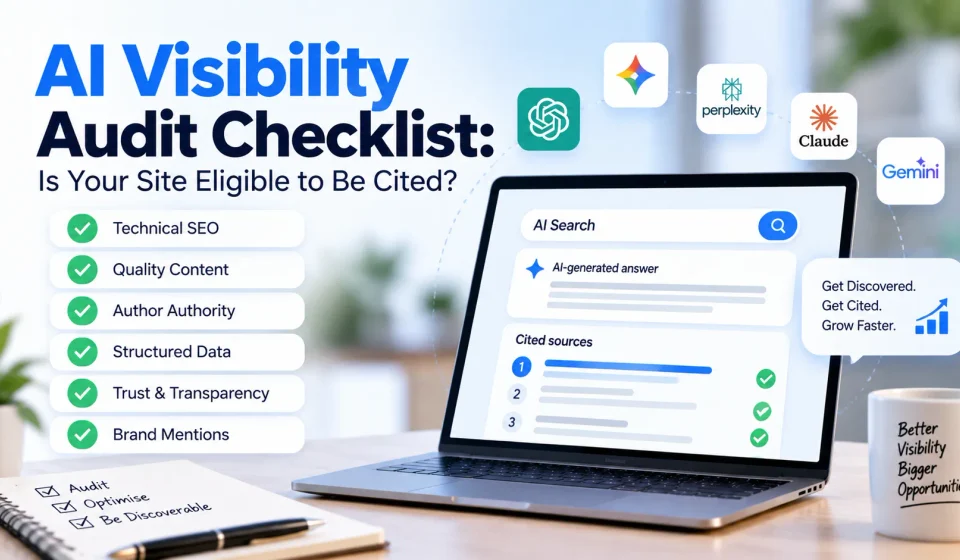
A complete AI visibility audit checks four layers in order: (1) technical crawlability — whether AI bots can access and render your content at all; (2) structured data — whether your markup tells AI systems what your content means and who’s behind it; (3) content structure — whether your pages are written in a format AI engines can extract cleanly; and (4) authority and entity signals — whether independent sources corroborate who you are and what you know. Run this checklist before hiring anyone, so you know which layer is actually broken.
Layer 1: Technical Crawlability
If AI crawlers can’t access your content, nothing else on this list matters. This is the most common — and most commonly overlooked — failure point.
- Check robots.txt for AI crawler access. Confirm that GPTBot (OpenAI), PerplexityBot, ClaudeBot (Anthropic) and Google-Extended are explicitly allowed. It’s a common and easily missed issue for sites to accidentally block these crawlers alongside spam or scraper bots when tightening robots.txt rules. (Source: TrackMyVisibility, AI Search Visibility Audit Checklist 2026)
- Test JavaScript rendering. Many AI crawlers don’t execute JavaScript the way a browser does. Disable JavaScript in your browser and check whether your key page content — headings, body text, pricing, FAQs — disappears. If it does, AI crawlers are likely seeing a blank or incomplete page. (Source: TrackMyVisibility, AI Search Visibility Audit Checklist 2026)
- Confirm each platform’s crawler separately. Each AI platform uses a different crawler with different behaviour: ChatGPT’s GPTBot favours content with direct, quotable answers; Perplexity emphasises source citation and rewards data-rich content; Claude’s crawler weights factual accuracy; Google AI Mode draws primarily from Google’s existing index. Optimising for one while accidentally blocking another is a common, avoidable mistake. (Source: SEOScore, AI Visibility Audit Guide 2026)
- Check for an llms.txt file. A growing number of AI-citation-ready sites are publishing a curated llms.txt manifest alongside their sitemap, giving AI agents a clearer map of which content to prioritise. This is still an emerging practice, not yet universal, but worth having in place. (Source: No7 Software, AI Visibility Tool)
Layer 2: Structured Data
Structured data is what tells AI systems what your content means, who you are, and why your answer is credible — not just that a page exists.
- Implement core schema types on priority pages, starting with Organization, Article, FAQPage and HowTo schema so AI crawlers can parse your content efficiently. (Source: QuickSEO, The Complete SEO Audit Checklist for 2026)
- Add
sameAsentity links. Organization schema should explicitly link your website to your LinkedIn, Crunchbase, Wikidata and other knowledge graph profiles, which signals to AI models that these separate profiles all refer to the same entity. (Source: TrackMyVisibility, AI Search Visibility Audit Checklist 2026) - Check for consistency between markup and visible content. AI systems check whether what your schema claims matches what’s actually written on the page — mismatches undermine trust signals rather than helping them.
- Validate schema on your top 20 pages first, rather than trying to cover the entire site at once — prioritise the pages most likely to answer high-intent buyer queries.
Layer 3: Content Structure and Extractability
Even a fully crawlable, well-marked-up page won’t get cited if the content itself isn’t written in a way AI engines can lift cleanly.
- Lead with a short, direct answer, then expand. Structure sections so the first sentence or two answers the implicit question, with supporting detail following — this is the format AI engines most reliably extract from. (Source: 201 Creative, The 2026 GEO Audit Checklist)
- Define terms on first use and keep language plain. Avoid jargon that requires outside context to parse correctly.
- Label facts, steps and thresholds clearly, and include sources or data points where relevant rather than vague claims.
- Publish dedicated FAQ pages that answer conversational, natural-language queries directly, since these map closely to how people actually phrase questions to ChatGPT and Perplexity. (Source: QuickSEO, The Complete SEO Audit Checklist for 2026)
- Rewrite case studies for quotability, following a problem → approach → measurable result → timeframe → proof structure with scannable takeaways an AI engine can lift as a self-contained answer.
- Check content freshness. Older, unmodified pages are cited less often than recently updated ones — review and update
dateModifiedtimestamps on content older than 12 months.
Layer 4: Authority and Entity Signals
This is the layer most businesses under-invest in, and it’s usually the difference between being technically eligible and actually getting cited.
- Run 20–30 buyer-intent queries manually. Go to ChatGPT, Perplexity and Google (with AI Mode enabled) and search the actual questions your customers would ask. Check whether your site appears in the citations. This qualitative check matters more than any automated score, because it shows you exactly what AI engines are choosing instead of you.
- Identify the “trust hubs” in your category. Run 30–50 commercial queries and note which domains get cited repeatedly across answers — these are the trust hubs for your space. Earning a mention on one of those pages often delivers faster citation gains than publishing new content of your own.
- Check your Wikipedia and Wikidata presence. These remain among the strongest trust signals for large language models. Confirm an entry exists, is accurate, and reflects your current positioning — and if it doesn’t exist, understand that it needs to be earned through genuine notability, not self-published.
- Assess E-E-A-T signals. If your brand isn’t showing up in AI responses despite being technically crawlable, the most common cause is a lack of Experience, Expertise, Authoritativeness and Trustworthiness signals or authoritative third-party citations — not a technical fault.
- Check earned-media presence, not just owned content. See our digital PR and AI citations guide for why third-party mentions typically outweigh on-site content when AI engines decide what to cite.
- Publish original research or data. A single study with specific, quotable statistics tends to earn citations from journalists, bloggers and AI systems alike in a way generic content cannot.
Setting a Measurable Baseline
None of the above matters without a way to track change over time. Before you make any fixes:
- Lock a stable prompt set of 10–30 queries relevant to your category and buyer journey, and keep the same set for every future audit so results are comparable.
- Capture screenshots and citation presence across ChatGPT, Perplexity, Gemini and Google AI Overviews for that prompt set, noting whether your brand appears, whether it’s linked, and how it’s positioned relative to competitors.
- Track brand citation frequency over time, not just a single snapshot — this is the only way to tell whether subsequent work is actually moving the needle.
- Re-run the full audit quarterly, with lighter monthly checks on the fastest-moving elements like structured data errors and citation presence, since AI platforms evolve their retrieval behaviour frequently enough that a one-time audit goes stale.
How to Read Your Results
If your manual query checks in Layer 4 show your brand rarely or never appearing, work backward through the checklist rather than assuming the problem is content quality:
- Nothing showing up anywhere, even for your own brand name? Start at Layer 1 — this is almost always a crawlability issue.
- Crawlable, but never cited on commercial queries? Check Layer 2 and 3 — your structured data or content format likely isn’t extraction-friendly.
- Well-structured content, still no citations, competitors dominating the same queries? The gap is almost certainly Layer 4 — you’re technically eligible but haven’t earned the third-party authority signals that tip AI engines toward citing you over a competitor.
This is also the point where it makes sense to bring in outside help rather than continuing to guess. Our Top 10 Best Perplexity SEO Agencies in Australia list and GEO pricing guide are the natural next stops if your audit turns up a Layer 4 problem, since that’s the layer paid digital PR and entity-building work is designed to fix.
Conclusion
Most AI visibility problems aren’t mysterious once you audit them in the right order. A site that’s invisible to ChatGPT and Perplexity is almost always failing at one specific, identifiable layer — a blocked crawler, missing schema, poorly structured content, or a lack of independent authority signals — not failing at all four simultaneously. Running through this checklist before spending on any paid GEO work tells you exactly which layer to fix first, and gives you a genuine baseline to measure whether anything you do afterward is actually working.
Start with the manual query check in Layer 4 today — it takes ten minutes and tells you more about your real AI visibility than any automated tool score. Then work backward through Layers 1 to 3 to find out why. If the diagnosis points to a bigger authority gap than you can close alone, GEO onboarding checklist will help you bring in the right help without overpaying for work you don’t need.
FAQs
How do I check if ChatGPT or Perplexity knows about my business?
Search 20–30 real buyer-intent queries directly in ChatGPT, Perplexity and Google AI Mode and note whether your site is cited. This manual check is more reliable than any single automated visibility score.
What’s the most common reason a site is invisible to AI search engines?
Accidentally blocking AI crawlers (GPTBot, PerplexityBot, ClaudeBot) in robots.txt is one of the most common and easily fixed causes. The second most common cause is a lack of third-party authority signals, even when the site is fully crawlable.
Do I need different strategies for ChatGPT versus Perplexity?
Yes. Each platform’s crawler and citation preferences differ — ChatGPT favours direct, quotable answers, Perplexity rewards data-rich, well-sourced content, and Google AI Mode draws heavily from its existing search index. A single-platform strategy typically leaves visibility on the table elsewhere.
How often should I re-run an AI visibility audit?
A full audit quarterly, with lighter monthly checks on structured data and citation presence, is a reasonable cadence given how quickly AI platforms change their retrieval behaviour.
Is a high SEO ranking enough to guarantee AI citations?
No. A page can rank well in Google and still be invisible to ChatGPT, and a page can be cited frequently by Perplexity while ranking on page three of Google. The two disciplines overlap but measure different outcomes, which is why a dedicated AI visibility audit is worth running separately from a standard SEO audit.