

If you’ve ever been asked to write a notice for a school function, a lost item, or an office announcement and weren’t sure where to start, you’re not alone. Notice writing is one of the most common formal writing tasks students and professionals are asked to complete – and also one of the easiest to get wrong, because it looks simple but follows strict, examiner-specific rules.
This guide covers everything in one place: the correct notice writing format, every major type of notice you’ll be asked to write, five fully solved examples, 20+ ready-to-use topics, and a clear, step-by-step answer to how to write a notice that scores full marks or reads as genuinely professional in a workplace setting.
What Is Notice Writing?
Notice writing is a formal, concise piece of written communication used to share important information with a specific group of people – students, employees, residents, or the general public – through a public or semi-public display. It’s meant to be read quickly, so it prioritizes clarity over detail.
Unlike a letter, which is addressed to one person, a notice is addressed to a group and is displayed on a board, portal, or public space for everyone in that group to see.
Where you’ll encounter notice writing:
- CBSE, ICSE, and state board English exams (Classes 6–12)
- School and college notice boards
- Corporate offices and HR communication
- Housing societies and RWAs
- Government and public announcements
Why Notice Writing Matters
Notice writing isn’t just an exam topic – it’s a real communication skill with practical value:
- Reaches many people at once without needing individual follow-up
- Creates a written, time-stamped record of what was communicated and when
- Builds credibility through a formal, professional tone
- Prevents miscommunication by putting details in writing rather than relying on verbal announcements
- Trains concise writing, since most notices are capped at 50 words
Also read: 100+ Paragraph Writing Topics in English with Samples
Notice Writing Format (Step by Step)
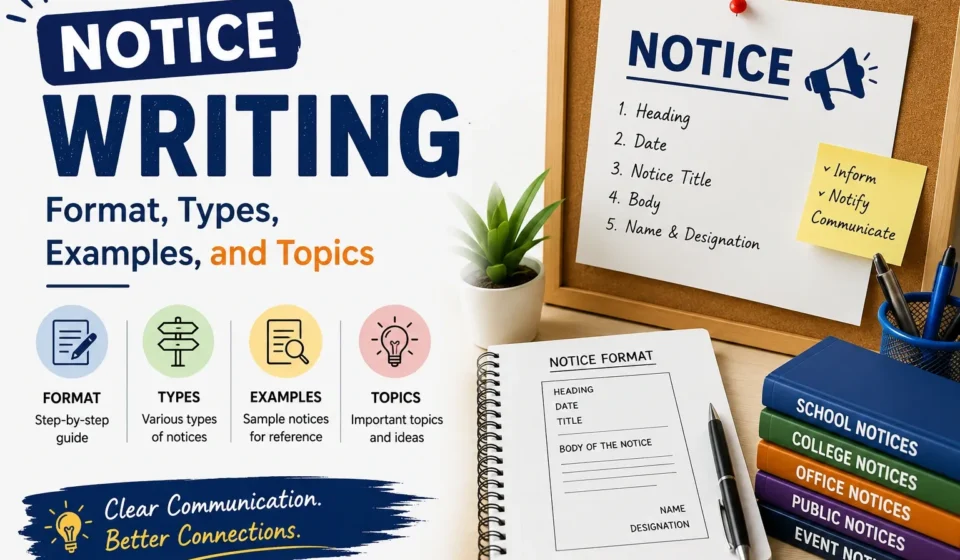
Every correct notice writing format follows the same six structural elements, in this order:
| # | Element | Details |
| 1 | Name of the Issuing Organization | School, college, office, or society name, placed at the top |
| 2 | The Word “NOTICE” | Centered, bold, capitalized – this is what identifies the document |
| 3 | Date of Issue | Written on the left, just below “NOTICE” |
| 4 | Heading/Subject | A short, underlined title stating exactly what the notice is about |
| 5 | Body | The core message – covers what, when, where, who, and why |
| 6 | Signature Block | Writer’s name, designation, and (if required) a box drawn around the entire notice |
A Quick Visual Template
[NAME OF ORGANIZATION]
NOTICE
Date: __________ [SUBJECT/HEADING]
Body of the notice – 4 to 5 lines covering:
what is happening, when, where, why, and
what action the reader should take.
Name
Designation
How to Write a Notice: A 7-Step Process
If you’re wondering exactly how to write a notice from scratch, follow this sequence every time:
- Identify the purpose. Ask: is this informing, inviting, warning, or instructing?
- List the 5 Ws. Jot down What, When, Where, Who, and Why before you write a single sentence – this prevents you from missing details mid-draft.
- Write the heading first. A precise heading (e.g., “Notice for Blood Donation Camp,” not just “Camp”) tells the reader instantly what to expect.
- Draft the body in passive, third-person voice. Formal notices avoid “I” and “you” – use phrasing like “Students are informed that…” instead of “I want to tell you…”
- Stick to the word limit. Most academic notices are 40–50 words. Professional notices can run slightly longer but should stay under 100 words wherever possible.
- Add contact details or an action step. A notice without a clear next step (who to contact, by when) is incomplete.
- Proofread for tone and grammar. Read it aloud once – if it sounds conversational, rewrite it in a more formal register.
Types of Notice Writing
Notices vary by purpose and audience. Here are 14 types you should know:
1. School/Academic Notice
Issued by a school or college for events, exams, holidays, or circulars affecting students.
2. Circular Notice
Sent within an organization to share policy updates, schedule changes, or internal announcements.
3. Employee/Warning Notice
Addressed to staff who haven’t followed workplace rules; used to formally flag the issue and request correction.
4. Event Notice
Promotes an upcoming event – a workshop, seminar, competition, or celebration.
5. Informational Notice
A general-purpose notice sharing routine information to a school, office, or public group.
6. Invitation Notice
Invites a group to an event, including venue, date, time, host, and RSVP details.
7. Lost and Found Notice
Informs a group about a lost or found item, with a description and contact information.
8. Meeting Notice
Announces an upcoming meeting, listing agenda points, participants, venue, and time.
9. Notice to Vacate
A formal notice, usually from a landlord to a tenant, requesting the property be vacated by a set date.
10. Public Notice
Issued by government bodies or municipal authorities for legal matters, public hearings, or civic announcements.
11. Termination Notice
Formally ends an employment contract, agreement, or membership.
12. Recruitment/Vacancy Notice
Announces open positions, eligibility criteria, and how to apply – common in schools, colleges, and companies.
13. Fee/Payment Notice
Informs a group about due dates, fee revisions, or maintenance charges (common in schools and housing societies).
14. Emergency/Safety Notice
Communicates urgent safety information – a closure, hazard, or evacuation instruction – and requires the clearest, shortest wording of all notice types.
Notice Writing Examples
Below are five fully solved samples across school, college, office, and society settings.
Example 1: Lost and Found Notice (School)
Prompt: You are Aarav, a student of Class 9-A, Delhi Public School. Write a notice about a lost blue backpack in the school library.
DELHI PUBLIC SCHOOL, NEW DELHI
NOTICE
Date: 15th July 2026 LOST BLUE BACKPACK
This is to inform all students that a blue backpack
was lost in the school library on 14th July 2026 during
the last period. It contains textbooks and a water bottle.
Whoever finds it is requested to contact the undersigned
at Class 9-A at the earliest.
Aarav Sharma
Class 9-A
Example 2: Event Notice (College)
Prompt: You are the Cultural Secretary of Xavier’s College, Mumbai. Write a notice announcing an inter-college photography competition.
ST. XAVIER’S COLLEGE, MUMBAI
NOTICE
Date: 20th July 2026 INTER-COLLEGE PHOTOGRAPHY CONTEST
The Cultural Committee is organizing an inter-college
photography competition on 2nd August 2026 in the
College Auditorium at 3:00 PM. Students from 8 colleges
will participate, and cash prizes await the top three
entries. Interested students must register at the
Cultural Office by 28th July 2026.
Riya Nair
Cultural Secretary
Example 3: Office Circular Notice
Prompt: You are the HR Manager at TechNova Pvt. Ltd. Write a notice about a change in office timings.
TECHNOVA PVT. LTD., BENGALURU
NOTICE
Date: 25th July 2026 CHANGE IN OFFICE TIMINGS
All employees are informed that, effective 1st August
2026, office hours will change from 9:00 AM–6:00 PM to
9:30 AM–6:30 PM. This applies to all departments.
Employees are requested to plan their commute
accordingly. For queries, contact HR at ext. 204.
Sameer Kapoor
HR Manager
Example 4: Housing Society Notice
Prompt: You are the Secretary of Green Valley Apartments. Write a notice about an upcoming water supply disruption.
GREEN VALLEY APARTMENTS, PUNE
NOTICE
Date: 27th July 2026 WATER SUPPLY DISRUPTION
Residents are informed that water supply will remain
suspended on 30th July 2026 from 10:00 AM to 4:00 PM
due to scheduled pipeline maintenance. Residents are
requested to store water in advance for the day.
Inconvenience is regretted.
Sunita Deshmukh
Society Secretary
Example 5: Meeting Notice (School Staff)
Prompt: You are the Principal of Green Meadows School. Write a notice calling a staff meeting to discuss the annual day.
GREEN MEADOWS SCHOOL, JAIPUR
NOTICE
Date: 29th July 2026 STAFF MEETING NOTICE
All teaching staff are informed that a meeting will be
held on 1st August 2026 at 3:30 PM in the Staff Room
to discuss arrangements for the Annual Day function.
Attendance is mandatory for all department heads.
Mrs. Kavita Rao
Principal
Topics for Notice Writing (20+ Ideas)
Looking for a good notice writing topic? Here are 20+ topics for notice writing organized by category, so you can pick one that matches your assignment or exam pattern.
School & College Topics
- Annual Day Celebration
- Inter-School Sports Meet
- Change in School Timings
- Parent-Teacher Meeting
- Registration for School Drama/Debate
- Library Book Return Reminder
- Summer/Winter Vacation Announcement
- Career Counselling Session
Community & Public Topics 9. Blood Donation Drive 10. Free Health Check-up Camp 11. Tree Plantation Drive 12. Road Closure for Repairs 13. Vaccination Camp Announcement 14. Society Annual General Meeting
Workplace Topics 15. Change in Office Policy 16. Job Vacancy Announcement 17. Employee Training Workshop 18. Office Relocation Notice 19. Work-from-Home Guidelines Update
General/Miscellaneous Topics 20. Lost and Found (ID Card, Bag, Phone) 21. Charity/Donation Drive 22. Book or Craft Exhibition 23. Maintenance Charges Reminder
Word Limit, Marking Scheme & Common Mistakes
Word limit: Academic boards (CBSE/ICSE) typically require 40–50 words for a notice. Going significantly over or under this range usually costs marks.
Common mistakes to avoid:
- Missing the box/border around the notice (required by most school formats)
- Forgetting the date or placing it on the wrong side
- Using first-person, informal language (“I want to tell everyone…”)
- Vague headings that don’t state the actual subject
- Leaving out the “action required” – what the reader should actually do
- No signature or designation at the end
- Exceeding the word limit with unnecessary detail
Notice Writing vs. Other Formats
| Format | Audience | Length | Tone |
| Notice | Group/public | 40–50 words | Formal, passive |
| Letter | One individual | 100–150 words | Formal, personal |
| Circular | Internal group | Varies | Formal, instructional |
| One or more people | Varies | Semi-formal to formal |
Expert Tips
- Keep sentences short – one idea per sentence
- Always double-check the date format matches your board’s convention
- Draw the box (in handwritten exams) before you start writing, so your content fits
- Use bold or capital letters only for the heading and the word “NOTICE,” not the entire body
- When in doubt about tone, err on the side of more formal, not less
FAQs
What is the correct notice writing format?
The correct format includes the organization’s name, the word “NOTICE,” the date, a heading, the body (with all key details), and a signature with designation – usually enclosed in a box.
What is the ideal word limit for notice writing?
Most academic notices should be between 40 and 50 words. Professional or public notices can be slightly longer but should stay concise.
How do I choose a good notice writing topic?
Pick a topic relevant to your setting – school events, lost items, meetings, or community drives are the most commonly asked topics for notice writing in exams.
What is the difference between a notice and a circular?
A notice is usually a one-time public announcement displayed on a board, while a circular is often used for recurring internal communication within an organization.
Should a notice be written in passive voice?
Yes, formal notices are conventionally written in passive, third-person voice (e.g., “Students are informed that…”) rather than first person.