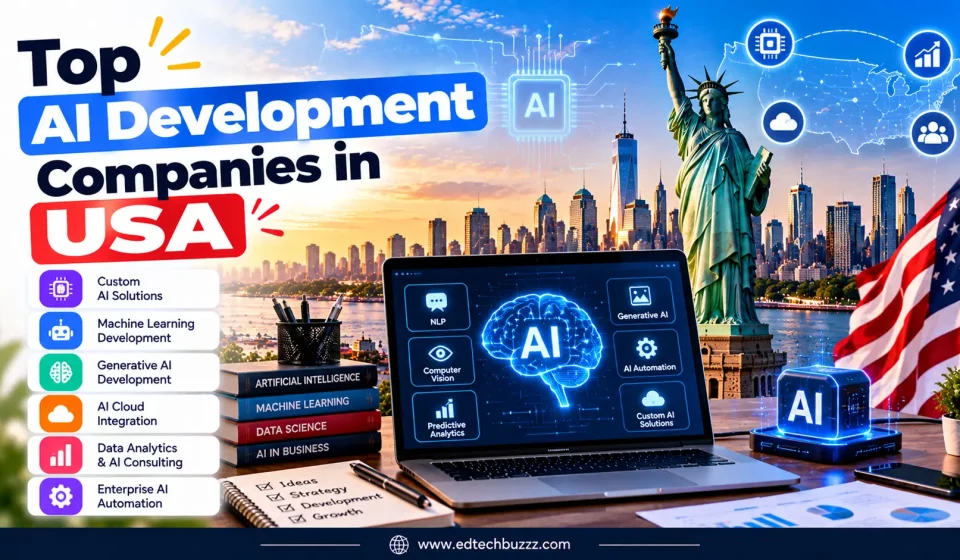

Artificial intelligence has moved from experiment to infrastructure. Most large organisations now use it somewhere in the business, and the harder question has become who should build it. The right AI development partner can ship a working system in months. The wrong one can burn a budget on demos that never reach production.
This guide profiles ten AI development companies serving US clients in 2026, with each firm’s founding year, headquarters, team size, core services, industries, pricing signals and the type of project it suits best. You also get the 2026 market numbers behind US AI investment and adoption, realistic cost ranges, and a checklist for choosing a partner and protecting yourself in the contract.
Quick answer: The top AI development companies serving US clients in 2026 include LeewayHertz, Simform, Coherent Solutions, Markovate, Azumo, SoluLab, Matellio, Idea Maker, EffectiveSoft and Citrusbug Technolabs. LeewayHertz and Simform suit larger enterprise builds, Markovate and Azumo suit focused generative AI and nearshore engineering, and Coherent Solutions suits buyers who want a long-established US-headquartered firm.
Editorial disclosure: This is an editorial ranking based on publicly available information: company websites, Clutch and Crunchbase profiles, industry roundups and press coverage, reviewed in October 2026. We have not audited any company’s client work. Ratings, review counts, team sizes and prices change often, so treat them as a snapshot and confirm them directly before you engage a vendor. Several firms deliver partly from offshore or nearshore teams, which we note in each profile.
AI in the USA: 2026 Market Overview and Key Stats
The United States remains the centre of gravity for AI investment, and Stanford’s 2026 AI Index gives the clearest picture of where things stand:
- US private AI investment reached $285.9 billion in 2025, about 23 times the $12.4 billion tracked for China, though Stanford notes the comparison likely understates Chinese spending because of government-backed funds. (Source: Stanford HAI, 2026 AI Index, Economy chapter)
- 88% of surveyed organisations reported using AI in 2025, up from 78% in 2024, and 70% reported using generative AI in at least one business function. (Source: Stanford AI Index 2026, as summarised by YourStory)
- Generative AI reached 53% population adoption within three years, faster than the personal computer or the internet. (Source: Stanford HAI)
- Generative AI led private funding growth, rising more than 200% and capturing nearly half of all private AI investment, while the number of newly funded AI companies rose 71%. (Source: Burges Salmon summary of the AI Index)
- The estimated annual value of generative AI tools to US consumers reached $172 billion by early 2026, up from $112 billion a year earlier. (Source: Stanford AI Index 2026 via YourStory)
- Adoption is wide but maturity is thin. The share of organisations that have achieved full integration at scale remains in the single digits across most business functions, and AI agent use is still early. (Source: Neodata analysis of the AI Index)
The takeaway for buyers: almost everyone is using AI, but few have turned it into scaled, production-grade systems. That gap between experimenting and operating is exactly where specialist development partners earn their fees.
How We Ranked These AI Development Companies
We scored firms on a weighted rubric using public evidence:
- Technical and AI depth (30%): documented AI, machine learning and generative AI work, not just a services page.
- Third-party ratings and client proof (25%): Clutch, GoodFirms or similar profiles with visible review counts and named outcomes.
- US presence and delivery model (15%): headquarters location and whether delivery is onshore, nearshore or offshore.
- Generative AI and agentic readiness (15%): current work on large language models, retrieval-augmented generation and AI agents.
- Pricing transparency and engagement fit (15%): published rates or ranges and suitability for startups, mid-market or enterprise.
Rankings are editorial judgements. A lower position does not mean a firm is worse for your project, so read the “Best for” line in each profile.
Comparison Table: Top 10 AI Development Companies in the USA
| Rank | Company | Founded | HQ / US presence | Core AI focus |
|---|---|---|---|---|
| 1 | LeewayHertz | 2007 | San Francisco, CA (engineering largely in India) | Enterprise AI agents, generative AI, ZBrain platform |
| 2 | Simform | 2010 | Ahmedabad, India (US offices in Orlando, Austin, Los Angeles) | Cloud-native AI/ML, agentic AI, product engineering |
| 3 | Coherent Solutions | 1995 | Minneapolis, MN | NLP, generative AI, predictive analytics, computer vision |
| 4 | Markovate | 2015 | San Francisco, CA | Generative AI, agentic AI, LLMs, MLOps |
| 5 | Azumo | 2016 | San Francisco, CA (Latin America nearshore) | AI/ML, generative AI, data engineering |
| 6 | SoluLab | 2014 | Los Angeles, CA (India delivery) | AI-native builds, generative AI, blockchain |
| 7 | Matellio | 2014 | San Jose, CA (UK and India) | AI/ML, IoT, custom enterprise software |
| 8 | Idea Maker | 2016 | Irvine, CA (LA and Dallas offices) | Custom AI, RAG, AI agents, project rescue |
| 9 | EffectiveSoft | 2000 | San Diego, CA (Eastern Europe delivery) | AI/ML, NLP, computer vision, generative AI |
| 10 | Citrusbug Technolabs | 2013 | Itasca, IL | Custom AI, generative AI, LLMs, AI agents, NLP |
Details reflect public company information and directory listings as of 2026 and may change.
1. LeewayHertz
Founded: 2007 | HQ: San Francisco, CA | Team: 250+ engineers, designers and data scientists | Pricing signal: roughly $50 to $99 per hour, typical project minimum near $10,000
LeewayHertz is an early mover in enterprise AI agents and generative AI. It has a US headquarters in San Francisco, with most engineering run from India, and it was acquired by The Hackett Group in September 2024. Its ZBrain platform is a generative AI orchestration product used to build and manage AI applications and agents, which gives clients a named platform rather than only bespoke code.
Core services: AI consulting and development, generative AI, AI agents, the ZBrain platform, plus blockchain and Web3. Industries: finance, healthcare, retail, supply chain and manufacturing.
Best for: Large enterprises needing production LLM and multi-agent work, who can plan around an India-based delivery team. The trade-off is that capacity for very large concurrent programmes may be more limited than at a staffing-scale firm.
2. Simform
Founded: 2010 | HQ: Ahmedabad, India, with US offices in Orlando, Austin and Los Angeles | Team: 1,000+ engineers | Pricing signal: project-based, minimum around $25,000
Simform is a large digital-engineering firm that Clutch ranked first for AI development among more than 14,000 firms in its Spring 2025 Global Leaders analysis. It holds Microsoft Azure Expert MSP status and works as an extension of a client’s own engineering team through a co-engineering model.
Core services: product and platform engineering, cloud and DevOps, data engineering, agentic AI and machine learning. Industries: SaaS, healthcare, fintech, retail, logistics and hi-tech.
Best for: Mid-market and enterprise teams wanting cloud-native AI with strong project management on AWS, Azure or GCP. Note that core delivery sits in India, so plan for time-zone overlap, and that Simform is headquartered outside the US even though it serves US clients through local offices.
3. Coherent Solutions
Founded: 1995 | HQ: Minneapolis, MN | Team: roughly 1,700 to 2,000 across ten countries | Pricing signal: roughly $30 to $70 per hour
Coherent Solutions is a US-headquartered engineering firm with three decades of history, development centres across Eastern Europe and Latin America, and a 2025 Clutch Global award in AI, NLP and robotics. It took strategic investment from IceLake Capital in 2025.
Core services: AI and machine learning, NLP, generative AI, predictive analytics, computer vision, cloud and DevOps. Industries: fitness and wellness technology, finance, healthcare and manufacturing.
Best for: Mid-market and enterprise buyers who value a long-established US partner. Because it is a broad digital-engineering house first and an AI specialist second, ask specifically about the AI team that would staff your build.
4. Markovate
Founded: 2015 | HQ: San Francisco, CA | Team: 50+ certified AI engineers, 300+ solutions delivered | Pricing signal: project-based
Markovate is built specifically around generative AI, agentic systems and MLOps rather than general software. It reports ISO 9001:2015 and ISO/IEC 27001:2022 certification, a meaningful signal for regulated buyers, and is led by CEO Rajeev Sharma, who has an enterprise AI background at AT&T and IBM.
Core services: generative AI, agentic AI, LLMs, MLOps, AI agents, computer vision and predictive models. Industries: manufacturing, healthcare, insurance, construction, real estate, fintech and SaaS.
Best for: Organisations that want an AI-first partner with formal security and quality certifications. The deliberately small team suits focused, senior-led builds more than sprawling multi-team programmes.
5. Azumo
Founded: 2016 | HQ: San Francisco, CA | Team: 51 to 200 | Pricing signal: roughly $30 to $70 per hour
Azumo pairs US-based leadership with nearshore engineering teams across Latin America in aligned time zones, which removes much of the lag of offshore delivery. It is SOC 2 certified, stays independent at the model layer (choosing among providers such as OpenAI, Anthropic, Google and open-weight models rather than pushing one) and reports 100-plus AI projects since 2016.
Core services: AI and machine learning, generative AI, data engineering, cloud, chatbots and voice. Industries: fintech, healthcare, media, gaming, e-commerce and logistics.
Best for: US teams wanting dedicated engineering pods in their own time zone, and buyers who prefer model independence. As a smaller firm it fits embedded-pod and staff-augmentation work better than very large fixed-scope programmes.
6. SoluLab
Founded: 2014 | HQ: Los Angeles, CA | Team: roughly 200 (reports vary) | Pricing signal: projects roughly $5,000 to $100,000 and up
SoluLab grew out of blockchain and Web3 work and has moved into an AI-first delivery model, pairing senior practitioners with AI-accelerated teams. Delivery centres are in India. It has roughly 50 Clutch reviews listed.
Core services: AI-native product development, generative AI, AI agents, blockchain, Web3 and tokenisation. Industries: healthcare, finance, education, supply chain and government.
Best for: Teams building at the crossover of AI and blockchain. Because the firm spans AI, blockchain and general software, pin down which team and specialty you are actually buying.
7. Matellio
Founded: 2014 | HQ: San Jose, CA | Team: around 250 (aggregator figures run lower) | Pricing signal: engagements roughly $10,000 to $500,000 and up
Matellio is a software-engineering studio with strong AI/ML and IoT depth, offices in the US and UK, and engineering labs in India. It reports CMMI Level 3 certification, a 98% client retention rate and more than 1,100 projects delivered, and was named to Clutch’s Top 15 AI Development Global Leaders in 2022.
Core services: AI and machine learning, IoT, custom software, digital transformation and enterprise platforms. Industries: healthcare, finance, retail, logistics and geospatial.
Best for: Mid-market companies wanting AI and IoT woven into a broader custom-software build with a US front and offshore delivery. It fits AI-plus-software programmes better than research-heavy modelling.
8. Idea Maker
Founded: 2016 | HQ: Irvine, CA, with offices in Los Angeles and Dallas | Rating: 4.9 on Clutch per its profile (confirm the live review count) | Pricing signal: project-based
Idea Maker is a US-based custom software and AI development company working on a boutique, founder-involved model. It reports more than 200 projects delivered since 2016 and runs a separate software-project-rescue service for stalled or inherited builds, which few AI firms offer as a named service line.
Core services: custom AI development, generative AI and retrieval-augmented generation (RAG), AI agents and automation, custom software, web and mobile development, and project rescue. Industries: fintech, healthcare, manufacturing, eLearning and legal.
Best for: Companies wanting a boutique partner to build a custom AI or SaaS product end to end, and teams needing a failed or inherited build audited and shipped.
9. EffectiveSoft
Founded: 2000 (some sources say 2003) | HQ: San Diego, CA | Rating: around 19 Clutch reviews | Pricing signal: project-based
EffectiveSoft is a long-established, US-headquartered engineering firm with development centres in Eastern Europe. It holds ISO/IEC 27001:2022 certification and uses a single-team ownership model, in which one accountable team stays involved from system definition through long-term operation.
Core services: AI and machine learning, NLP, computer vision, generative AI, predictive analytics and robotic process automation. Industries: healthcare, fintech, trading, logistics and independent software vendors.
Best for: Companies wanting AI integrated into existing production systems by a team with 20-plus years of engineering behind it and a fintech and healthcare track record.
10. Citrusbug Technolabs
Founded: 2013 | HQ: Itasca, IL | Rating: 4.7 out of 5 on Clutch from 48 reviews, per its directory listing
Citrusbug Technolabs is an Illinois-based software company offering custom AI development alongside web and mobile engineering. Its listed AI services cover generative AI, large language model development, AI agents, machine learning and natural language processing.
Best for: Small and mid-sized businesses wanting a US-headquartered vendor for custom AI features within a wider software project. Ask for AI-specific case studies, since public detail on its AI engagements is thinner than for some larger firms.
How Much Does AI Development Cost in the USA?
Costs depend heavily on scope and data readiness. The ranges below are market observations drawn from published agency pricing, not quotes:
| Project type | Typical range (USD) | What it usually includes |
|---|---|---|
| Proof of concept | About $10,000 to $50,000 | A narrow working demo to prove the idea and reduce risk |
| Mid-scope build | About $50,000 to $250,000 | A production feature or application integrated into existing systems |
| Enterprise platform | About $250,000 to $1,000,000+ | A full platform with governance, security and ongoing operation |
Blended hourly rates track delivery location more than anything else. Firms with nearshore or offshore delivery often blend to roughly $30 to $99 per hour, while US-heavy senior teams run higher. The line item most buyers forget is data readiness: cleaning, labelling and building pipelines can account for an estimated 20% to 40% of a budget before any model is trained.
How to Choose an AI Development Company
- Define success in numbers first. Decide what the AI must do and what it should move, such as tickets deflected, hours saved or error rate reduced. A good partner will challenge a vague goal.
- Check data fit. Most AI projects succeed or fail on data. Ask how the vendor assesses data quality, volume and legal rights to use it.
- Confirm who writes the code. Get the names and seniority of the people on your project in writing, and ask how work is reviewed.
- Verify security and compliance. SOC 2 or ISO/IEC 27001 is a reasonable baseline for anything touching sensitive data.
- Plan post-launch ownership. Models drift and data changes, so confirm monitoring, retraining and maintenance costs after go-live.
Three contract questions to get in writing
- Who owns the trained model and its weights? Some firms retain fine-tuned models and license them back.
- Who owns the data pipeline and processed datasets? Without them you may be locked in every time you retrain.
- What does handover include? Source code, documentation, deployment access and a retraining plan should all be specified.
Red flags include no verifiable third-party reviews, vagueness about model and data ownership, no security certifications, accuracy promises that sound too clean, no discovery phase, and a pitch led by senior people who disappear once juniors take over.
Conclusion
With US private AI investment at record levels and organisational adoption near 90%, the competitive edge now comes from building systems that work in production, not from experimenting. The ten companies above each cover a different need: enterprise agents at LeewayHertz, cloud-native scale at Simform, long-established stability at Coherent Solutions, focused generative AI at Markovate, nearshore pods at Azumo, AI plus blockchain at SoluLab, AI plus IoT at Matellio, boutique end-to-end builds and rescue at Idea Maker, production integration at EffectiveSoft and cost-conscious custom builds at Citrusbug.
Match the firm to where your project is most likely to break, confirm ownership and post-launch support in writing, and verify ratings and certifications on the day you decide.
FAQs
What is an AI development company?
An AI development company designs, builds, fine-tunes, deploys and maintains custom AI systems for clients, such as chatbots, recommendation engines, document-processing tools and AI agents. Unlike foundation-model labs, these firms apply existing models and techniques to specific business problems.
Who are the top AI development companies in the USA in 2026?
Frequently cited firms serving US clients include LeewayHertz, Simform, Coherent Solutions, Markovate, Azumo, SoluLab, Matellio, Idea Maker, EffectiveSoft and Citrusbug Technolabs. The best fit depends on your project scope, data maturity and preferred delivery model.
How much does it cost to hire an AI development company?
A focused proof of concept typically costs about $10,000 to $50,000, a production build roughly $50,000 to $250,000, and an enterprise platform $250,000 to $1 million or more. Hourly rates for many firms fall between about $30 and $99 depending on delivery location.
How long does an AI software build take?
A proof of concept usually takes four to eight weeks, a production build three to six months, and a full enterprise platform six to twelve months or more. Data readiness is the biggest swing factor.
Is an offshore or nearshore AI company risky for a US project?
Not inherently. The real risks are time-zone overlap, communication, data jurisdiction and security posture, all of which can be managed. Check certifications such as SOC 2 or ISO/IEC 27001, contract terms on IP and data residency, and client references.
What if my data isn’t ready for AI?
That is the normal starting point. Most serious engagements begin with a data assessment, and you should budget for cleanup, labelling and pipeline work. Be wary of any vendor that quotes a build timeline without examining your data.
What should I ask before signing an AI development contract?
Ask who owns the trained model and weights, who owns the data pipeline, what the handover includes, who will write the code, and what maintenance costs after launch. Get all of it in writing.