
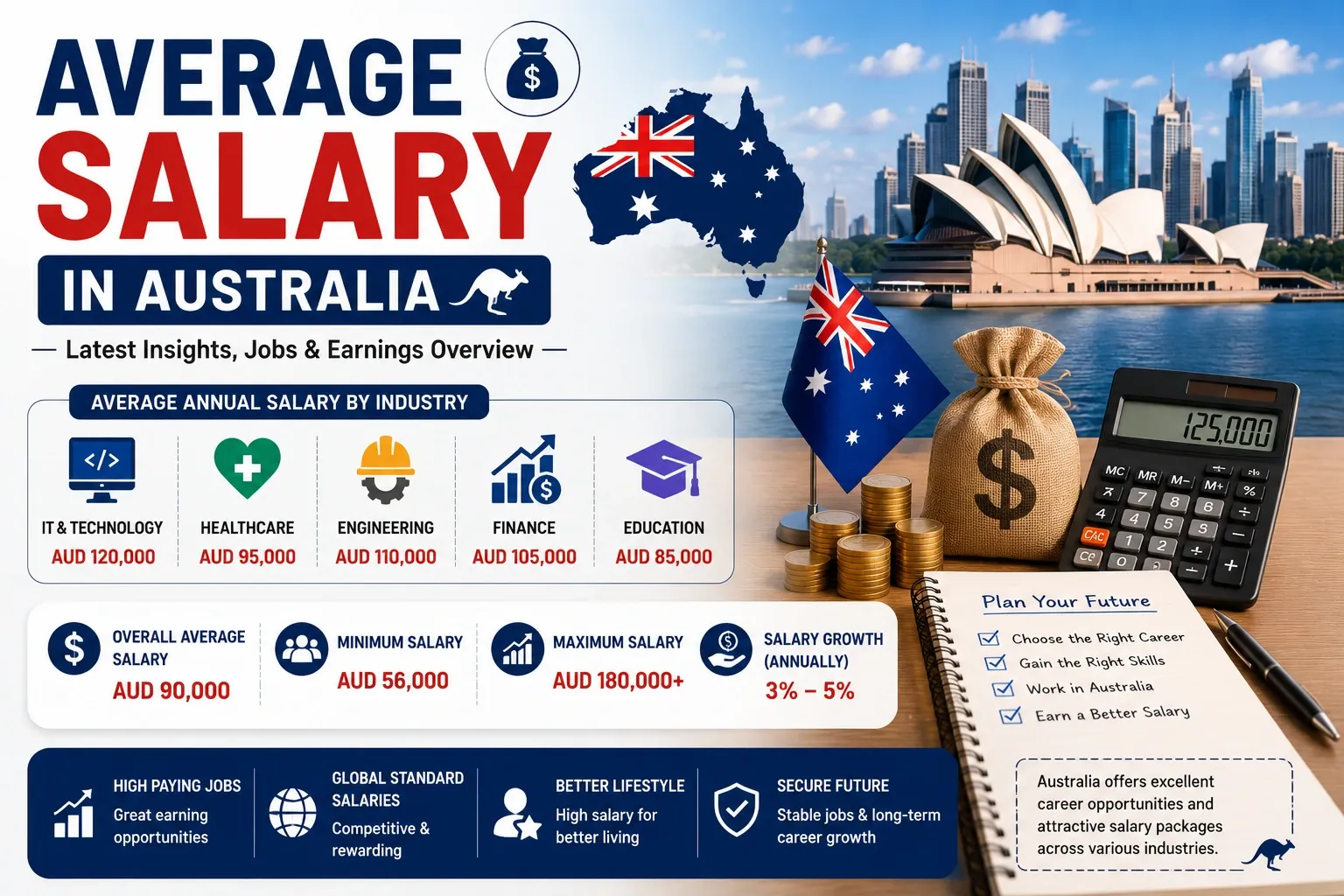

The average salary in Australia in 2026 is approximately AUD $98,218 per year (around AUD $8,184 per month) for full-time employees, based on data from the Australian Bureau of Statistics (ABS). The median salary in Australia – which better reflects what most workers actually earn – is approximately AUD $72,000 – $78,000 per year. The national minimum wage in Australia from July 2026 is AUD $24.10 per hour, which equals approximately AUD $915 per week or around AUD $3,965 per month for a full-time worker.
Introduction: Why Understanding Australian Salaries Matters in 2026
Australia is one of the most popular migration and study destinations in the world – and for good reason. It consistently ranks among the top five countries globally for quality of life, worker rights, and earning potential.
Whether you are an Indian student planning to study and work in Australia, a skilled professional evaluating an Australian job offer, or simply curious about how Australian wages compare – understanding the average salary in Australia is your starting point.
But here is the thing most salary guides miss: the average wage in Australia alone does not tell you the full story. What matters more is:
- What is the median salary – the real middle-ground most workers earn?
- What is the minimum salary per month guaranteed by Australian law?
- How does pay differ by industry, city, experience, and qualification?
- And critically for Indian readers – what does an Australian salary look like in Indian Rupees (INR)?
This complete guide answers every one of these questions with the most up-to-date 2026 data.
What Is the Average Salary in Australia in 2026?
Based on the Australian Bureau of Statistics (ABS) Average Weekly Earnings (AWE) survey, the latest full-time adult average weekly ordinary time earnings data for 2026gives us the following benchmarks:
Australia Average Salary – 2026 Snapshot
| Metric | Amount (AUD) | Amount (INR approx.) |
|---|---|---|
| Average Annual Salary (Full-Time) | AUD $98,218 | ₹54.5 Lakhs |
| Average Monthly Salary | AUD $8,184 | ₹4.54 Lakhs |
| Average Weekly Salary | AUD $1,889 | ₹1.05 Lakhs |
| Average Daily Rate (5-day week) | AUD $378 | ₹20,980 |
| Average Hourly Rate | AUD $47.20 | ₹2,620 |
Note: INR conversions calculated at 1 AUD = ₹55.50 (approximate rate, July 2026). Exchange rates fluctuate – always check the current rate before making financial decisions.
Also read: SAT Exam 2026: Full Form, Eligibility, Dates, Syllabus, Fees
Average vs Median Salary in Australia – What Is the Difference?
This is the most important distinction most salary articles fail to explain clearly.
Average salary is calculated by adding up all salaries and dividing by the number of workers. The problem? A small group of very high earners – mining executives, surgeons, CEOs – can drag the average up significantly, making it look like “everyone” earns that much. Most people do not.
Median salary is the salary right in the middle – half of all workers earn more than this, and half earn less. It is a much more realistic picture of what a typical Australian worker actually takes home.
Average vs Median Salary in Australia 2026
| Measure | Annual (AUD) | Monthly (AUD) | What It Tells You |
|---|---|---|---|
| Average Salary | ~$98,218 | ~$8,184 | Skewed upward by high earners |
| Median Salary | ~$72,000 – $78,000 | ~$6,000 – $6,500 | What most Australians actually earn |
| Median Weekly Earnings | ~$1,425 per week | – | ABS Labour Force Survey data |
Key Insight for Indian Job Seekers: When an Australian employer or recruiter mentions salary expectations, compare against the median salary – not the average. If you are offered AUD $70,000–$80,000 for a standard professional role, that is actually in line with or above what most Australians earn.
Read Also: Top 10 Toughest Exams in India (2026)
Minimum Salary in Australia Per Month 2026- The Legal Baseline
Australia has one of the highest national minimum wages in the world, set and reviewed annually by the Fair Work Commission.
Australia Minimum Wage 2026 (Effective 1 July 2026)
| Period | Minimum Amount (AUD) | INR Equivalent (approx.) |
|---|---|---|
| Per Hour | AUD $24.10 | ₹1,337 |
| Per Day (8 hours) | AUD $192.80 | ₹10,700 |
| Per Week (38 hours) | AUD $915.90 | ₹50,830 |
| Per Month (approx.) | AUD $3,968 | ₹2.20 Lakhs |
| Per Year (full-time) | AUD $47,636 | ₹26.44 Lakhs |
Important: The national minimum wage is the absolute legal floor. Most Australian workers – especially in skilled professions – earn significantly more. Many industries also have Modern Awards that set higher minimum rates than the national minimum wage.
Australia Basic Salary Compared to Other Countries
| Country | Annual Minimum Wage (USD equiv.) |
|---|---|
| Australia | ~USD $31,000 |
| United States | ~USD $15,080 |
| United Kingdom | ~USD $24,000 |
| Canada | ~USD $25,000 |
| India | ~USD $1,200 – $3,600 |
Australia’s basic salary and minimum wage framework is among the most generous globally – a key reason why it attracts skilled migrants and international students looking for part-time work rights.
Average Salary in Australia Per Month – By Career Stage
Understanding how monthly salary in Australia grows with experience helps you plan your career trajectory realistically.
Monthly Salary by Experience Level (2026)
| Career Stage | Annual Salary (AUD) | Monthly Salary (AUD) | INR/Month (approx.) |
|---|---|---|---|
| Entry Level (0–2 years) | $50,000 – $65,000 | $4,167 – $5,417 | ₹2.31 – ₹3.00 Lakhs |
| Junior Professional (2–5 years) | $65,000 – $85,000 | $5,417 – $7,083 | ₹3.00 – ₹3.93 Lakhs |
| Mid-Level (5–10 years) | $85,000 – $110,000 | $7,083 – $9,167 | ₹3.93 – ₹5.09 Lakhs |
| Senior Professional (10–15 years) | $110,000 – $150,000 | $9,167 – $12,500 | ₹5.09 – ₹6.94 Lakhs |
| Executive / Management | $150,000 – $250,000+ | $12,500 – $20,833+ | ₹6.94 – ₹11.57 Lakhs+ |
Learn more: DHA Exam 2026: Full Form, Eligibility, Fees, Syllabus Guide
Average Income Australia – Industry-Wise Breakdown 2026
Not all industries pay equally. Here is a detailed look at average salary in Australia by industry – one of the most searched aspects of Australian wage data.
Industry-Wise Average Salary Australia 2026
| Industry | Average Annual Salary (AUD) | Average Monthly (AUD) |
|---|---|---|
| Mining & Resources | $145,000 – $180,000 | $12,083 – $15,000 |
| Financial Services & Banking | $110,000 – $150,000 | $9,167 – $12,500 |
| Information Technology (IT) | $105,000 – $140,000 | $8,750 – $11,667 |
| Engineering (Civil, Mechanical) | $95,000 – $130,000 | $7,917 – $10,833 |
| Healthcare & Medicine | $90,000 – $160,000+ | $7,500 – $13,333+ |
| Construction & Trades | $85,000 – $120,000 | $7,083 – $10,000 |
| Legal Services | $90,000 – $140,000 | $7,500 – $11,667 |
| Education & Training | $75,000 – $100,000 | $6,250 – $8,333 |
| Marketing & Communications | $70,000 – $100,000 | $5,833 – $8,333 |
| Accounting & Finance | $75,000 – $110,000 | $6,250 – $9,167 |
| Retail & Hospitality | $50,000 – $65,000 | $4,167 – $5,417 |
| Agriculture & Farming | $55,000 – $75,000 | $4,583 – $6,250 |
| Social Work & Community Services | $65,000 – $85,000 | $5,417 – $7,083 |
| Arts, Media & Entertainment | $55,000 – $75,000 | $4,583 – $6,250 |
Highest Paying Industries in Australia 2026: Mining leads by a wide margin, followed by Financial Services and IT. If you are planning a career change or choosing a study program in Australia, these three industries offer the best long-term salary growth.
Average Salary in Australia by Occupation 2026
Here are the average wages for specific job roles – the most practical salary data for job seekers and students.
Top 20 In-Demand Jobs and Their Average Salaries
| Job Role | Average Annual Salary (AUD) | Monthly (AUD) |
|---|---|---|
| Surgeon / Specialist Doctor | $250,000 – $500,000+ | $20,833+ |
| Anaesthetist | $200,000 – $350,000 | $16,667 – $29,167 |
| Mining Engineer | $130,000 – $180,000 | $10,833 – $15,000 |
| Software Engineer / Developer | $110,000 – $145,000 | $9,167 – $12,083 |
| Data Scientist / AI Engineer | $120,000 – $155,000 | $10,000 – $12,917 |
| Cybersecurity Analyst | $110,000 – $140,000 | $9,167 – $11,667 |
| Project Manager | $110,000 – $140,000 | $9,167 – $11,667 |
| Registered Nurse | $78,000 – $100,000 | $6,500 – $8,333 |
| General Practitioner (GP) | $150,000 – $220,000 | $12,500 – $18,333 |
| Dentist | $120,000 – $180,000 | $10,000 – $15,000 |
| Pharmacist | $95,000 – $120,000 | $7,917 – $10,000 |
| Civil / Structural Engineer | $100,000 – $135,000 | $8,333 – $11,250 |
| HR Manager | $100,000 – $130,000 | $8,333 – $10,833 |
| Financial Analyst / Accountant | $85,000 – $115,000 | $7,083 – $9,583 |
| Electrician / Plumber | $85,000 – $110,000 | $7,083 – $9,167 |
| Secondary School Teacher | $78,000 – $100,000 | $6,500 – $8,333 |
| Marketing Manager | $95,000 – $125,000 | $7,917 – $10,417 |
| Architect | $85,000 – $115,000 | $7,083 – $9,583 |
| Physiotherapist | $75,000 – $100,000 | $6,250 – $8,333 |
| Chef / Head Cook | $60,000 – $85,000 | $5,000 – $7,083 |
Average Wage in Australia by State and City 2026
Where you live in Australia significantly affects your salary. Here is how average income in Australia varies by state and territory:
Average Salary by Australian State 2026
| State / Territory | Average Annual Salary (AUD) | Average Monthly (AUD) | Key Driver |
|---|---|---|---|
| Australian Capital Territory (ACT) | $105,000 – $115,000 | $8,750 – $9,583 | Government & Defence |
| New South Wales (NSW) | $95,000 – $105,000 | $7,917 – $8,750 | Finance, Tech, Professional Services |
| Victoria (VIC) | $88,000 – $98,000 | $7,333 – $8,167 | Education, Health, Retail |
| Western Australia (WA) | $95,000 – $108,000 | $7,917 – $9,000 | Mining, Oil & Gas |
| Queensland (QLD) | $85,000 – $95,000 | $7,083 – $7,917 | Tourism, Construction, Mining |
| South Australia (SA) | $78,000 – $88,000 | $6,500 – $7,333 | Healthcare, Agriculture |
| Tasmania (TAS) | $72,000 – $82,000 | $6,000 – $6,833 | Agriculture, Tourism |
| Northern Territory (NT) | $80,000 – $92,000 | $6,667 – $7,667 | Mining, Public Sector |
Average Salary in Key Australian Cities
| City | Average Annual Salary (AUD) |
|---|---|
| Sydney | $98,000 – $110,000 |
| Melbourne | $92,000 – $105,000 |
| Canberra | $105,000 – $115,000 |
| Perth | $98,000 – $112,000 |
| Brisbane | $88,000 – $98,000 |
| Adelaide | $80,000 – $92,000 |
| Hobart | $74,000 – $84,000 |
| Darwin | $82,000 – $95,000 |
Note for Indian Students Choosing Between Cities: Sydney and Melbourne offer the highest average wages but also the highest cost of living. Canberra and Perth offer excellent salary-to-cost ratios, especially for IT, engineering, and government roles.
Average Salary in Australia by Education Level
Higher qualifications directly translate to higher earning potential in Australia.
Salary by Education Qualification (2026)
| Education Level | Average Annual Salary (AUD) | Monthly (AUD) |
|---|---|---|
| No Formal Qualification | $45,000 – $55,000 | $3,750 – $4,583 |
| Certificate III / IV | $55,000 – $72,000 | $4,583 – $6,000 |
| Diploma / Associate Degree | $65,000 – $82,000 | $5,417 – $6,833 |
| Bachelor’s Degree | $72,000 – $95,000 | $6,000 – $7,917 |
| Postgraduate / Master’s Degree | $95,000 – $130,000 | $7,917 – $10,833 |
| Doctorate / PhD | $120,000 – $160,000+ | $10,000 – $13,333+ |
For Indian Students: A master’s degree from an Australian university combined with relevant work experience can push you comfortably into the $95,000–$130,000 salary bracket – making the investment in Australian education highly worthwhile from a return-on-investment perspective.
Gross vs Net Salary in Australia – What You Actually Take Home
Knowing the gross salary (before tax) is only half the picture. Here is what Australians actually receive as net (take-home) pay after taxes and superannuation.
Australia Tax and Superannuation Overview (2026)
| Component | Rate / Amount |
|---|---|
| Superannuation (Employer Contribution) | 11.5% of gross salary (compulsory) |
| Tax-Free Threshold | First AUD $18,200 per year |
| Tax Rate: $18,201 – $45,000 | 16% |
| Tax Rate: $45,001 – $120,000 | 30% |
| Tax Rate: $120,001 – $180,000 | 37% |
| Tax Rate: $180,001+ | 45% |
| Medicare Levy | 2% of taxable income |
Net Monthly Take-Home Pay Examples
| Gross Annual Salary | Estimated Monthly Net Pay (AUD) | INR Equivalent (approx.) |
|---|---|---|
| AUD $55,000 | ~$3,750 | ₹2.08 Lakhs |
| AUD $72,000 | ~$4,700 | ₹2.61 Lakhs |
| AUD $90,000 | ~$5,750 | ₹3.19 Lakhs |
| AUD $110,000 | ~$6,900 | ₹3.83 Lakhs |
| AUD $140,000 | ~$8,400 | ₹4.66 Lakhs |
| AUD $180,000 | ~$10,300 | ₹5.72 Lakhs |
Superannuation Note: Your employer also pays 11.5% on top of your salary into your superannuation (retirement) fund. This is separate from your take-home pay but adds significant long-term financial value to your employment package.
Gender Pay Gap in Australia 2026
The gender pay gap in Australia remains an important topic in workforce discussions.
- The national gender pay gap in Australia is approximately 11.5% as of 2026- a reduction from 13% in prior years
- Men earn on average AUD $26,000 more per year than women in full-time roles
- The gap is widest in Financial Services, Construction, and Mining
- The gap is narrowest in Healthcare, Education, and Public Administration
- The Australian Government’s Workplace Gender Equality Agency (WGEA) now mandates large employers to publish their gender pay gap data publicly – a major step toward closing the divide
Average Salary in Australia for International Students and Graduate Visa Holders
A huge number of readers searching for average salary in Australia are Indian students or recent graduates on Temporary Graduate Visas (Subclass 485). Here is what you need to know:
Part-Time Work During Study
International students in Australia are permitted to work limited hours during their course. With the minimum wage of AUD $24.10/hour, even part-time work provides meaningful income compared to most countries.
| Hours Per Week | Monthly Earnings (AUD) | Monthly Earnings (INR approx.) |
|---|---|---|
| 10 hours/week | ~$1,044 | ₹57,940 |
| 24 hours/week | ~$2,506 | ₹1.39 Lakhs |
| 40 hours/week (full-time) | ~$4,177 | ₹2.32 Lakhs |
Graduate Salary Expectations (First Job After Degree)
| Field | Average Starting Salary (AUD) | Monthly (AUD) |
|---|---|---|
| IT / Computer Science | $75,000 – $90,000 | $6,250 – $7,500 |
| Engineering | $70,000 – $88,000 | $5,833 – $7,333 |
| Nursing / Healthcare | $68,000 – $80,000 | $5,667 – $6,667 |
| Business / Finance | $65,000 – $82,000 | $5,417 – $6,833 |
| Education | $65,000 – $80,000 | $5,417 – $6,667 |
| Accounting | $65,000 – $80,000 | $5,417 – $6,667 |
What Factors Affect Your Salary in Australia?
Understanding what drives salaries higher helps you make strategic career and education decisions.
1. Industry and Sector
The industry you work in is the single biggest determinant of your salary. Mining, technology, and finance consistently pay the most. Retail and hospitality pay the least. Choosing a high-demand industry – especially one with a skills shortage – can add $20,000–$50,000 per year to your earnings.
2. Location Within Australia
Working in Canberra, Sydney, Perth, or Melbourne generally means higher salaries. Regional and rural areas often pay less, though some remote mining and healthcare roles offer location allowances that significantly boost total compensation.
3. Qualifications and Education Level
Each qualification tier – from Certificate IV to Master’s degree – typically unlocks a higher salary band. Postgraduate qualifications are especially valuable in healthcare, engineering, IT, and finance.
4. Years of Experience
Experience is directly rewarded in Australian workplaces. Most professional salary scales show clear increments every 2–3 years, with the biggest salary jumps happening between 5 and 10 years of experience.
5. Visa and Work Rights Status
Permanent residents and Australian citizens typically earn the same wages as any other worker. However, workers on temporary visas should ensure their employer is paying them at least the market salary rate as required by Australian immigration law – especially those sponsored on 482 (TSS) visas.
6. Union Membership and Enterprise Agreements
Many Australian industries operate under Enterprise Bargaining Agreements (EBAs) – negotiated between employers and unions – that set pay rates above the national award minimum. Healthcare, education, construction, and mining workers often benefit significantly from EBAs.
How to Use Australian Salary Data Practically
Here are four ways to directly apply this salary information to your situation:
1. Evaluate a Job Offer If you receive an offer of AUD $85,000 for a Software Engineer role in Melbourne, compare it against the industry median of $110,000–$145,000. This tells you the offer is below market – and gives you data to negotiate higher.
2. Choose Your Study Field Wisely If you are selecting a course to study in Australia, look at which fields have the highest graduate salaries and strongest job demand. IT, Engineering, Nursing, and Finance consistently offer strong starting salaries and career growth.
3. Plan Your Budget Knowing the minimum wage in Australia per month (approximately AUD $3,968) and your expected take-home pay helps you build a realistic monthly budget – covering rent, groceries, transport, and savings goals in Australia.
4. Benchmark Your Current Salary If you are already working in Australia, compare your salary against the industry average and median. If you are earning below the median for your role and experience level, it may be time to renegotiate or explore new opportunities.
Key Data Sources for Australian Salary Research
Always verify salary data using authoritative, primary sources:
- Australian Bureau of Statistics (ABS) – abs.gov.au – Average Weekly Earnings survey (published twice yearly)
- Fair Work Commission – fwc.gov.au – Minimum wage determinations and Modern Awards
- Fair Work Ombudsman – fairwork.gov.au – Industry pay guides and wage calculators
- SEEK Salary Insights – seek.com.au/salary – Real-time job market salary data by role and location
- LinkedIn Salary Insights – linkedin.com/salary – Professional salary benchmarks
- Workforce Australia – workforceaustralia.gov.au – Labour market data and employment trends
Conclusion: Australian Salary in 2026- The Complete Picture
Understanding the average salary in Australia requires looking beyond the headline number. Here is your complete summary:
| Key Figure | 2026 Data |
|---|---|
| Average Annual Salary (Full-Time) | ~AUD $98,218 |
| Median Annual Salary | ~AUD $72,000 – $78,000 |
| Average Monthly Salary | ~AUD $8,184 |
| Minimum Wage Per Month | ~AUD $3,968 |
| Australia Basic Salary (Hourly) | AUD $24.10/hour |
| Highest Paying Industry | Mining (~AUD $145,000–$180,000) |
| Fastest Growing Salary Sector | IT & Cybersecurity |
| Best City for Salary vs Cost | Canberra / Perth |
For Indian students and professionals evaluating Australia as a study or migration destination, the numbers are compelling. Even entry-level professional roles in Australia pay significantly more than equivalent positions in India – and with the Post-Study Work Visa (Subclass 485), qualified graduates can build real career momentum while earning strong Australian wages.
Frequently Asked Questions (FAQs) – Average Salary in Australia
Q1. What is the average salary in Australia per month in 2026?
The average salary in Australia per month in 2026 is approximately AUD $8,184 (around ₹4.54 Lakhs INR) for full-time adult workers, based on ABS Average Weekly Earnings data. However, the median monthly salary – which reflects what most workers actually earn – is closer to AUD $6,000 – $6,500 per month.
Q2. What is the minimum salary in Australia per month in 2026?
The minimum salary in Australia per month from July 2026 is approximately AUD $3,968 (about ₹2.20 Lakhs INR), based on the national minimum wage of AUD $24.10 per hour for a 38-hour full-time work week, as set by the Fair Work Commission.
Q3. What is the basic salary in Australia?
The Australia basic salary – also called the national minimum wage – is AUD $24.10 per hour or AUD $915.90 per week from July 2026. This is the lowest legal amount any employer can pay a full-time worker in Australia. Most professional workers earn significantly more than this basic salary.
Q4. What is a good salary in Australia in 2026?
A salary above AUD $90,000 per year (AUD $7,500 per month) is generally considered comfortable for a single person in major Australian cities. For families or those living in Sydney or Melbourne where the cost of living is higher, a combined household income of AUD $150,000+ is typically needed for a comfortable standard of living.
Q5. What is the average salary in Australia in INR?
Converting the average annual salary of AUD $98,218 at an approximate exchange rate of 1 AUD = ₹55.50 (July 2026), the average salary in Australia in INR is approximately ₹54.5 Lakhs per year or around ₹4.54 Lakhs per month. Note that exchange rates fluctuate regularly.
Q6. Is median salary better than average salary to use for comparison?
Yes. The median salary is a more accurate benchmark for most people because it is not distorted by extremely high earners. In Australia, the median salary of AUD $72,000–$78,000 per year is more representative of what the majority of full-time workers actually earn, compared to the average of ~$98,000.
Q7. How much does an international student earn in Australia part-time?
International students in Australia working at the national minimum wage of AUD $24.10 per hour earn approximately AUD $2,506 per month working 24 hours per week (previously capped; always check current Fair Work rules). This can significantly offset living and study expenses.
Q8. Which state in Australia has the highest average salary?
The Australian Capital Territory (ACT – Canberra) consistently has the highest average salary in Australia at AUD $105,000–$115,000 per year, largely driven by federal government employment. Western Australia also ranks high due to its mining and resources sector, averaging AUD $95,000–$108,000.
Q9. What is the difference between average salary and average wage in Australia?
The terms average salary in Australia and average wage in Australia are often used interchangeably. Technically, “salary” refers to fixed annual compensation while “wage” may refer to hourly or weekly pay. In ABS data, both refer to total earnings for employed persons and represent the same concept in common usage.
Q10. How often does Australia’s minimum wage increase?
The Fair Work Commission reviews and announces any changes to the national minimum wage in Australia every year, typically effective from 1 July. The 2026 increase brought the minimum wage to AUD $24.10 per hour, representing a 3.5% rise from the previous year.